All posts by Alex Kittle

I like ambiguous video and installation art, experimental comic books, screaming lady bands, and of course, delightfully strange and surreal films. I dig regular stuff, like pizza and The Kinks, too. I also make and sell film-inspired art: http://www.etsy.com/shop/guiltycubicle

LIST CANDIDATE: BLACK SWAN (2010)

Must See

DIRECTED BY: Darren Aronofsky

FEATURING: Natalie Portman, Vincent Cassel, Mila Kunis, Barbara Hershey, Winona Ryder

PLOT: A shy up-and-coming ballet dancer lands the lead in a production of “Swan Lake.”

Still from Black Swan (2010)

Obsessed with perfection and paranoid that the dual role will be taken away from her, she struggles to become both the virginal White Swan and the seductive Black Swan characters.

WHY IT MIGHT MAKE THE LIST: This is a psychological horror-thriller, no doubt about it, and in many ways it sticks to the conventions of that kind of film . But at the same time, Black Swan is so eerie, so unsettling, and so strange in its hallucinatory freak-outs and loosening grip on reality—and so good overall—that it probably warrants inclusion on the List.

COMMENTS: It is very difficult to write any kind of in-depth review of this movie without some spoilers, so if you don’t want to know anything, just take my word for it that Black Swan is a truly exceptional film and you should go see it.  Otherwise, I’ll try to avoid any big revelations, but will mention various plot points.

It seems the controversial Darren Aronofsky has found a way to combine the considerable and versatile talents he exhibited in his preceding films into one near-perfect thriller that’s both unsettling and emotionally gripping.  He infuses his new feature with all the depravity of Requiem for a Dream, the visceral surrealism of Pi, the visual splendor of The Fountain, and the grounded character of The Wrestler, while of course adding some beautiful dance sequences and a sapphic fantasy. His camera moves with the dancers as they bound across the stage, offering a volatile but accessible glimpse at a live art form and throwing in enough technical tricks to keep any camera geek guessing.

Nina is a quiet, innocent young woman—an obvious product of her coddling, controlling mother—and her quest for perfection in dance leads her to attempt a complete personality overhaul. To play the Black Swan role in Tchaikovsky’s “Swan Lake” she must release the dark, confident, seductive force within her that’s been fighting to break out. This duality within her character is frequently hinted at throughout the film through use of mirrors, sex, and hallucination woven so seamlessly with reality that the viewer is frequently unsure what is real—as is Nina herself. The constant mind games Aronofsky plays with his audience—along with Natalie Portman’s dedicated performance—make for a captivating, tense experience. I was so engaged and so anxious during this movie I felt myself physically relax about twenty minutes after it ended, though mentally I still felt shaken.

A testament to the great struggles inherent to any artistic expression, Black Swan is an intense and passionate film. Every sound is acutely felt, every strange vision strikes a cord. At times things get as visceral as Cronenberg‘s body horrors. The horror is derived from how little we really know about anything outside of Nina’s own experience, and how unsure we are about how much worse it’s going to get. Everyone around her presumably leads a fairly normal, expected life (well, everyone except Winona Ryder’s tragic, boozy ex-dancer Beth), but we are rarely able to see outside of Nina’s self-constructed dual prison of home and studio, which is inflated in her own head. Indeed, the few times we are reminded of the outside world offer welcome comedic breaks to somewhat ease the ever-building tension.

All of Aronofsky’s stylistic flourishes and subtly terrifying images are tempered by several truly impressive performances. Portman perfectly embodies the conflicted Nina, capturing her fear, desperation, and exhilaration. Mila Kunis is an excellent foil, physically mirroring the shy protagonist while exuding the sexuality and abandon Nina strives for. Vincent Cassell is a superb jackass, channeling George Balanchine in his romantic, tyrannical choreographer Thomas Leroy, and Barbara Hershey is appropriately sympathetic and creepy as Nina’s obsessive mother Erica.

From the very beginning Black Swan reaches out and grabs its audience, never letting its grip slip until well after the credits roll. At times it may be hard to watch, but you’ll never want to look away, and what you see will certainly stick with you. And the combination of backstage ballet drama, pulp-thriller gore, and hallucinatory allegory actually is pretty weird.

WHAT THE CRITICS SAY:

“Darren Aronofsky’s ‘Black Swan’ is a full-bore melodrama, told with passionate intensity, gloriously and darkly absurd.” –Roger Ebert, Chicago Sun Times

71. HOUSE [HAUSU] (1977)

366 Weird Movies may earn commissions from purchases made through product links.

“One of the most, if not the most, original films I’ve ever seen… and I’ve seen some weird stuff.”–Ti West, director of House of the Devil

Must SeeWeirdest!

DIRECTED BY: Nobuhiko Obayashi

FEATURING: Kimiko Ikegami, Miki Jinbo, Yôko Minamida

PLOT: A group of fun-loving Japanese school girls plan to spend their summer at a beautiful, isolated mansion, but after experiencing paranormal activity they come to realize the house itself may want them dead.  Their mysterious wheelchair-bound hostess seems to have a nefarious fate in mind for her guests, but the girls are oblivious to the warning signs.  Their affable, mutton-chopped teacher is en route to the house, but may not make it in time to save them—and indeed, has no idea they are even in danger.

Still from House (1977)

BACKGROUND:

  • Hausu was writer/director Obayashi’s first full-length feature. He had previously made a name as a director of commercials, though he had also made some experimental art films in the 50′s and 60′s.
  • The movie draws concepts from popular Japanese folklore/horror movie tropes, including a kaibyo: a half-feline, half-demon who can move between cat and human bodies. Much of the plot was actually inspired by the “eccentric musings” of Obayashi’s eleven-year-old daughter.
  • Hausu was initially intended as a horror-thriller meant to appeal to a teen audience, as Toho Studios tried to compete with Hollywood blockbusters like Jaws that were dominating the Japanese box office. The film was released on the bottom half of a double bill along with a sweet teen romance, sporting the tagline “How Seven Beauties Were Eaten!”
  • Obayashi spent two years working on the story and music, working with pop group Godiego on the soundtrack. He also inserted cultural and era-specific references in his casting of the teen-idol lookalikes. Hausu was a big hit in Japan, establishing Obayashi as a well-known and successful filmmaker.  Today he is popular for his anime and manga adaptations. In 2009 he received the imperial badge of the Order of the Rising Sun, along with Clint Eastwood.
  • Despite its popular success in Japan, House was never released in the United States until recently. After a spectacular success debuting at the 2009 New York Asian Film Festival, the film was picked up for screenings across the nation.

INDELIBLE IMAGE: Almost any scene could fit the bill, but the most infamous and iconic sequence is the ravenous piano gradually chopping up the music-loving “Melody” as her friend helplessly watches. With a mixture of live-action and animation techniques, the scene depicts various body parts flailing throughout the instrument (after she’s somehow been stripped of her clothes, of course) and colorful effects. Sounds of pounding piano keys mix with screams and, for an unknown reason, laughter, as a display skeleton dances goofily in the background. It’s a strange scene, both hilarious and terrifying.

WHAT MAKES IT WEIRD: A more apt question would be, what doesn’t make it weird? Rife with images of flying heads, murderous furniture, laughing watermelons, an invisible wind machine, and a truly demonic kitty, the film’s surrealist atmosphere and ever-shifting styles are as hilarious as they are inscrutable. There is no way to get a handle on Hausu—the viewer is completely at the mercy of Obayashi’s bizarre whims.


Criterion Collection trailer for House (Hausu)

COMMENTS: This movie starts off as a laughably saccharine, soft-glow teenage drama, Continue reading 71. HOUSE [HAUSU] (1977)

CAPSULE: SUCK [2009]

DIRECTED BY: Rob Stefaniuk

FEATURING: Rob Stefaniuk, Jessica Pare, Malcolm McDowell, Dave Foley, Alice Cooper

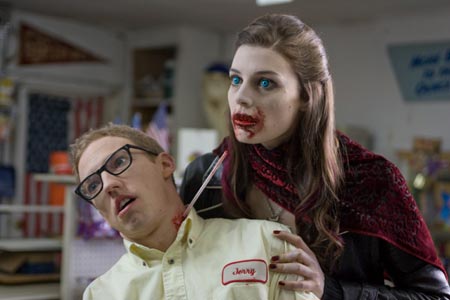
PLOT: A struggling Canadian rock band finds sudden success when their female

Still from Suck (2009)

bassist becomes a vampire.

WHY IT WON’T MAKE THE LIST: It’s a campy, tongue-in-cheek music movie with a horror/comedy flavor, but doesn’t do much we haven’t seen before.  It draws from other films and music videos to create a light parody of the music industry that’s enjoyable but ultimately forgettable.

COMMENTS:  The plot of Suck is oddly (and I assume unintentionally) reminiscent of Zombie Strippers: both feature a group of performers who willingly become a monstrous entity in order to boost their own popularity, and then climatically reap the consequences of their selfishness.  It gives a satirical bent to the overdone “fledgling musical group hits the big time but get more than they bargained for” premise, substituting blood addiction for drug addiction and topically tapping into society’s sudden Twilight-fueled obsession with vampires.  The concept of vampirism is handled in a very matter-of-fact way, resulting in a lot of unexpected jokes and straightforward humor.

Writer/director Rob Stefaniuk stars as Joey, the lead singer of “The Winners”, playing the straight man surrounded by ridiculous figures for most of the film.  Jessica Pare holds her own as the only female lead, funny and sexy as the hot bassist Jennifer, while Malcolm McDowell (always ready to bring the camp) is awesomely over-the-top as vampire hunter “Eddie” Van Helsing.  Appearances from an impressive bevy of old timer rock stars lend Suck an air of credibility as a rumination on modern-day rock and roll.  Iggy Pop is a wise rocker-turned-recording engineer, Alice Cooper is a creepy mind-reader who spouts unwanted advice, Henry Rollins is a goofy rock DJ, and Moby is a meat-loving frontman.  The highlight for any Kids in the Hall fan will of course be Dave Foley’s few scenes as the Winners’ incompetent manager, delivering the film’s best deadpan lines.

Suck incorporates a lot of different visual techniques that give it more variety than one might expect of a low-budget horror-comedy.  The use of stop-motion miniatures and blood-stained maps for transitions were a neat touch, and the frenetic cuts and dramatic lighting during many of the vampire-centric scenes cleverly reference contemporary music videos.  The music itself is catchy and fun, but doesn’t do much to set itself apart from any generic indie rock band’s output.  It’s not a true musical, saving most of its songs for stage performances except for one unexpected impromptu goth music video set at a vampire’s really pale party.

As a movie, this sits somewhere in the middle of funny and boring, smart and stupid, bold and underachieving, rocker and poser.  It’s got a good concept that blends several genres, but isn’t as effective as it could have been.  It needed to be funnier, scarier, more rockin’, or all three.  As it stands, it’s a cute film with some really enjoyable comedic bits and a few great performances, but not nearly humorous or weird enough to be memorably entertaining.

WHAT THE CRITICS SAY:

…Stefaniuk bites off more than he can chew in this star-studded rock ‘n’ roll fantasy vampire flick. Juggling conventions, skewering clichés and referencing genre cues, Stefaniuk packs the film with so many insider jokes that what could have been a wild ride simply isn’t.”–Barbara Goslawski, Box Office Magazine (festival screening)

LIST CANDIDATE: PEPPERMINTA [2009]

DIRECTED BY: Pipilotti Rist

FEATURING: Ewelina Guzik, Sven Pippig, Sabine Timoteo, Elisabeth Orth
Still from Pepperminta (2009)

PLOT: A whimsical young woman brimming with optimism moves breezily through her hometown in Switzerland, picking up new friends Werwen (Sven Pippig)—a sickly momma’s boy—and Edna (Sabine Timoteo)—a cross-dressing gardener—along the way.  The trio’s mission is to teach others to live without fear through experimental color hypnosis.

WHY IT MIGHT MAKE THE LIST: Pepperminta is a creative, experimental, singular film that defies standard classification.  It is at once funny, thought-provoking, insightful, fanciful, sexual, and wistful; it contains memorable visuals, bizarre characters, impromptu musical numbers, and flashes of complete fantasy.  It’s wonderfully weird, to be sure, but its sentimentality and naive perspective can be cloying and alienating for some audiences.

COMMENTS: Swiss video artist Pipilotti Rist is known for saturated colors and themes of harmony and sensuality in her short works.  Pepperminta marks her first foray into feature-length narrative film, allowing her to expand upon these concepts in a more accessible manner.  Inspired by Pippi Longstocking, the story is a fantastical urban adventure set in a magical realist universe that’s open to Utopian ideas, and the central character is unflappable in her quest to bring joy, beauty, and strength to everyone she meets.  Pepperminta transforms the souls of those she chooses to be a part of her mission, healing them with flowers, touch, music, and contagious confidence.  She believes that through certain combinations of color a person’s outlook can be altered, and demonstrates this in several wacky encounters.

Pepperminta is primarily driven by its mysterious but likable characters.  The title character is quick-to-smile, red-haired, freckled, and feels completely at ease in her own body.  She wins others over to her side with unshakable kindness, even if her weirdness confuses most people at first.  Werwen is shy,  middle-aged, and allergic to everything; he easily falls in love with Pepperminta, most likely because she’s the first girl with whom he’s interacted.  With her help he conquers his fear of the outside world bred by his overprotective mother.  Edna is taciturn and serious-minded, slowly released from her hard outer shell as she opens herself up to her new friends, even tapping into the magical aspects of Pepperminta’s personality. Continue reading LIST CANDIDATE: PEPPERMINTA [2009]

CAPSULE: MIRRORMASK (2005)

DIRECTED BY: Dave McKean

FEATURING: Stephanie Leonidas, Jason Barry, Gina McKee, Rob Brydon

PLOT: A bratty teenager who works as a juggler in her parents’ circus is transported to a devious world of her own imagination after her mother falls ill.  With the help of a cowardly juggler, she navigates a crumbling surrealistic city where everyone wears masks in search of a charm that will help bring her back to her own life.
Still from MirrorMask (2005)

WHY IT WON’T MAKE THE LIST: While Dave McKean’s impressively out-there creature and set design certainly gives MirrorMask some memorable visuals, the story and characters are lifted right out of typical fantasy stock, resulting in a beautiful but ultimately conventional movie.  366weirdmovies adds: I agree that MirrorMask shouldn’t go on the List; but, I will admit that when the androids popped out of their pods and gave the heroine a “bad girl” makeover while singing a weirdly harmonized version of the Carpenters’ “Close to You,” I was strongly tempted to nominate it as a Candidate.

COMMENTS: Popular fantasy author Neil Gaiman teamed up Dave McKean, the cover artist for his “Sandman” comics, delivering a script that revisits themes from his young adult book Coraline (which itself draws on archetypes found in The Wizard of Oz and “Alice in Wonderland“) for a movie that recalls the wild, inventive imagery of “Sandman” and his Neverwhere BBC miniseries.  MirrorMask is an allegorical adventure about a girl who grows up quickly, redeeming her past selfish actions through new-found respect for her parents and her own talents.  It’s a family film, and is at times bogged down by patronizing, simplistic dialogue and obvious symbolism, including a world literally divided by “Light” and “Shadow.”  There’s even a girl whose clear displays of “evilness” are fishnet stockings, cigarettes, and (gasp!) kissing a boy.

For all its narrative flaws, the film still charms with the help of a talented cast.  Stephanie Leonidas is excellent as Helena, effectively capturing the many moods of a teenage girl while still creating a sympathetic character.  Jason Barry works well with his chatty, comic-relief sidekick character, despite the inherent cliches in his personality.  But it’s Gina McKee in her triple role as Helena’s mother, the “Queen of Light”, and the “Queen of Darkness” who really Continue reading CAPSULE: MIRRORMASK (2005)