All posts by Gregory J. Smalley (366weirdmovies)

Gregory J. Smalley founded 366 Weird Movies in 2008 and has served as editor-in-chief since that time. He is a member of the Online Film Critics Society, and his film writing has appeared online in Pop Matters and The Spool.

APOCRYPHA CANDIDATE: EVERYTHING EVERYWHERE ALL AT ONCE (2022)

366 Weird Movies may earn commissions from purchases made through product links.

DIRECTED BY:  ( and )

FEATURING: Michelle Yeoh, Stephanie Hsu, Ke Huy Quan, Jamie Lee Curtis, James Hong

PLOT: Evelyn Wang is barely keeping it together, running a business and raising a family while the threat of an IRS audit hangs over her head; as if that wasn’t enough stress, just before a last-chance appointment with her stern auditor, a visitor from a parallel universe tells her the fate of the multiverse lies in her hands.

Still from Everything Everywhere all at Once (2022)

WHY IT MIGHT JOIN THE APOCRYPHA: Based on the trailer, I had originally assumed this was going to be Daniels’ mainstream popcorn movie: a sci-fi/action/comedy not likely to be significantly weirder than The Matrix or the latest Marvel Phase 4 offering. And while there were plenty of wisecracks, kung fu free -for-alls, sentimentality, and CGI frippery, the makers of Swiss Army Man  snuck enough genuine weirdness and unpredictability into the formula that, as the credits rolled, a young theater patron was moved to loudly announce “bizarre is the only word that describes that.”

COMMENTS: Evelyn is a hot mess: a hot mess in a quiet, middle-aged matron kind of way, but a hot mess nevertheless. Harried and constantly distracted, she vainly tries to balance running her laundry business with an overextended social life. She also has to deal with the family members constantly vying for her attention: neglected husband Waymond, lesbian daughter Joy and her new girlfriend, and disapproving, ailing father Gong Gong. It’s no wonder that Evelyn’s 1040 was selected for audit, and that she’s having enough trouble filling out the forms correctly and collecting the proper receipts and documentation that the business is in danger. And so it’s also little surprise that, when told by an interdimensional emissary that the fate of the entire multiverse depends on her, her response is an exasperated “Very busy today, no time to help you.”

But of course, help she reluctantly does. After the setup, the movie reveals its relatively complicated mechanics about infinite universes that branch off at individual’s decision points (i.e., marry Waymond or don’t marry Waymond creates a new universe, as does eating eggs for breakfast instead of noodles), all leading to a network of bubble universes that are visualized as nodes on a smartphone app. A helpful avatar of her husband from the “Alpha” universe explains the evil force threatening all existence (which involves a “bagel of everything”) and how Evelyn can access the skills and knowledge of versions of herself from parallel universes to counter it. So she does, with both badass successes and wacky failures along the way.

With its focus on branching realities, the Canonically Weird movie Everything Everywhere all at Once most resembles is Mr. Nobody (2009) rather than Swiss Army Man. In fact, it’s Nobody to the nth degree: where ‘s cult classic confined itself to three main alternate histories (with notable detours like the argyle universe), Everything attempts to live up to its title with dozens upon dozens of alternate realities, from simple ones where Evelyn is a martial arts expert or a movie star to bizarre worlds where she’s a piñata, a sentient rock, or (the audience’s favorite) a lesbian in a universe where everyone has hot dog fingers. Adding to the eccentricity, the Daniels posit that it’s necessary to seed a jump to a new universe by performing an unpredictable action like eating an entire tube of ChapStick or—in another audience favorite scene—finding an unconventional use for a suggestively shaped IRS auditor’s award.

The script requires almost every actor to play multiple roles, and the ensemble acting is about as good as it gets. Everyone shines, although naturally it’s Yeoh who holds it all together with a performance that recalls (and references) her Hong Kong roots in wuxia films, as well as her recent turn to comedy with Crazy Rich Asians. And a special kudos have to be given to 93-year-old James Hong, for whom this would be an excellent cherry on the top of an incredible 450-role career (except that he still has more films coming out, and may be trying to hit 500 credits before he passes the century mark).

Ultimately, all the apocalyptic furor relates to events in Evelyn’s real universe—uh, the universe we started in, that is. My only slight reservation is with the ending, which gets a bit sappy in delivering its honorably intended “love yourself, faults and all” message. On the other hand, not everyone is a black-hearted cynic like me, and most audience members seemed as moved by the film’s pathos as they were invigorated by its action and amused by its comedy. In the end, this impressive feature comes pretty close to delivering Everything, with bizarre and imaginative conceits delivered at a hyper pace that does make it sometimes seem like they’re happening All at Once. Everything Everywhere all at Once is recommended for everyone everywhere as soon as you can.

WHAT THE CRITICS SAY:

“…an explosion of creative weirdness that is equal parts exhilarating and overwhelming…  It’s ground-breaking because it allows a new perspective, but it’s also just blatantly weird. It’s not glossy or careful; the film is an onslaught of visual and thematic ideas… In an era of sequels and remakes, something this outside the box is a welcome alternate reality.”–Emily Zemler, Observer (contemporaneous)


CAPSULE: DELTA SPACE MISSION (1984)

366 Weird Movies may earn commissions from purchases made through product links.

DIRECTED BY: , Mircea Toia, Victor Antonescu

FEATURING: Voices of Mirela Gorea, Marcel Iures

PLOT: A super-powerful A.I. computer falls in love with a beautiful alien journalist and chases her across the universe.

Still from Delta Space Mission (1984)
COMMENTS: Though made in Romania in the dying days of the Cold War, Delta Space Mission proves that some concepts have universal appeal: Mankind’s drive to explore the fascinating universe in which it finds itself. Faith that our essential goodness will one day abolish prejudices, so that people of different genders, races and species can work together for the common good and against common enemies. The stalkerish love of an Epcot Center-shaped supercomputer for a shapely green alien.

If Delta Space Mission‘s plot seems episodic—and a bit choppy—when you watch it, that’s because it was originally twelve short films made together as proofs of concept, then assembled into a feature film. Had the pilot film been a big success, Delta Space Mission would have become a franchise—possibly even an international export. In the opening, Starfleet Federation-type characters are introduced, but hardly fleshed out; presumably, had the series continued, they would have become more meaningful players. But this arc belongs to lime-skinned journalist Alma (who’s also a pretty good shot with a raygun) and her metal-eating alien space dog, Tin.

When Alma is so enchanted by the jewel-like beauty of the giant spherical  supercomputer that she imagines herself dancing with it in a cosmic ballet, watching it grow multicolored rings along which she gracefully sails before the whole scene dissolves into a a splatter of colors, you’ll see the potential appeal of the series to the psychedelic crowd. Other episodes range from the computer animating giant stone robots, ocean waves, and a radio tower in a vain attempt to capture Alma, to the pivotal confrontation on a swamp planet full of strange aliens that wouldn’t look too out of place on Fantastic Planet (including some friendly green blobs with Kermit the Frog heads who treat Tin as their personal beach ball). The pastiche of classic sci-fi influences and references are entertaining to pick out: the space station looks like the Death Star, a spaceship chase though some rock formations that recalls The Empire Strikes Back‘s asteroid field escape, and so on.

The similarity to American Saturday morning cartoons of the period, or to the animated segments of 1970s-era “Sesame Street,” comes from the budgetary constraints. The movie has a lot of action—in fact, it’s near constant shootouts and chases—but it’s animated at a low frame rate, and not particularly fluid. There are lots of static scenes, and the designs for characters and other moving elements are simple, with detail reserved for the bright, dramatic backgrounds. The action is accompanied by an abstract, vintage space-synth soundtrack that sounds like a cross between Tangerine Dream and a malfunctioning Atari 2600. But Delta Space Mission works within its limitations, never letting them confine an imagination that soars towards the cosmic. If the idea of a kitschy Saturday morning sci-fi adventure with an offbeat, mildly psychedelic Eastern European spin to it sounds appealing to you, you won’t be disappointed with Delta Space Mission.

Delta Space Mission is released by Dead Crocodile on Blu-ray or VOD.

You can also watch our interview with director Calin Cazan, where he provides some more background information on the project.

WHAT THE CRITICS SAY:

“…yes, “Delta Space Mission” is supremely weird… a head-trip viewing experience that does well with colors and sound, connecting to younger viewers and those in an altered state of mind. “Delta Space Mission” doesn’t offer cohesive storytelling (a few characters introduced early in the picture have nothing to do with the plot), but it’s an engrossing sit, with strong artistic achievements and a few weirdo touches to keep it all wonderfully amusing.”–Brian Orndorf, Blu-ray.com (Blu-ray)

(This movie was nominated for review by Will, who called it “such an amazing animated feature and would work perfect among some of the other movies already featured on this site.” Suggest a weird movie of your own here.)

MISSION INTO THE PAST: CALIN CAZAN ON “DELTA SPACE MISSION”

We sat down with Delta Space Mission‘s  to reminisce about the making of the 1984 Romanian space epic and get a recommendation for where to eat in Bucharest.

Mr. Cazan provided some additional notes and links post-interview:

“Romanian cinema had several studios: for live-action films there were several studios in Buftea (near Bucharest); for documentaries, there was a studio, Sahia, with two offices in the capital; for animation, there was Animafilm, with two offices.

About 300 people worked at Animafilm. The animation was best for the budget, because it made series for children (6 to 12 years old) that sold well, for television, bundled in Europe, Asia, and Africa.

I studied architecture at the Ion Mincu Institute of Architecture—after my internship, I went to Animafilm. After graduating from a course taught by Victor Antonescu, I joined as an animator. Because my architecture studies were not recognized, I also attended courses at the Institute of Fine Arts.

Victor Antonescu initiated a sci-fi series, based on which the General Manager launched a kind of promotional contest for a new series. Together with Mircea Toia, we assembled a team to work on the first episode, which was a success. The management asked us to continue the series.

Delta Space Mission was intended for ages 12-20 years, and over. The destination was also international, targeting the countries with which Animafilm already had commercial relations.

Of course, we were influenced by the sci-fi movies that were on the market at the time. But also the books and publications. George Anania, who was the director of Animafilm, was also a writer of sci-fi novels.

For a meal in Bucharest, I recommend, for young people, ”Curtea Veche,” and for those close to my age, any restaurant in Charles de Gaulle Square or Herăstrău Park.”

Literary influences on Delta Space Mission:

  • Jules Verne – “Twenty Thousand Leagues Under the Sea”, “Around the World in Eighty Days”, “A Journey to the Center of the Earth”, “From the Earth to the Moon”
  • Isaac Asimov – Foundation (1951), Foundation and Empire (1952), Second Foundation (1953), I Robot (1951)
  • Arthur C. Clarke – 2001 – A Space Odyssey (1968), “2010 – Odyssey Two” (1982), “Rendezvous with Rama” (1973)

Movies cited as influences on Delta Space Mission: 2001: A Space Odyssey (1968); Meteor (1979); War of the Worlds (1953); Solaris [Solyaris] (1972); Stalker (1979)

Other movies discussed/subsequent favorites: Spaceballs (1987); Up (2009); Inside Out (2015); Zootopia [AKA Zootropolis] (2016); WALL-E (2008)

Calin Cazin’s personal homepage

Victor Wegemann’s paperback science fiction covers that helped inspire the look of the film

CAPSULE: THE SCARY OF SIXTY-FIRST (2021)

366 Weird Movies may earn commissions from purchases made through product links.

DIRECTED BY: Dasha Nekrasova

FEATURING: Betsey Brown, Madeline Quinn, Dasha Nekrasova, 

PLOT: Two roommates rent a bargain flat on Manhattan’s Upper East Side that was previously owned by Jeffrey Epstein.

Still form The Scary of Sixty-First (2021)

COMMENTS: The awkwardly-titled The Scary of Sixty-First is equally awkwardly made. It feels like an adaptation of a Jeffrey Epstein conspiracy podcast that realized it didn’t have enough crazy ideas to spin into a feature film, so a horror movie subplot was added. At least half the film is spent rehashing the Epstein case without developing any deranged (or even interesting) new theories: there’s the discovery of some arguably pedophilic tarot cards, some real estate research to see if Epstein’s properties form a pentagram, and a doppelganger of Ghislaine Maxwell (who looks almost nothing like the now-convicted socialite—intentionally?) walking around Manhattan, but the hints of occultism never really take root. A lot of potential craziness goes uncrazed: if they could have Q-Anoned the Epstein case into some kind of pareidoliac parody involving the ghost of RFK running a secret cabal out of a fleet of taco trucks or something, they might have had a movie.

While Scary does nothing wrong, cinematically, there is a strong “first film” sensibility at work here. As bold as the choice to center the movie around a contemporary atrocity might be, the rest of the stylistic choices tend to the conventional. The acting isn’t up to snuff: co-writer/director Dasha Nekrasova is fine, but co-writer Madeline Quinn (as roommate Noelle) gives some distractingly flat line readings, and minor characters (a crystal shop owner) go too far into caricature. Fortunately, Betsey Brown’s Addie saves the day—after she gets possessed—with sexual hysterics that include what surely will be the most bizarre Prince Andrew-themed masturbation sequence of the year.

Noelle, and Dasha Nekrasova’s nameless conspiracist, are humorless (although sometimes funny—“Have you heard of Pizzagate?”), and their investigation goes nowhere. Nor do their characters provide psychological insights into their obsession—as far as we can tell, it’s simply a product of boredom, and maybe too much White Claw and Vyvanse. Addie, on the other hand, is neurotic and (it’s hinted) kinky even before being possessed by the spirits haunting this orgy flophouse of the damned. Her erotic antics provide the freakiest moments: besides her multiple self-pleasure scenes, including one that’s intercut with an asphyxiation, there’s some really out-of-bounds roleplay during intercourse with her douchey boyfriend that ends with a nod to The Exoricst. Rent it for the promised rabbit hole horror; but if you chose to stay, stay for the sex in this surprisingly horny female-driven horror.

WHAT THE CRITICS SAY:

“One oddity worth a look for the adventurous is Dasha Nekrasova’s The Scary of Sixty-First, which is exactly as peculiar and WTF as that not-quite-grammatical title… too eccentric for any easy classification.”–Dennis Harvey, 48 Hills (contemporaneous)

CAPSULE: ULTRASOUND (2021)

366 Weird Movies may earn commissions from purchases made through product links.

Utrasound is currently available for VOD rental.

Recommended

DIRECTED BY: Rob Schroeder

FEATURING: Vincent Kartheiser, Chelsea Lopez, Bob Stephenson, , Tunde Adebimpe

PLOT: After a car accident, a man spends a night at a couple’s remote house and—at the husband’s insistence—sleeps with his much younger wife, which leads to an increasingly strange series of events.

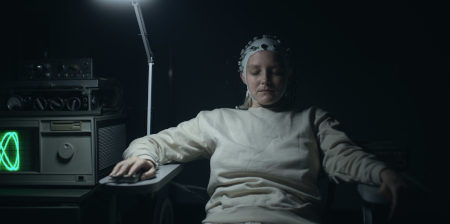
Still from Ultrasound (2021)

COMMENTS: Glenn blows out a tire in the rain returning from a remote wedding and takes shelter at the home of a strange couple. After an awkward evening between Glenn, heavyset “depressive” host Art, and his young wife, Cyndi, the scene suddenly switches to a new character, a woman swimming laps in a pool. She sometimes appears pregnant, and sometimes not.

“I don’t see the link between the two things,” says Glenn, much later, from a wheelchair. “It will all make sense as we go along, I promise” assures the therapist who’s guiding him through a roleplay exercise as a form of physical therapy.

Juggling multiple plots and subplots, the script basically keeps the promise suggested by the above line of dialogue. Characters will sometimes appear to change into other characters or locations into other locations, and their lives will take major turns without explicit explanations. Two pregnancies, which may or may not be pregnancies, supply part of the impetus for the title Ultrasound. Besides Art, Glenn, Cyndi, and the mysterious swimming woman, there’s a major conspiracy afoot, and a couple of other subplots running around, making for a movie that demands close attention if you want to figure it all out (a careful second viewing will, of course, make the timelines clearer, and allow you to catch otherwise obscure clues).

The acting is good, with veteran character actor Bob Stephenson a standout as the unassuming but subtly persuasive Art. (“Art has gotten so weird lately,” says one character, and another corrects her: “more emphasis on so weird.”) The score and sound design effectively increase the tension in moments when things seem “off” even though there is not much action onscreen. Although the sets and visuals aren’t lavish, first-time director Schroeder frames some clever compositions: in one shot, a countertop lines up with a refrigerator and a cabinet to create an imaginary line down the middle of the frame—a sort of in-camera split screen effect implying a world divided into different realities.

Still, it’s the script that’s the standout here. Ultrasound‘s profound paranoia resonates in our gaslit world of deepfakes, fake news, and fake claims of fake news. But it’s possible to puzzle our way through the illusions: the screenplay answers nearly all our questions, and what it leaves ambiguous is easily filled in by the savvy viewer. A satisfying outing for fans of reality-bending films who demand answers to the mysteries and aren’t afraid to do a little mental lifting to get them.

WHAT THE CRITICS SAY:

“Weird, disorientating, and complex, Ultrasound compels the viewer into a fugue state into which this darkly dangerous science-fiction can unfold and wrap around then. Some truly uncomfortable ideas around the ability to control others are told through an overtly science-fiction lens, but the potential truth within the film is what makes it a harrowing watch.”–Kat Hughes, The Hollywood News (festival screening)