16. CARNIVAL OF SOULS (1962)

“We hoped for the look of a Bergman film and the feel of Cocteau.”–variously attributed to screenwriter John Clifford or director Herk Harvey

Must See

DIRECTED BY: Herk Harvey

FEATURING: Candace Hilligoss, Sidney Berger

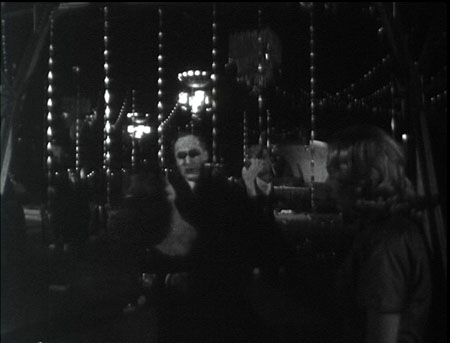
PLOT:  Mary Henry, a church organist, is the lone survivor of an accident when the car she’s riding in plunges over the side of an old wooden bridge.  Looking to start over, she takes a job as an organist at a new church in a town where she knows no one.  She finds herself haunted by the sight of a pale grinning man who appears to her when she is alone, and fascinated by an old abandoned carnival pavilion visible from the window of her boarding house that she senses hold a mysterious significance.
carnival_of_souls
BACKGROUND:

  • Carnival of Souls was made in three weeks for less than $100,000 (figures on the budget vary, but some place it as low as $33,000).  The film was a flop on its initial release, but gained a cult following through late night television showings.  The film was restored and re-released in 1989 to overwhelmingly positive reviews.
  • Director Herk Harvey, screenwriter John Clifford and composer Gene Moore worked together at Centron Corporation, an industrial film company, creating short safety documentaries such as Shake Hands with Danger and high-school propaganda/hygiene films such as What About Juvenile Delinquency? None were ever involved with a feature film again.
  • Mesmerizing star Candace Hilligoss acted in only one other feature film, 1964’s The Curse of the Living Corpse, before retiring to raise a family.
  • The movie has been very influential on other films, particularly low-budget horror films.  Director George Romero has said that the ghostly figures in Carnival of Souls inspired the look and feel of the zombies in The Night of the Living Dead (1968).  Other writers see a Carnival of Souls influence on films such as Eraserhead (in regards to its ability to evoke the nightmarish quality of everyday objects), Repulsion (disintegration of the mind of a sexually repressed woman), and even Apocalypse Now (the shot of Martin Sheen rising from the water mimics a similar scene involving The Man–thanks to Matthew Dessem of “The Criterion Collection” for the catch).
  • Carnival of Souls was “remade” in 1998, although the plot (about a clown killer and rapist) shared nothing with the original except the name and the final twist.  Wes Craven produced.  The remake went direct to DVD and was savaged by critics and audiences alike.

INDELIBLE IMAGE: What else, but the titular carnival? Ghostly figures waltz to an eerie, deranged organ score on what appears to be an old merry-go-round at the abandoned amusement park. The tableau recurs twice in the film: once clearly in a dream, and once near the end as a scene that may also be a dream, but may be another state of being entirely.

WHAT MAKES IT WEIRDCarnival of Souls is set in the ordinary, everyday world, but as seen through the eyes of an alienated, frightened woman. The world the film depicts is familiar, but made maddeningly strange, and its the subtle, grubby touches rather than ghostly apparitions that allow this creepy low-budget wonder to seep deep under your skin.


Trailer for Carnival of Souls

COMMENTS: Carnival of Souls is a minor film miracle. There was little reason to suspect Continue reading 16. CARNIVAL OF SOULS (1962)

WHAT’S IN THE PIPELINE

A full review of the classic 1962 microbudget horror, Carnival of Souls, should post tomorrow.

Next in the review queue is Terry Gilliam’s 2005 offering, Tideland.

Alfred Eaker has agreed to provide writing for the site on a weekly basis.  We’re looking forward to his critical re-evaluation of Tod Browning’s Dracula on Thursday.

In addition, we are working on moving the entire site to new hosting as soon as possible.  WordPress free hosting has been truly wonderful and we recommend it wholeheartedly to anyone looking to start a free blog.  We can offer more content and hopefully deliver some improvements to the site by moving it to our own domain, however.  This website will remain here indefinitely, but new content will be posted at the new domain once it’s up and running.

WEIRD HORIZON FOR THE WEEK OF 3/27/09

A look at what’s weird in theaters, on hot-off-the-presses DVDs, and on more distant horizons…

Trailers of new release movies are generally available on the official site links.

IN THEATERS (WIDE RELEASE):

Monsters vs. Aliens (2009):  A DreamWorks 3-D adventure for children about a group of mutated monsters fighting an alien invasion.  The trailer begin with the phrase “The weird will save the world.”  Moderately interesting possibility to introduce kids to old b-movie tropes. Also screening in IMAX.  Featuring the voice of Reese Witherspoon.    Monsters vs. Aliens Official Site

That’s it this week!  Remarkably slim pickings for fans of the offbeat…

What are you looking forward to? If you have any weird movie leads that I have overlooked, feel free to leave them in the COMMENTS section.

STANLEY KUBRICK, CULTURAL OMNIVORE

This guest essay is by Alfred Eaker, director of Jesus and Her Gospel of Yes!, which was voted Best Experimental Film in the 2004 New York International Film and Video Festival, and the feature W the Movie.

“We must be cultural omnivores and raid all the art forms to enhance our own art”– Pierre Boulez; Modernist French composer.

Although, the meaning of postmodernism is replete with vagaries, one prominent characteristic of the so-called movement is that it abounds in eclecticism.  Pierre Boulez’s advice for artists to mantle a mental state of being cultural omnivores seems tailor made for much that is pronounced in postmodernism.  In that light, the movement had one of it’s most well-known, brilliantly driven, unofficial spokespersons in the late Stanley Kubrick.kubrick1

Kubrick, of course, patterned his body of film work after a Beethoven aesthetic.  Each of Beethoven’s nine symphonies had an individual theme.  The Eroica was Beethoven’s initial support, later renounced, bio-portrait of Napoleon.  The 4th, according to Robert Schumann, was a Greek maiden between two Norse gods.  The immortal fifth was THE anti-war statement.  The 6th , a pastorale; the 7th, a series of  rhythmic movements; the 8th, more abstract, is a favorite among modernist conductors; and, of course, the mighty Ode to Joy.

Kubrick wanted to create a work in each of the genres and it’s unfortunate he never got to make his western (Marlon Brando foolishly took over directing One Eyed Jacks, after having Kubrick sacked).  Regardless of genre, each Kubrick film is filtered through his own unique sensibilities (i.e., the dehumanization of man), thus rendering the idea of applying something as superfluous as a genre akin to hopelessly trivial labeling.  When it comes to Kubrick, the genre/subject is almost incidental.  Kubrick defiantly stamped his personal vision onto everything he approached (as author Stephen King would discover, to his complete dismay, when Kubrick took on The Shining.  Kubrick was no assignment director).

Volumes have been written about Kubrick’s body of work with wildly varying and opposing opinions, but the almost unanimous conclusion that can be drawn is that Kubrick’s films are not designed for casual viewing.

Indeed, upon repeated absorption, Kubrick’s films reveal the degree to which Kubrick was a cultural omnivore.

Kubrick’s rep as being a “supremely controlled” artist is a misnomer.  He was just as apt for experimentation, improvisation, and utilizing ideas from actors, etc.  Hence, Kubrick’s reason for disallowing the publishing of his scripts (which he often deviated from) and ordering the destruction of all unused footage.  In it’s rough cut, Clockwork Orange was originally a four hour film.

One of Kubrick’s most compelling scenes in Clockwork Orange was, by turns, supremely controlled and experimental, yet gives compelling insight into Kubrick’s multi-hued layering and eclectic aesthetics.

Alex and the droogs appear at an ultra modernist home, which welcomes visitors with a lit sign, marked simply “Home.” Kubrick’s customary symbolic red and white design work is as heavy laden here as it is throughout the rest of the film.

Husband Patrick Magee types away at his typewrite when the doorbell rings.  The doorbell sounds of the overly familiar first four notes of Beethoven’s Fifth: Fate knocking at the door.  However, those four notes sound deceptively innocuous here, almost tinkling.

The camera pans across the room revealing Magee’s redhead wife, Adrienne Corri, dressed in red pajamas, sitting comfortably in a white, plastic chair in the next room.  Husband and wife are detached from one another, echoing the barrenness of the house.  Corri answers the door to hear Alex proclaim “there has been an accident outside” and his request to use the telephone.  Corri is reluctant, but Magee instructs her to let the visitors in.  With the unlocking of door, Fate enters in like a Beethovenian storm.

The “Singing in the Rain” beating/dance was not scripted and was improvised, worked, and re-worked until Kubrick was satisfied with the flowing tone.  Adding this element was a brilliant instinct on Kubrick’s part.  Without it, the breaking-in would have felt more like a tempest than a storm.

After Magee is tied up and beaten, Alex and the droogs turn to Corri.  They take her in front of painting on the wall and begin to rape her.  The visuals in this vignette reveal a homage narrative, akin to developing patterns in an unfolding puzzle.  The design of the painting on the wall has a pronounced familiarity.  In it’s colors and forms, it is a homage to Gustav Klimt and bears striking resemblance to Klimt works like “Farmhouse with Birch Trees”.  Corri appears as a Klimt model personified.  She is Klimt’s mysterious red head, pale and thin (i.e., “Hope 1”).  She and the scene call to mind imagery from Klimt’s “The Beethoven Frieze” (especially in the sections, “The Longing for Happiness Finds Repose in Poetryand “Hostile Powers”).  In essence, Kubrick is paying homage to Klimt paying homage to Beethoven.

Continue reading STANLEY KUBRICK, CULTURAL OMNIVORE

CAPSULE: THE MOTHMAN PROPHECIES (2002)

DIRECTED BY: Mark Pellington

FEATURING: Richard Gere

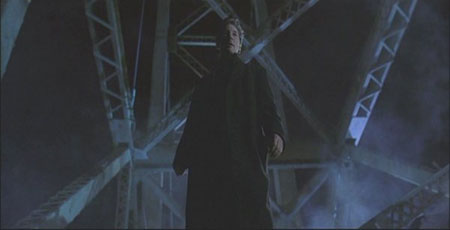
PLOT:  A Washington Post reporter loses his wife in an automobile accident,

mothman_prophecies

then finds himself spirited away to a West Virgina town where the residents are spotting monsters and undergoing horrifying precognitive hallucinations.

WHY IT WON’T MAKE THE LIST:  Not weird enough.  Taking its cues from parapsychology and cryptozoology, and positioning itself as a “true story,” The Mothman Prophecies paranoidly posits a world where omniscient Mothmen are simply a part of the natural order.  I wouldn’t want to dishonor the producer’s sincere “the truth is out there” vision by suggesting there’s something a little weird about it.  On a more serious note, The Mothman Prophecies is an effective chiller with a mildly unique spin on a conventional horror yarn that generates enough unease to make it worth checking out for fans of the eerie side of the weird, but it’s ultimately too lightweight and conventional to be more than a passing diversion.

COMMENTS: Director Mark Pellington, who previously explored themes of conspiracy and paranoia in the thriller Arlington Road, translates his talents to horror well and does a very fine job of pleasantly chilling the viewer’s blood through the early segments of the Mothman Prophecies.  Unexplained occurrences, from an impossible car detour that lands our protagonist on the Ohio border with West Virginia to a yokel who swears he’s been visited by Richard Gere before, pile on top of each other until the viewer is pleasantly on edge and disoriented.  When the antagonist is eventually revealed, his powers verge on the omnipotent and his motives lie firmly in the realm of the inscrutable.  The conclusion ties things up in a nice little bow–sort of, because all the pieces resolved belong to subplots.  The central mystery of  the Mothman is never even touched, which frustrated viewers who crave nothing more than narrative cohesion but shouldn’t bother weirdophiles a bit.  Despite its silly premise, Mothman is a highly effective unease-generating machine, which is (or at least, should have been) its only aspiration. 

The “based on a true story” angle is patently a scam.  Although it’s true that there were “Mothman” sightings in West Virginia in the 1960s and a bridge collapsed soon thereafter, anyone who doesn’t recognize the convenient presence of an attractive romantic foil for Richard Gere and the archetypal visit to the reclusive old wizard for a bit of exposition and dire warnings as the work of a screenwriter rather than a documentarian probably should be permanently ineligible for jury duty.

WHAT THE CRITICS SAY:

“…thriller that purports to be based on true events but operates in that bombastic plane of reality reserved for the apocalyptic horror movie.”–Jan Stuart, Los Angeles Times (contemporaneous)