Tag Archives: Western

FLAMING STAR (1960)

Hollywood’s model of taking pop music phenomenons and placing them in film productions began with Bing Crosby and accelerated with Frank Sinatra. Unfortunately, producers were usually clueless as to how to tap the stars’ prodigious talents. The model petered out in Madonna’s whisper of a film career. In between Madonna and Bing came the biggest and perhaps most disappointing of them all: . Tinseltown did attempt to tailor its vehicles to Presley, which may have been one of its big missteps. Most critics and audiences concede that Presley’s early films were the best, though many might argue that is not saying much. Presley debuted in the Civil War era Western Love Me Tender (1956) with a supporting role, while Loving You (1957), Jailhouse Rock (1957) and King Creole (1958) all had thinly disguised biographical elements. Yet, none of these films fully captured the unbridled energy and vitality seen in just a few moments of Presley’s documentary footage of the period. G.I. Blues (1960) began a deadly slide, placing the star in dumbed-down, misogynistic family fare. Blues reached its nadir with the king of rock and roll singing to a puppet.

Presley followed G.I. Blues with Flaming Star (1960), a progressive western, directed by that taut craftsman, . Presley desperately wanted a film career and envisioned one modeled after his film idol, Marlon Brando. Ironically, Siegel and the producers originally wanted Brando for Presley’s role of Pacer Burton. With Presley finally getting his chance at a Brandoesque role, he comes closest to the celluloid Elvis that he himself envisioned. Unfortunately, it was not what the American public wanted, and the result was a box office bomb, despite good critical reception. The public wanted Presley singing, not acting, and he only gets one song here (along with the title track). Despite the public indifference, Presley made another stab at dramatic acting in the Clifford Odets-penned Wild In The Country (1961). Miscasting aside, Presley, who was too seasoned to play a juvenile delinquent, gave a relatively good performance in a mediocre soaper. Again, the public did not respond, which signaled the star’s management team to take the reigns with Blue Hawaii (1961). This was Hollywood’s saccharine death kiss. A best-forgotten string of execrable movies followed, and it wasn’t until Presley left Hollywood that he became (briefly) vital again. With the “’68 Comeback Special” and several documentaries, Presley finally became an imposing film presence, simply by being the leading man in his own unique life. Of course, Vegas seduced the King, just as Hollywood did, but his second fall from grace was at least a more original and fascinating American parody.

Although Flaming Star is imperfect, it gets one aesthetic component of the Presley paradox: Siegel shrewdly pinpoints the desperation and conflict inherent within an ambitious artist seeking to overcome his white trash origins. Here, he transplants them to Elvis as a half-breed. There has long been an identification amongst some whites with the archaic image of Native American as savage. Rather than tailoring a vehicle to Presley’s public persona, Siegel gives the actor an identification point within an already framed narrative. Stepping into Brando territory, Presley gives a thoroughly convincing and enthusiastic performance, possibly his only one as a professional actor.

Presley and Siegel smartly and predominantly ignored the pop star’s fan base by tapping the star’s edginess and making him actually play a character in an ensemble. In the promo trailers, studio execs interpreted that “edge” as a shirtless Presley fighting a savage. The scene it’s culled from is actually brief, and renders the trailer grossly misleading. Rather, the real “edge” is Pacer nervously conversing through a door slat with unwelcome visitors, followed by his beating the hell out of two racists when they insult his mother Neddy (Delores del Rio). Siegel draws on Presley’s latent maternal fixation for the scene. (Interestingly, one of Presley’s most effective songs, amidst one too many Neil Diamond covers during his final John-Wayne-in-a-Shazam-cape phase was an intimate, maternal version of the rosary. Catering to the imagined mindset of the King’s alleged WASP fan base, Presley’s distributors usually omit it from the plethora of posthumously-released gospel compilations).

Still from Flaming Star (1960)Presley’s acting in Flaming Star is simple and not bogged down with the type of dialogue he would have been ill-suited for. While Brando would have given an excellent performance, Presley delivers a commendably natural one. As a half breed, he has divided loyalties in this tale about racism. Thankfully, Siegel and scriptwriter Nunnally Johnson do not lose focus. For the first and only time, Presley has no love interest. Here the trailers, again, were misleading, making it look as if a King was romantically entangled with a genie. Actually, Roslyn (Barbara Eden) is the “britches wearin'” girlfriend of brother Clint (Steve Forrest).

The entire Burton family is caught up in divided loyalties, and racism is seen from all sides. Neddy is shunned by her Kiowa tribe for having married the white man, Sam (John McIntire). Smartly, the film opens, like John Ford’s The Searchers (1956), with an intimate look at the family, but it’s also a reason to show off Elvis singing. This is almost essential before the bleakness sets in.

An Indian massacre follows, which will eventually take victims beyond that single incident. Although the Burtons do not excuse the brutality of the Kiowas, they also refuse to be willing victims of community resentment and demonization. Hostilities quickly make their way to Neddy, even from friends and extended family, such as Roslyn. When the town doctor refers to an injured Neddy as “that woman” Presley responds: “That woman? Don’t she got a name, like white people?” Poignantly delivered, it’s one of his best acting moments, .

Flaming Star was shot on a modest budget, which is occasionally obvious (as in the day for night scenes). Siegel, as usual, is in his element with outdoor settings, regardless of funding constraints. Comparisons to The Searchers are inevitable, but while that film was grandiose (perhaps too much so), Flaming Star tells its smartly paced story in a far briefer running time, leaving no room for unnecessary distractions.

HIGH NOON (1952)

366 Weird Movies may earn commissions from purchases made through product links.

Olive Film’s 60th anniversary Blu-ray edition of High Noon (1952) presents this critically lauded, still controversial western masterpiece in a Hi-Def transfer that renders all other home video versions obsolete.

The Stanley Kramer production, tightly directed by Fred Zinnemann and written by the blacklisted Carl Foreman, earned the hatred of 1950s McCarthyists, including  and Howard Hawks, who were so outraged they made Rio Bravo (1959) as a right-wing response. Wayne went further than that, teaming up with Hollywood Gossip mogul Hedda Hopper and the House Un-American Activities Committee to run Foreman out of the country. Foreman moved to England and never returned. Wayne forever boasted of forcing the writer into exile. Kramer, responding to accusations that High Noon was anti-American, tried to get Foreman’s name taken off the credits. Gary Cooper intervened on Foreman’s behalf, making Kramer’s effort unsuccessful, but Kramer had better luck forcing Foreman to sell his part of their company. So much for loyalty under pressure: ironic, given the film’s theme of civic morality.

The biggest offense of the film, for Wayne and his fellow extremist kooks, was the final shot of Will Kane supposedly dropping his marshal’s badge in the dust and stomping on it. Wayne saw symbolism aplenty, but his faulty vision was filtered through a lens of Cold War paranoia and exaggeration. ((Due to John Wayne’s interpretation of this scene, he and fellow right wing extremist Ward Bond bullied Gary Cooper into backing out of a planned independent production company with Forman and producer Robert Lippert.)) Will Kane merely dropped the badge. He never stepped on it. The other offense was the portrayal of the townspeople as a greedy, self-cannibalizing lot, a hypocritical church community who argue their way out of communal (and personal) loyalty. Wayne and Hawks’ Rio Bravo depicted, in sharp contrast, a town full of old-fashioned buddy-buddy camaraderie. If Wayne and Hawks were alive today they might have rethought their depiction, because High Noon could served as an apt snapshot of contemporary division. It’s a good thing that actor/director team didn’t live to see the 21st century, though, because despite the intent behind Rio Bravo, and despite its occasional tendency towards sentimental phoniness, it remains, along with High Noon, one of the standout westerns in the genre’s greatest decade. ((The American Film Institute lists High Noon second in its list of top ten westerns. First is John Ford’s The Searchers (1956) with Wayne. Two other films starring Wayne made the list: Red River at number five and Ford’s Stagecoach (1939) at number nine.))

Still from High Noon (1952)One cannot approach High Noon without addressing its political themes, both within the film’s text and those raised in its aftermath. Along with writer Formean, co-star Lloyd Bridges and cinematographer Floyd Crosby were also awarded with temporary blacklists until the FBI cleared them of Communist affiliations. The fifty-one year old Gary Cooper was engaged in an affair with his twenty-three year old co-star Grace Kelly (putting an end to Coop’s affair with Patricia Neal.) Kelly’s fling with the long established Republican protected her from McCarthyism’s scrutiny. Cooper was friendly with the HUAC, and testified before them (without ever naming names), but he only did what was expected of him, then returned to his top priority of resuming his romance with a future princess.
Cooper was in Europe by the time the Academy Awards Ceremony rolled around and asked Wayne to accept the award of Best Actor on his behalf, should he happen to win. Of course, he did, and the Duke did a prompt, public about-face in his acceptance speech: “Ladies and gentlemen, I’m glad to see they’re giving this to a man who is not only most deserving, but has conducted himself throughout the years in our business in a manner that we can all be proud of. Coop and I have been friends hunting and fishing for more years than I like to remember. He’s one of the nicest fellows I know. And our kinship goes further than that friendship because we both fell off horses in pictures together. Now that I’m through being such a good sport about all this sportsmanship, I’m going back and find my business manager, agent, producer, and three-name writers and find out Continue reading HIGH NOON (1952)

ANTHONY MANN’S MAN OF THE WEST (1958)

When the subject of Anthony Mann’s contribution to the western genre is explored, it is his cycle with James Stewart that is inevitably brought up. Indeed, the Stewart collaboration Naked Spur (1953) remains Mann’s highest praised achievement in the great American genre. However, it is his nearly forgotten, last true western, Man of the West (1958), starring , that is his most strikingly modern achievement. A telling sign of this film’s greatness lies in the fact that its status is still debated decades later.

Mann’s casting of Cooper is nothing less than inspired, although it probably cost the film box office revenue. Mann and Stewart had fallen out during the making of the previous year’s Night Passage, but by then audiences had come to accept Mann’s reinvention of Stewart’s on-screen persona. Starting in 1950, under Mann’s direction, Stewart had been portrayed as violent, selfish, cynical and remarkably complex.

In 1958, Gary Cooper was nearing the end of his career, and no director had manipulated Cooper’s screen personality in the way Mann had done with Stewart. , a competent journeyman director who, nevertheless, lacked a real consistent vision, had come closest in Springfield Rifle (1952), where he portrayed Cooper’s character as an accused coward in the first half of the film. That turned out to be an undercover ploy to smoke out the real traitors, however, so Cooper retained his pure-as-the-driven-snow nobility after all. Still, even then, neither audiences nor critics bought it. Laconic simplicity and nobility were Cooper’s well-established trademarks. Mann took advantage of what was already established, and manipulated it with a darkly hued underbelly. Under Mann’s direction, the “yup” mannerisms of Cooper’s Link Jones convey evasiveness in an attempt to hide a less than noble past.

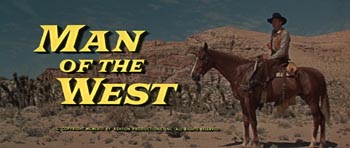
Title from Man of the West (1955)Link Jones is about to catch a train headed for Texas. He is on a mission to find a school teacher for his small town’s new school, and is carrying the funds to pay for her. A Marshall at the local train station thinks he recognizes Link, asks Link his name, inquires into Link’s past, and asks him if he knows the fugitive Doc Tobin (Lee J. Cobb). Link cautiously shakes his head, lies, squints, and evades the Marshall’s penetrating looks. Mann’s expert manipulation of Cooper’s personality traits is so subtle as to be believable and, thus, unnerving. It was unsettling enough for 1958 audiences to reject it, and even contemporary critics have often lamented the casting of Cooper, as opposed to Stewart, in this film. Stewart would not have worked nearly as well, simply because his casting would have been acceptable, even expected.

Cooper’s Link Jones consistently plays dumb throughout the film, first to evade discovery, then out of sheer necessity, for survival. We believe that he hides a sordid past. Link’s trip is cut short when bandits rob the train. Link, saloon singer Billie (Julie London) and con man Sam (Arthur O’ Connell) are left stranded. Link recognizes the nearby area as his one-time home. Knowing the nearest town is 100 miles away, Link leads his fellow Continue reading ANTHONY MANN’S MAN OF THE WEST (1958)

HENRY KING’S THE BRAVADOS (1958)

Henry King may be the most quintessentially American of American filmmakers. Compared to the likes of the stylized extrovert John Ford, King is a straightforward director and, therefore, remains one of the underrated American symphonists (putting him in good company with forever underrated fellow American symphonists, such as David Diamond and Paul Creston). Twelve O’ Clock High (1949), The Gunfighter (1950) and The Bravados (1958) are all integral canvases of the American frontier landscape that King made with Gregory Peck, yet the latter two languish in near obscurity.

King often directed Peck, and in Peck King had his best collaborator. Gregory Peck was the real deal. With Peck, one does not have to separate the artist or the persona from the actual person (as we have to do with ). Gregory Peck fit the bill of integrity and nobility on and off-screen and, thus, personifies the best and most honestly masculine qualities in the Western (which, along with jazz, is one of the two great American art forms).

Together, King and Peck vividly imprinted these qualities into each film without flinching from the flaws, warts and frailties which flesh out and give resonance to well-rounded characters. King and Peck had created their previous Western, The Gunfighter, eight years earlier. That is a film which deserves all the accolades it has received. The Bravados has less of a reputation. It is a very different film than The Gunfighter, yet it deserve a wider audience. While The Gunfighter was shot in stark black and white, in color The Bravados benefits greatly from cinematographer Leon Shamroy’s sense of composition and use of ethereal blue filters.

Still from The Bravados (1958)The Bravados, at first, seems to be another standard revenge film, but it is the juxtaposition of faith and violence that gives this film its tense individuality. Here again, we have the authenticity of Peck, the man of a deep Catholic faith that informs his role, imbuing it with a striking intensity. Peck conveys emotions with expert skill, acting with his eyes and an internal hesitancy. He stops short of speaking several times. Peck makes this a remarkable role.

Then, in direct contrast, is Joan Collins. Playing the old flame, Collins was still fairly early in her career, and it shows. Despite her reputation, Collins did eventually sharpen her acting skills considerably, but that improvement is not yet in evidence here. In several scenes, such as her initial reunion with Peck, discovering his past via a local priest, or pleading with him to take revenge, Collins is stiff. Her part is also underwritten and awkward, rendering her mostly decor, a role she does succeed in filling out. Still, Peck’s attraction to her never registers.

Future Stooge Joe DeRita is quite good in his eccentric characterization. His is a small role, but he fleshes it out with personality, making one wish he had taken this Western character actor route instead of being a comic fill-in. Of the four antagonists, only Stephen Boyd and Henry Silva have any real personality. Boyd is a real, slimy threat. Silva is admirably restrained when face-to-face with his hunter.

The shifting landscapes make for interesting expressionist parallels. The rugged, rocky canyon terrain gives way to an ominous forest in which Peck both murders and escapes murder. A waterfall provides temporary sustenance. A small, claustrophobic cabin houses the ugly, terrible truth. The unrealistically large Catholic parish contains the vast possibilities of sanctuary and redemption, but that is only reached after revelation at the home of the good thief, where Peck meets surprising hospitality and familiarity.

The Bravados is a harsh, brooding, tautly paced example of the 1950s western at its most adult. Despite some minor flaws, it is a stand-out in its genre, during a great decade.

RUDOLPH MATE’S BRANDED (1950)

Rudolph Maté’s Branded emerged at the dawn of the 1950’s. It stars Alan Ladd and is little remembered today, due in part to Ladd’s being cast in George Stevens’ phenomenally popular Shane a mere three years later. I do not side with the consensus of contemporary criticism in the reassessment that says Stevens’ classic is overrated, just as I will not concede to revisionist opinions regarding High Noon (1952), although I do believe there were, and still are, better westerns: Henry King’s The Gunfighter, ‘s The Tall T, or Anthony Mann’s Naked Spur. However, Branded is as almost as good as the film which sealed the surprising superstardom of Ladd.

There is something quintessentially cinematic and mythic in the image of a man on a horse under an expansive sky. Branded fills that bill to the Technicolor brim, contradicting an often held opinion that Westerns simply look better in black and white. Sydney Boehm’s unpredictable screenplay comes from a Max Brand novel and meshes well with Maté’s sense of pacing.

Alan Ladd was an actor of limited range, and came off best when his persona of icy precision was used to full advantage, as it is here in the role of Choya. This film literally starts off with a bang. Choya holes up in a general store, surrounded by enemies. He pulls off an exciting escape and teams up with T. Jefferson Leffingwell (Robert Keith) and his aptly named partner, Tattoo (John Berkes). Leffingwell has a guaranteed get rich scheme. Leffingwell knows of a wealthy ranch family with a long lost son who was kidnapped 25 years ago. The son had a unique birthmark, which Tattoo tattoos on Choya’s shoulder. Once Tattoo’s services are no longer needed, Leffingwell brutally murders his partner to increase his share. Choya doesn’t seem to care.

Choya arrives at the Bar O-M Ranch looking for work. The ranch foreman, Ransom (Tom Tully) recognizes a gunslinger when he sees one and is reluctant to take Choya on, but does so at the insistence of the rancher’s daughter Ruth Lavery (Mona Freeman). Choya plays the chip on his shoulder to the hilt, resulting in a fight in which he conveniently loses his shirt, revealing his “birth mark.” Upon seeing Tattoo’s handiwork, the family is convinced that Choya is their long lost son.

Poster for Branded (1950)Along the way however, Choya starts developing a conscience after coming to like his new family. Additionally, falling in love with his “sister” doesn’t help. After feeding Choya enough background information to fool the ranchers, Leffingwell, tired of the long wait, pops up to make a nuisance of himself and throws a monkey wrench into the unfolding plot. Keith registers trashy slime to perfection in the role. Ladd is equally impressive in the role of Choya and has, in Maté, a rare director who expertly knows how to utilize his actor’s limitations and personality. Matte draws a tormented, internalizer fire out of Ladd, by keeping it under a layer of thick, exterior ice. Ladd’s character is so apt at piling lie upon lie while increasingly sympathizing with the victimized family that we genuinely do not know which way he will go and, indeed, initially find him to be no better than Leffingwell. Branded is a film which does not flinch from conveying a struggle towards spiritual redemption, and Matte enhances the message with his cinematographer’s eye for sumptuous composition.

Branded is a bit like discovering music from the Gil Mellé Quartet after repeated exposure to the better known masterpieces from Miles Davis & John Coltrane (and there is something so right in likening the western genre to jazz) . Compared to the likes of Ford, Mann, Boetticher, Peckinpah, or Leone, Rudolph Maté is barely a blip on the radar, but his Branded is a worthwhile blip.