Tag Archives: Science Fiction

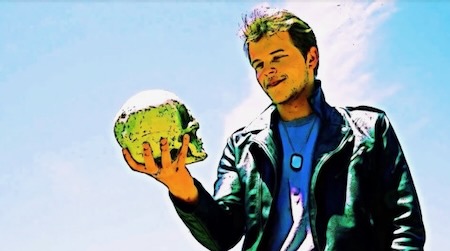
APOCRYPHA CANDIDATE: TODD TARANTULA (2023)

366 Weird Movies may earn commissions from purchases made through product links.

DIRECTED BY: Ansel Faraj

FEATURING: Ethan Walker, Kelly Erin Decker, Nathan Wilson, David Selby

PLOT: Todd Tarantula’s prized motorcycle is stolen; more disconcertingly, he keeps slipping through time.

Still from Todd Tarantula (2023)

WHY IT MIGHT MAKE THE APOCRYPHA: Todd Tarantula renders L.A. in neon-sparked hues, a surreal effect heightened by the underlying grit of the smog-soaked city. The slippery narrative coursing beneath the death-candy visuals touches on ancient Pueblo lore, modern ennui, technological immortality, and a pleasing finish that is fairly rare in our corner of cinema. Also, there’s a skull-headlight time-travel motorbike.

COMMENTS:

I can’t tell if this is blood or snot! Can somebody help?

The scene is set with efficiency, because for Ansel Faraj, time is of the essence. This pressing speed is somewhat ironic when one considers that the protagonist, ne’er-do-well business scion Todd Tarantula, has time on his side. Well, more accurately, he has time at his disposal. This stubbled James Dean stand-in has his share of troubles—deceased mother, estranged father, dead-end life—but  at least hehas a bitchin’ bike: his treasured means of escape from the demons that pursue him. But over the course of an evening, he loses that, and considerably more.

Tell me one—just one dream—that’s all I ask.

Rotoscoping is a wondrous technique, creating what is possibly the uncanniest of valleys. Grafting animation on to filmed reality anchors us in form and flow, while allowing unfettered tinkering. Faraj’s peripheral tinkering is limited, for the most part, to a glorious color skew. Murky nights shift from green to black. Dazzling sun-lit cityscapes become a Technicolor kaleidoscope. Negative space morphs into clingy radiance. When Todd finally encounters his father, the wire-and-bandage-wrapped patriarch appears as a tethered angel amidst his array of hospital machines and plastic draping. During a car ride with Lucifer (a business rival of his father), the power of animation emphasizes Todd’s claustrophobia and draws the eye to the old gentleman’s skull-topped cane, hinting at the unspoken cost of the business deal playing at the tip of Lucifer’s tongue.

News of death travels fast; dare I say, ‘I’m sorry’?

Ansel Faraj’s film is not perfect. The performances are inconsistent, and the narrative thread sometimes veers too far from the main stitching. However, he has an interesting story to tell here, and it is told entertainingly, with many clever bursts. When he learns of his father’s demise, and the deceased’s disrupted attempt to achieve digital immortality, Todd is idling at the La Brea Tarpits—site of others who have failed to achieve a favorable form of perpetuity.

I don’t know what’s real any more, and I’m really fucking tired of it.

As events unfold (and, in some cases, re-fold), Todd Tarantula slows its pace, drawing everything together at the end for a finish that some will consider a touch too trite. I, on the other hand, was pleased, and relieved to see something pleasant and astounding befall this troubled bohemian nomad. Todd Tarantula sears the eyes, bends the mind, and has the good manners to elicit a satisfied grin.

Todd Tarantula is currently streaming free on Tubi.

WHAT THE CRITICS SAY:

“The search for his missing motorcycle takes Todd on a journey into the darkest and weirdest byways of Los Angeles… Todd Tarantula is like the lovechild of an unholy union between an urban dungeons and dragons quest and a ‘50s teen angst movie. To bless the union, Faraj and company digitally rotoscoped the footage in post production to make the colors, characters and scenery pop like a cross between a live-action graphic novel and an acid trip.”—Brian Schuck, Films From Beyond (contemporaneous)

IT CAME FROM THE READER-SUGGESTED QUEUE: THE MYSTERIANS (1957)

Chikyû Bôeigun

366 Weird Movies may earn commissions from purchases made through product links.

DIRECTED BY: Ishirô Honda

FEATURING: Kenji Sahara, Yumi Shirakawa, Momoko Kôchi, Akihiko Shirata

PLOT: The Mysterians, a technologically superior force from another world, threaten the people of Earth with destruction unless they are granted access to a small plot of land and intermarriage with the planet’s women.

Still from The Mysterians (1957)

COMMENTS: The Japanese monster movie stands today mostly as a magnificent punchline, a peak in the field of cheesy filmmaking. With men in rubber suits wreaking havoc upon cardboard cities and sober-voiced scientists sagely predicting doom while hordes of citizens flee in terror, they can feel appealing nearly seven decades later specifically because of their amateurism. The home-movie caliber special effects, the hilarious destruction of major metropoli, and at least here in the West, the peculiarly emotive and awkwardly translated dialogue are all part of their charm. And as the sequels and copycats have piled on, that has largely become the raison d’etre for the whole genre. That was supremely silly, we say. Give us more.

But was it silly? An interesting side effect of their continued popularity is the rise of dedicated scholarship that examines the very serious origins of some of these stories. Consider the giant among giants: Ishirô Honda’s 1954 classic Gojira, which used a rampaging beast to tell a story of Japan’s psychic fallout from the atomic blasts of World War II, as well as to react to current events in which Japanese sailors were contaminated by exposure to a nuclear test. (Later kaiju, such as Mothra and Gamera, would have similar nuclear-inspired origins.) Yes, it’s a monster movie, but those in the know recognize it for much more.

Someone who absolutely knows the subtext is Ishirô Honda, and he practically triples down on it in The Mysterians, a movie about an occupying force that holds immense power over the occupied, who claims to want little but always seems to take more and more. If you imagine Honda and screenwriter Takeshi Kimura weren’t thinking about the United States, then you’ve been well-distracted by the aliens who look like baggy-suited Power Rangers and the monster who seems to be a blend of Big Bird and a steel-plated baseball umpire. Or you’re an American.

That’s far from the only theme The Mysterians wants to get across. There’s the matter of Ryōichi, the scientist who throws in with the invaders only to realize too late that the purity of science was no match for the corruption of power. He deflects accusations of treason only to regret his folly: “Even science has no value in itself!” he declares in his final message. “It all depends on how it’s used – for good or for evil!” And if science has a lesson to learn, so does the whole world, as a relieved functionary proclaims at the film’s conclusion. “The nations of the world must now stay united, and struggle against unknown forces instead of fighting each other.” Remind me to check on how that’s going.

The messages seem more prominent and more didactic than in Godzilla’s film debut, and that might be because the threat seems a lot less impressive. Even though the stakes have gone from the fate of Tokyo to the fate of the world, the battles themselves feel smaller. After the monster is deployed early in the film, the rest of the Mysterians’ danger is represented by being impervious to attacks, firing lasers, and enacting some of the lamest kidnappings ever filmed. They just don’t deliver shock and awe, no matter their demands or their dominance. That carries over into a painful lack of suspense. With Earth foiled at every turn, you need a really big payoff to buy the home team’s ultimate victory, and you don’t get one. Ultimately, the Earth Defense Force just has to keep working on better weapons until they find one that makes a dent, and that’s exactly what happens. It’s the equivalent of playground banter wherein one kid announces he has a forcefield to protect himself from harm, and the next kid declares that he has an anti-forcefield gun.

There are some genuinely great special effects, such as the dramatic flooding and the melting tanks caused by the Mysterians’ weapons, and the Akira Ifukube score is exciting and propulsive. But overall, The Mysterians just ends up not being that interesting. Honda and the team at Toho had a lot more to say, but this go-around wasn’t a particularly compelling way to say it all. Seems like another reason the monsters had more staying power than the messages.

WHAT THE CRITICS SAY:

“It’s solemn and silly, with too many earnest scientific-military discussions, but it pulls out all the stops when unleashing destructive weaponry, melting tanks, bizarre futurist décor, panicking hordes and kicking the baddies off the planet.” – Kim Newman, Empire

(This movie was nominated for review by Neil Lipes. Suggest a weird movie of your own here.)

APOCRYPHA CANDIDATE: FLAMING EARS (1992)

Flaming Ears has been promoted to the list of Apocryphally Weird movies. Please read the official entry.

Rote Ohren fetzen durch Asche

366 Weird Movies may earn commissions from purchases made through product links.

Weirdest!

DIRECTED BY: Ursula Puerrer, A. Hans Scheirl, Dietmar Schipek

FEATURING: Susana Helmayr, Ursula Puerrer, A. Hans Scheirl

PLOT: Spy makes comics, but her printing press is torched by Volley, a night-club performance artist/pyromaniac who has a pet girlfriend alien named Nun; the year is 2700.

Still from Flaming Ears (1992)

WHY IT SHOULD MAKE THE APOCRYPHA: With a plot as disjointed and intriguing as its stop-motion special effects, Flaming Ears rounds out the low-budget, lo-fi, lo-and-behold dystopian eccentriptych that began with ‘s Jubilee (1978)  and continued with ‘s Liquid Sky (1982).

COMMENTS: The future belongs to the lesbians, and judging from what directors Puerrer, Scheirl, and Schipek have imagined in Flaming Ears, I wish them the best of luck. The year 2700—“the year of toads”—is dismal, dangerous, and wet. Cubo-futuristic flirtations gel with sado-punk aesthetics at the local club; flames and orgasmic grinding flicker together; and love, which does still linger in this society, gloms to the body like a horrible, cherished memory. With no money at their disposal, the directors are free to explore intimacy at odd angles, craft violence with ketchup and cardboard, and cruise through Salzburg’s ramshackle roads at night and in miniature.

The plot trail opens wide and ambiguous, as the lives of Spy, Volley, and Nun intersect in unlikely ways. When Spy’s nib explodes by her face, ink splatters and an old frenemy saunters in. Smooth, suited, and smoking, Magdalena informs Spy that the printers was burnt to the ground. By whom? Well, none other than Volley, who is introduced by a clip-clip crash into Hell, but not before she grinds one out on a handsome side-table coated in lighter fluid. Fluid falls from the ever-dark skies on to the ever-slimy streets, and also onto the ever-red-PVC-clad alien. She wanders the nights when it rains, and she wanders to an erotic art-house dance club. Out front she finds the ailing Spy, who was bounced away by the machine-gun toting bouncer. Then, things get a little less clear.

Flaming Ears is pure punk-house, so don’t worry about the plotline. While I presume that budgetary considerations forced the filmmakers into Super-8 film, its inherent graininess, baked-in contrast, and just-a-bit-off color distortion would make it my first choice for this film. Everything in 2700 sounds “more” (yet another appropriate side-effect: post-production sound), and most of that “more” sounds wet. Drips, drizzles, sprays, spurts, and squishes are all up in your ear. But this is not just an underground soaking sin-fest, it’s an educated one. Last Year at Marienbad and (I would just about swear…) Tetsuo: The Iron Man get a nod in nearly the same breath. And while the post-punk scene in early ’90s Austria may have involved a whole lot of cubo-futurism on its own, Puerrer, Scheirl, and Schipek were wise to harness its jagged incongruity.

This whole exercise is simultaneously a chin-scratcher and an eye-opener, alternating gleaming cheapness with sellotape wonderment—typically in the same scene, or even shot. It doesn’t hurt that all the leads (who make up most of the creative and production team, unsurprisingly) have decent acting chops. They’re probably helped by the fact they’re performing long-crafted personas, but I’d be unsurprised if you told me that A. Hans Scheirl was actually an alien, Ursula Puerrer was a sex-crazed pyro, and that Susana Helmayr was somehow trapped between life and death. So, scrap any expectations, embrace pretensions, and slide skate-feet-first into Flaming Ears Hell.

WHAT THE CRITICS SAY:

“A strange, surreal film that may as well have “destined for cult status” emblazoned across every frame, Flaming Ears is guaranteed to be unlike anything you’ve seen before.”–Lee Jutton, Film Inquiry (re-release screening)

IT CAME FROM THE READER-SUGGESTED QUEUE: ANALOG (2012)

DIRECTED BY: Ebbëto

FEATURING: Fábio Norat, Giovanna Velasco

PLOT: An android tasked with guarding a lone man in hibernation on a deep-space journey takes radical steps to protect his charge, including creating a female companion and acting to protect the pair from sin.

Still from Analog (2012)

COMMENTS: Surely we’ve learned by now that leaving an artificial intelligence in charge of the future of all life on a lengthy space voyage is a risky proposition. The supergenius mainframe might become homicidal. A highly damaged android might implant the embryos of a malevolent race of unstoppable killers. An autopilot might plot to prevent humanity from returning to its ancestral home. There’s a good argument that those pesky AIs can’t be trusted with our safety at all, and Analog provides us with a new reason to be skeptical: the dang thing might try to become God.

Filmmaker Ebbëto (in addition to directing, he also takes credits for screenplay, cinematography, editing, and 2D animation) makes his intentions clear in his own description of the film: “Strange events with biblical analogies begin to occur, disturbing the machine and making it rethink its priorities.” The obviousness is not overstated. Sensing his charge’s loneliness, The Machine extracts a rib for the purposes of crafting a companion creature. Later, he will probe the minds of the pair and discover desires that he cannot sanction, as though they had new knowledge of themselves. What Analog brings to the table is an appalling realism: the cutting, bleeding, and growing attendant with these procedures are made explicit. So, too, is the humans’ punishment for their sinful thoughts. This is Adam and Eve retold as horror.

Analog is a marvelous example of the remarkable potential of DIY filmmaking. Ebbëto creates a number of immersive settings, including the cramped, industrial spaceship. It’s not always completely realistic – the green-screen technology sometimes gives off that DVD-ROM cut-scene vibe – but it’s thoroughly otherworldly and cleverly overcomes its limitations. There’s a lot of mileage to be gotten out of smart cables, rotating tubes, and robot repair.

But what little story there is amounts to a kind of grotesque punchline. The biblical beats hint at critique or satire but are really just the excuse for an outline, and once you’ve admired the bang-for-your-buck ethos, there’s not much more to it. Analog works best as a proof-of-concept for Ebbeto’s filmmaking skills; that’s the more interesting genesis story going on here.

WHAT THE CRITICS SAY:

Analog definitely isn’t going to be for everyone. It is slow and obtuse, and while I tend to dig that kind of deliberate, cautious tempo, I’ll admit, the whole thing does feel too long… Analog is still an interesting watch. There is a creepy ambience, and while that blanched out visual style can overwhelm your eyes from time to time, the look is consistent and unique.” – Brent McKnight, Giant Freakin Robot 

(This movie was nominated for review by Lesharky. Suggest a weird movie of your own here.)

CAPSULE: FP 4EVZ (2023)

366 Weird Movies may earn commissions from purchases made through product links.

FP 4EVZ is currently available for VOD rental or purchase.

Recommended*

*Frrlz

DIRECTED BY: Jason Trost

FEATURING: Jason Trost, , , Leigh Myles, Mike O’Gorman

PLOT: The wet shit threatens to 187 the FP, and so JTRO and CHAI-T must B.E.A.T. into the futuredoo with their daughter to save the nowsies.

COMMENTS: Let me be abundantly clear: there is no reason for this movie to be this good. No, we are not talking love-child of and Harron—that’d be a real masterpiece. FP 4EVZ, a passion-continuation of Jason Trost’s lifelong FP passion-project, is not high cinema, or even middle cinema. But it’s a refreshing blast to the face, made in the difficult style of haute stupidité. The premise is idiotic—as it has been, it seems, for over a decade now; for those of you not in the knowsies, Trost has been exploring the intersectionality of dystopian living and DDR (re-named in this universe “BEAT”, probably for legal reasons, but also because “Balance/Expeditiousness/Aggression/Tempo” is a delightfully silly sum-up of that whole arrow-stomp-dance nonsense) for his entire professional career.

I have not seen the first three parts of the FP franchise, but that’s okay: this chapter begins with a thorough recap of the machinations so far. Space Ducks once lorded over humanity, which was saved by a visitation from a cosmic entity who brought with it a comet-ful of booze. Civilizations have risen, and fallen. Humanity—or at least, sober humanity—is hanging on by its finger-nails. JTRO, the scion of a BEAT bloodline, is married to the warrior queen CHAI-T, and their daughter CHAI-LATTAY is the chosen one. Chosen to what? Dance. Dance at the direction of flying neon arrows.

There are many flying neon arrows. And countless examples of dum-dum “modern” speak rips and dialogues. No other framework could allow a destiny child be praised as having “the body of a mortal—but the blood and soul of a duck.” Or for a long-dormant thinking machine to not only insist on being referred to by name (“Monsieur Computer”), but sport a stupid beret on its Frenchie AI head graphic.

I eventually gave up on scribbling down the saga-style exposition, the pun-soaked quips, and the genuinely heartfelt speeches, all of which were crafted in an hilarious pastiche of idiotic slang from the past decade. It was all delivered ably—and delivered in all seriousness. And that is the main reason why FP 4EVZ works as well as it does: it never winks at the audience. All the DDR combat, the plot-twists, the CGI desolation: never once did I disbelieve. So take my recommendation with a few grains of salt, perhaps, but Trost’s latest outing is something to revel in—preferably, as they themselves advise before the feature, with at least a few drinks in you.

WHAT THE CRITICS SAY:

“…Z grade in the best of ways. Damn near every shot takes place in front of a green screen, with some cheap After Effects to populate the space. But it’s clear they’re going for a certain aesthetic. It’s all cheese, all the time. There are never any weird elements fading in and out; the effects are well-executed, just a little strange and cheap.”–Tyler Nichols, JoBlo (contemporaneous)