Tag Archives: Recommended

CAPSULE: LABYRINTH (1986)

Recommended

DIRECTED BY:

FEATURING: ,

PLOT: A dreamy teenage girl must rescue her kidnapped baby brother by journeying to the Goblin City at the center of a bizarre labyrinth.
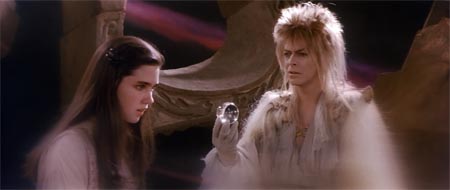
Still from Labyrinth (1986)
WHY IT WON’T MAKE THE LIST: Despite the MC Escher-inspired set-design, the unexpected sexual tension between teenaged Connelly and fruitily-dressed goblin king Bowie, and a devout cult following, Labryinth is ultimately just too close to a mainstream Muppet fantasy to place on a List of the 366 Weirdest movies. We’ve passed over slightly stranger movies in this genre—the visually similar Henson-directed The Dark Crystal and the thematically similar Henson-produced MirrorMask—and, although I think Labyrinth is a better film than either of those, it’s difficult to justify certifying this one when its companion films don’t even get to sniff the List.

COMMENTS: In The Wizard of Oz, Judy Garland’s breasts were famously flattened out with tape so the 16-year old could play a pre-pubescent girl. Labyrinth takes a different strategy: 14-old Jennifer Connelly plays exactly her age, portraying a hormonally testy girl-woman caught at the stage where her attention starts to shift from stuffed animals to the well-stuffed pants of strutting rock stars. That shot of rising estrogen distinguishes Labyrinth from other Oz/Alice in Wonderland fairy tale variations, giving it a subtext that goes over the heads of the tots in the audience but leaves adults with additional nuggets to ponder (and no, that’s not another reference to Bowie’s stretch pants).

There’s an impressive amount of imagination on display here, starting with Henson’s puppets, who reveal an almost limitless variety (each individual goblin looks like a representative of its own species) and a nearly human expressiveness (to be honest, the puppets out-act both Connelly and Bowie). The girl’s three companions—the cowardly dwarf Hoggle, the bestial Ludo, and Sir Didymus, the comic relief knight/terrier—are all worthy additions to Henson’s Muppet menagerie, and there is a zoo full of eccentric Wonderland-esque supporting creatures, including walking playing cards, Continue reading CAPSULE: LABYRINTH (1986)

106. LA GRANDE BOUFFE (1973)

AKA The Big Feast; Blow-Out

“If you don’t eat, you won’t die.”–Ugo, La Grande Bouffe

Recommended

DIRECTED BY:

FEATURING: , , , ,

PLOT: Four middle-aged, upper middle-class men (a judge, a TV personality, a pilot and a chef) hole up at a country villa to feast; it is gradually and casually revealed that they plan on eating themselves to death. They gorge themselves constantly, but the pilot can’t stand to go even for a day without sex, so prostitutes are invited to join them—along with a schoolteacher who attaches herself to the group willingly. As the gluttonous orgy continues the whores flee in disgust, but the teacher joins in the bacchanalia with gusto.

Still from La Grande Bouffe (1973)

BACKGROUND:

  • All of the main actors use their real names. All four of the male stars were well-established (Mastroianni, of course, was an international star and sex symbol). Except for Noiret, each had worked with director Ferreri before. Each had also had prominent roles in weird films from other European directors (Mastrioanni, most famously, in Federico Fellini films, but Noiret appeared in Zazie dans le Metro for Louis Malle, Piccoli was a mainstay in Buñuel movies, and Tognazzi had small roles in Roger Vadim’s Barbarella and  Fellini’s Satyricon). The quartet would reunite with the director the next year for a surrealist rendering of Custer’s last stand called Don’t Touch the White Woman (starring alongside another weird favorite, ).
  • The scatological content of the film scandalized some viewers at Cannes, but the film nonetheless won a FIPRESCI prize for Ferreri.
  • At its British showings La Grande Bouffe was protested by infamous decency crusader Mary Whitehouse; her attempts to have the movie banned ironically led to modification of the Obscene Publications Act to exempt films with artistic merit.

INDELIBLE IMAGE: The visions that will probably stick with you when you think back on La Grande Bouffe are scenes of four great European actors stuffing their faces with turkey legs, a castle made out of pâtés, and a pair of matching cakes shaped like breasts. Michel Piccoli dancing with a pig’s head is another strong candidate, as are the numerous gross scatological moments. But, the strangest and most lingering image may be the final one: sides of meat scattered around the villa lawn—a slab of beef wedged in the crook of a tree—and a pack of dogs sitting and looking attentively at the carcasses, making no move to eat.

WHAT MAKES IT WEIRD: La Grande Bouffe takes an absurd premise—four men decide to eat themselves to death—and plays it out with illogical realism, proffering no explanations or motives for what happens. It’s an unnatural but straight-faced parable that suggests nothing about how we’re supposed to take it. It’s a grotesque spectacle, but a strangely engrossing one, with a fascination that comes largely thanks to a dream cast of 1970s Euroweirdos.


Alternate trailer for La Grande Bouffe

COMMENTS: In the course of their Grande Bouffe, the four suicidal gourmands scarf Continue reading 106. LA GRANDE BOUFFE (1973)

103. BLOOD TEA AND RED STRING (2006)

366 Weird Movies may earn commissions from purchases made through product links.

“The doll character had been working its way into my drawings since 1990.  A lot of these things evolved from drawings.  The drawing is coming from the subconscious, really, so you don’t really know why, or say ‘why am I drawing it’?”–Christiane Cegavske on the DVD commentary to Blood Tea and Red String

Recommended

DIRECTED BY: Christiane Cegavske

FEATURING: With one minor exception, all characters are silent animated puppets

PLOT:  A group of aristocratic white mice commission rodentlike creatures with beaks (called the “Creatures Who Dwell Under the Oak”) to create a doll for them, but once the puppet is fashioned the Creatures refuse to give it up; instead, they revere it and sew an egg they find floating in a creek inside its torso.  The mice steal the doll and take it to their lair, so the Creatures set out on a journey to recover it.  Along the way they meet a frog sorcerer and a spider with a human face, and everything changes when the egg inside the doll hatches.

Still from Blood Tea and Red String (2006)

BACKGROUND:

  • The film took 13 years to make, with Cegavske animating perhaps 10 seconds a day.  Many of the models and effects used show up in the director’s 1992 short Blood and Sunflowers.
  • Cegavske intends for Blood Tea and Red String to be part of a trilogy, and in 2011 she announced the second part of the project, titled Seed in the Sand.  She estimates this installment will take five years to complete.

INDELIBLE IMAGE: Blood Tea is bizarre throughout, and many will be attracted to the psychedelic splashiness of the sequence where the Oak Dwellers eat hallucinogenic berries and see morphing pink and green leaf patterns overlaid on the courtyard garden.  For my money, though, things are at the weirdest when we climb inside the dark mouse hole and watch the well-dressed vermin pour bloody tea onto the lips of the lifeless doll while their skull-headed pet raven looks on.

WHAT MAKES IT WEIRD: A dialogue-free stop-motion animated fable done in the style of Jan Svankmajer, but with a darkly feminine spin, Blood Tea and Red String gently folds surrealism into its fairy tale structure to create a weirdly compelling world. It’s an inverted Alice, told from the perspective of mutant rodents, depraved white mice, and mystical frogs.


Original trailer for Blood Tea and Red String

COMMENTS:  Artist Christiane Cegavske had been living with the haunting creatures of Blood Continue reading 103. BLOOD TEA AND RED STRING (2006)

CAPSULE: CINEMA 16: EUROPEAN SHORT FILMS (U.S. EDITION) (2007)

Recommended

DIRECTED BY: Juan Solanas, , Christopher Nolan, Roy Andersson, Toby MacDonald, Lynne Ramsay, Jan Svankmajer, Mathieu Kassovitz, , Virgil Widrich, Ridley Scott, , Balint Kenyeres, Anders Thomas Jensen, Martin McDonagh, Nanni Moretti

FEATURING: Natalie Press, , Rúaidhrí Conroy, Klas-Gösta Olsson, Kris Marshall, Johannes Silberschneider, Tony Scott,

PLOT: This collection of sixteen award-winning shorts made by Europeans (mostly Brits) is a mix of dramas, comedies, and experimental pieces.

Still from Jabberwocky (1971)

WHY IT WON’T MAKE THE LIST: Compilations aren’t eligible for the List.  Although there are several short films on this set that are both weird, and great for their length, none of them have the weight it would take to displace a full-length feature film from the List.

COMMENTS: Like any box of chocolates, you never know what you’re going to get with this collection of sixteen shorts—it could be a caramel, a raspberry creme, or one of the dreaded coconuts.  The wide array of styles from artists working free of commercial concerns makes collections like this excellent primers on what cinema can accomplish, and this selection  from short film specialists Cinema 16 is one of the most award-studded compilations you’ll find.  Not having to worry about the box office receipts allows short film-makers to experiment with technique and go weirder than they otherwise would; indeed, about half of the movies here have at least a nodding acquaintance with the bizarre, while a couple are full-fledged works of surrealist art.  But no matter what direction your tastes run, rest assured there is something here to delight, and to bore, every film fan.

For completeness’ sake, I’ll briefly run down the realism-based entries first, in ascending order of quality.  We’ll then spend a little more time with the experimental offerings, a few of which are extremely important to the world of weird film.

The oldest film, Ridley Scott’s 1956 Boy and Bicycle, about a lad who takes a bike ride to the Continue reading CAPSULE: CINEMA 16: EUROPEAN SHORT FILMS (U.S. EDITION) (2007)

102. LUCIFER RISING (1981)

366 Weird Movies may earn commissions from purchases made through product links.

“The montage of hermetic symbols becomes first dreamlike, then menacing; centuries of mystical thought are distilled into a series of voyeuristic fantasies, a kinky psychodrama backed by the carnival strains of a maleficent calliope.  Anger intended Lucifer Rising to stand as a form of ritual marking the death of the old religions like Judaism and Christianity, and the ascension of the more nihilistic age of Lucifer.”–Mikita Brottman in “Moonchild: The Films of Kenneth Anger

RecommendedWeirdest!

DIRECTED BY:

FEATURING: Myriam Gibril, , , Leslie Huggins,

PLOT: Lava erupts and the goddess Isis awakens, calling to her husband Osiris. In a room far away a man wakes up, sits on a throne in his apartment and somehow spears a woman in a forest far away, then climbs into a bathtub to wash off the blood. Later, the moon awakens the goddess Lilith, a magick ritual summons Lucifer, and flying saucers appear over Luxor, Egypt.

Still from Lucifer Rising (1981)

BACKGROUND:

  • Anger originally shot a film called Lucifer Rising (A Love Vision) in 1966, which starred Bobby Beausoleil as Lucifer. Anger claimed that Beausoleil stole most of the completed footage and hid it; the star contended that Anger merely ran out of money to complete the movie.  Anger then took out an obituary-style ad in The Village Voice announcing his retirement from filmmaking.  Whatever the case, Anger incorporated some of the surviving footage from the original Lucifer into Invocation of My Demon Brother (1969).
  • Anger began working on the project again in 1970 and completed the first cut of Lucifer Rising in 1973, with a score by Jimmy Page.  After a falling out with Page he had the movie re-scored by Bobby Beausoleil.
  • Beausoleil was a Haight-Ashbury musician who came under Anger’s influence during the Summer of Love.  After his falling out with Anger the musician joined Charles Manson’s “Family.” He murdered music teacher Gary Hinman in 1969 over a drug deal gone wrong, and was convicted and sentenced to life imprisonment.  Anger contacted him to create the music for Lucifer Rising, and he wrote and recorded the score from prison.  The band heard on the soundtrack is comprised of his fellow inmates.
  • Lucifer Rising was completed with funds from the National Film Finance Corporation of Great Britain, prompting some controversy about state funding of a “devil film.”  Anger also received financial assistance from the Germany’s Hamburg Television and the U.S.’s National Endowment for the Arts.
  • Anger did not complete the editing on the final cut until 1981, a decade after work was begun.
  • In one of the film’s final scenes there is a long shot of the Colossi of Memnon in Upper Egypt. If you look hard you can see a puff of smoke rising in the distant background. According to Anger, this came from him ceremonially burning the film’s script because the work was now complete.

INDELIBLE IMAGE: The orange UFO flying over the crumbling columns of the Temple of Luxor, then peeking over the shoulder of the colossal ancient statue of Ramses II.

WHAT MAKES IT WEIRD: Egyptian gods and goddesses frolicking through a magickal psychedelic landscape, summoning Lucifer and flying saucers.


Trailer for “The Films of Kenneth Anger, Vol. 2 (including clips and music from Lucifer Rising)

COMMENTS:  A shaggy-haired man in a robe of many colors caresses a stone column. A Continue reading 102. LUCIFER RISING (1981)