Tag Archives: Quirky

LIST CANDIDATE: SAINT CLARA [CLARA HAKEDOSHA] (1996)

DIRECTED BY: , Ori Sivan

FEATURING: Lucy Dubinchik, Halil Elohev, Johnny Peterson, Yigal Naor, Israel Damidov, Joe El Dror

PLOT: An Israeli girl uses her psychic powers to help classmates cheat on tests, but she will

Still from Saint Clara [Clara Hakedosha] (1996)

lose them if she falls in love.

WHY IT MIGHT MAKE THE LISTClara Hakedosha mixes quirkiness, magical realism, coming-of-age drama and light absurdity together in exotic and unfamiliar proportions, like a postmodern twist on some ancient Israeli narrative recipe.  After watching it twice and thinking about it for weeks, I’m still not sure I know what the point is, and can’t decide whether I enjoyed it or not.  Maybe that’s the sign of a truly weird movie?

COMMENTS: Lucy Dubinchik plays 13-year old Clara, “a weird Russian girl with purple eyes,” with a blank face that makes it hard to figure out what she’s thinking or feeling.  Given that her character is defined by her mysterious psychic powers, it’s appropriate that she’s inscrutable; but it’s still a relief when a recognizable emotion like fear or contentment briefly flits across her face.  Though it often does an excellent job of evoking that period of early adolescence on the eve of your first kiss, the filmmakers’ motives in Saint Clara can be as inscrutable as those of a 13-year old girl—you may find yourself watching the action and wondering what the filmmakers intended you to feel.  For example, there’s a scene where a baseball bat-wielding child gangster (chauffeured by his 16-year old sister) and his female sidekick (in an aviator’s helmet) demand the passing Clara climb in their convertible: “Get in, fairy.  We’ll take you for a ride in heaven.”  Sitting in the backseat, the kids ride through a neon-drenched city with completely expressionless faces as organ-driven cruising music chugs on in a minor key. Is Clara a captive, or just a kid out on a joyride with schoolmates?  Is her host trying to intimidate her, or make her fall in love with him?  Saint Clara contain odd, alienating moments that strangen what might otherwise be a simple, quirky love story between a boy and his psychic fantasy girl.  There’s the reporter on television with the puffy black hat who’s always warning of impending nuclear or ecological disasters while carrying a lapdog or sporting a yellow raincoat; the constant talk of rebellion, as if the kids are a bunch of Marxist revolutionaries from the 1960s; the peculiar anecdotes their teachers tell about meeting Bobby Fischer and Edith Piaf; Uncle Elvis, a former psychic who lost his powers just as Clara will one day, who walks his pet goat through town like a dog; and there’s the huge bird that crashes through the classroom window one day, somehow turning the sky blood red in the process.  Adolescence here is a brief, bored slice of time perched perpetually on the brink of an apocalypse—although when the disaster finally arrives, it turns out to be a letdown.  For these kids, the onset erotic love entails the loss of childhood magic and vitality. The story is as much, if not more, about Clara’s would-be beau as it is about her; his infatuation with this “weird Russian girl” may cost him his position in the punk pecking order.  Barry Sakharov’s instrumental rock soundtrack, with its main theme with guitars screeching like birds of prey in the distance, adds to the film’s odd ambiance. Saint Clara seems to beg for an allegorical explanation, and there are allusions to political events that may make more sense to an Israeli than to an outsider; but perhaps its only purpose is to capture the iherent surrealism of puberty. If so, it hits the mark squarely.

Co-director Ori Sivan disappeared from the cinema stage but found a home in television, adapting his hit Israeli series “Be Tipul” as “In Treatment” for HBO, starring Gabriel Byrne as a psychotherapist who is in therapy himself.  The other co-director, Ari Folman, went on to score a big arthouse hit with the fairly weird Waltz With Bashir (2008), an animated examination of the Israeli national conscience, and is currently in post-production on the animated sci-fi adaptation The Congress (see this post).

WHAT THE CRITICS SAY:

“…a surreal, riotous affair… an exhilarating and wildly passionate film debut.”–Marc Savlov, The Austin Chronicle (contemporaneous)

FILM FESTIVAL DOUBLE FEATURE: THE LAST CIRCUS [BALADA TRISTE DE TROMPETA] (2010)/RAINBOWS END (2010)

Your faithful correspondent has returned from the field with reports on two offbeat festival films…

Still from The Last Circus (2010)Alex de la Iglesia bolsters his already fine cult film résumé (Acción Mutante, The Day of the Beast) with this b-movie styled action/melodrama that’s also an allegory for the Spanish Civil War. The movie’s best sequence is the prologue, where the Republican army conscripts a circus troupe into emergency action (“a clown with a machete—you’ll scare the s**t out of them”!) Flash forward to 1973, when the embittered son of one of the Shanghaied carnies embarks upon a career as a “Sad Clown,” but is immediately smitten by a beautiful trapeze artist. Unfortunately for him, the acrobat Natalia is the personal property of the “Happy Clown,” a psychotic, drunken woman-beater who just happens to be great with kids. The two mountebanks’ working relationship quickly turns sour as they take turns beating the greasepaint off each other in a brutal rivalry that eventually leaves both of them mutilated and insane. Which mad harlequin will Natalia choose? The Spanish Civil War angle is simplistic and neither adds nor subtracts from the narrative, which starts as a tawdry carnival melodrama and morphs into an action movie with a high-flying, clown-mauling showdown atop a giant cross. A few Sad Clown dream sequences–he keeps seeing his dead father and archival footage of Spanish pop singer Raphael singing a vintage ballad in clownface—add nominal weirdness, but these touches aren’t pervasive enough to raise the film above the level of aggressively offbeat. Still, there are those who are going to want to check out any film where an insane jester uses lye, an iron, and some clerical vestments to improvise his own clown costume, then steals a cache of automatic weapons and walks the streets of Madrid armed to the teeth with homicidal gleam in his eye. One final note: my movie-going companion was disappointed in the lack of variety in the clown-on-clown violence; he had been hoping to see a wide variety of Bozos brutalizing each other in an all-out melee. So be forewarned—if you consider two killer clowns too few, this Circus is not for you.
THE LAST CIRCUS [Balada Triste de Trompeta] (2010). Dir. Álex de la Iglesia, Featuring Carlos Areces, Antonio de la Torre, .

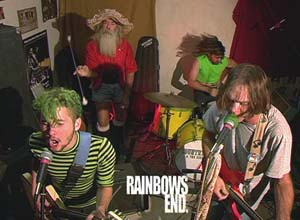
Rainbows EndIf The Last Circus is edgy, Rainbows End occupies the opposite end of the offbeat spectrum—it’s whimsical. Ostensibly a documentary about six east Texas eccentrics on a road trip to California to pursue a motley assortment of dreams, it’s also one of the funniest movies yours truly has had the privilege of checking out in 2011. It’s the characters who drive the bus in this episodic feature—and in this case that bus needs a push start, leaks radiator fluid, and at times is literally held together with duct tape. Continue reading FILM FESTIVAL DOUBLE FEATURE: THE LAST CIRCUS [BALADA TRISTE DE TROMPETA] (2010)/RAINBOWS END (2010)

CAPSULE: ESCANABA IN DA MOONLIGHT (2001)

DIRECTED BY: Jeff Daniels

FEATURING: Jeff Daniels, Harve Presnell, Joey Albright, Wayne David Parker, Randall Godwin, Kimberly Guerrero

PLOT: 42-year old Rueben must bag a buck during this year’s deer season or he’ll become

Escanaba in da Moonlight (2001)

the oldest male in the history of the Soady family never to have done so; with the help of a potion supplied by his Native American wife, he encounters strange supernatural forces that help him in his quest.

WHY IT WON’T MAKE THE LISTEscanaba is unique, at least: it’s got an interesting subject (the deer hunting subculture in Upper Michigan), lots of local color, and evil spirits (or UFOs, or God) haunting the woods.  Jeff Daniels has a lot of ideas here, but most of them fail: the crude quirk and sporadic weirdness never gels into something either meaningful or mirthful.  It ends up as a regional indie curiosity.  Escanaba does have its share of dedicated fans (mostly Michiganders)—must be a Yooper thing, eh?

COMMENTS:   The name Escanaba in da Moonlight sounds pretty cool, but doesn’t really fit the film—almost none of the action takes place in the town of Escanaba, and what little that does happens in the glare of the sun.  There’s plenty of moonlight, but it all falls well outside the town’s borders.  That’s pretty much the story of the movie, which puts things in just because they seemed cool at the time, without paying attention to whether they fit or not.  The movie knows where its soul is—holed up in the woods of the Upper Peninsula in a shack stocked with of maple whiskey and Leinenkugels, pronouncing its “th”‘s as “d”‘s, worried whether this will be the year middle-aged Rueben Soady finally shoots a deer.  It’s a recipe for a low-key male bonding comedy, but Escanaba loses its way when it expands beyond deer camp and goes cosmic.  Rueben is determined to break his curse before he becomes the record holder for oldest buckless Soady male, so he drinks a potion brewed by his mystically-attuned Indian wife and things get a bit weird.  Rueben and his camp pals—crusty but supportive dad, superstitious brother, and a family friend named “da Jimmer” who’s had a speech defect ever since he was abducted by an alien—chug down the brew and endure a night that’s half vision quest, half mushroom trip, with a touch of demonic possession and religious ecstasy thrown in for good measure.  They endure the flashing lights of UFOs, denatured whiskey, impossible euchre hands, a DNR ranger who’s just seen God, anxiety dreams, possession, epic flatulence, and a “bearwalk,” an evil spirit from Algonquin folklore.  The Soadys and their guests aren’t nearly as freaked out by these events as folks from under da Bridge would be; no matter how unsettling the paranormal events should be, the tone remains consistently stuck on coarse quirk, with jokes revolving around the supposed magical properties of jars of porcupine urine and the humiliation of accidentally drinking a moose testicle.  The movie’s message seems to be that in order to self-actualize and shoot a deer, it’s necessary to believe in something—anything—and it doesn’t really matter whether it’s aliens, ancient spirits, God, or the power of love.  That’s why all the supernatural occurrences that afflict the cabin are so damnably arbitrary; the trials Rueben goes through in that long night of the soul aren’t tightly tied to his psychological journey, and anyway, helpful spirits will show up at the end to solve his problem in about two minutes.  The unique Upper Peninsula flavor, deer-hunting rituals and likable rustic characters give Escanaba a lift, but the weirdness doesn’t work for the film, the comedy is gutshot and the spiritual triumph is lame.

Jeff Daniels, who grew up in Lower Michigan, not only starred, but also directed and scripted Escanaba, from his own play.  In the public mind, Daniels’ Golden Globe for The Purple Rose of Cairo (1985) has long been overshadowed by the scene where he suffers sudden and severe colonic distress in Dumb and Dumber (1994).

WHAT THE CRITICS SAY:

“…suggests Evil Dead II as directed by a lobotomized Garrison Keillor…”–Nathan Rabin, The Onion A.V. Club

(This movie was nominated for review by reader “Wycuff,” who called it “defiantly weird” but hedged with “It probably wont make the list but it’s at least worth a review and an honorable mention.”   Suggest a weird movie of your own here.)

CAPSULE: GENTLEMEN BRONCOS (2009)

DIRECTED BY: Jared Hess

FEATURING: Michael Angarano, , Sam Rockwell, Halley Feiffer, Jennifer Coolidge, Hector Jimenez

PLOT:  A pretentious pulp fantasy icon who’s run out of ideas steals a home-schooled teen writer’s sci-fi epic, “Yeast Lords: The Bronco Years,” and positions it to be his next bestseller; meanwhile, the original author has sold the property to a team of his nerdy peers who are making it into a YouTube-quality adaptation.

Still from Gentlemen Broncos (2009)

WHY IT WON’T MAKE THE LIST:  Weirder than expected and funnier than its reputation suggests, Gentlemen Broncos falls just short of a general recommendation, and just short of being weird enough to be considered for the List.  You may want to take a flyer on this uneven but sporadically hilarious spoof of sci-fi nerdom, though; the beyond-offbeat tone is sure to alienate many, but if you can connect with it you may come away with a peculiar affection for this messy film, the kind of devotion an owner gives a particularly ugly dog.

COMMENTS: Gentlemen Broncos is a movie with three different tonal layers, which sometimes conflict, but ensure that the movie remains stylistically unpredictable and never gets boring.  The base tone —which might be styled “nerd grotesque”—takes some getting used to; in fact, you’re going to have to work to meet the movie halfway on it. Jared Hess creates a world as seen through the eyes of a frightened adolescent: everyone young Benjamin encounters is uncomfortably strange, every social interaction awkward and fraught with the danger of humiliation. It’s as if every character in the film is some variation of Napoleon Dynamite. His role models include a nightgown-designing mom who supplements her income by selling homemade popcorn balls and a Church-appointed Big Brother with an incontinent albino python and a perpetually stoned expression framed by permed blond ringlets.  His peers are fellow maladjusted home-schooled youths: when he first meets the scheming Tabatha, she fleeces him for half his meal allowance, then cozies up to him by sitting next to him on the bus and letting him give her a squishy hand massage.  Even stranger is Lonnie, the creepiest kid on the block, a no-budget movie mogul whose flamboyant air of artistic superiority could have been hilarious if not for the freakish dental prosthetic he wears that stretches his mouth into a permanent Mr. Sardonicus death mask.  This base layer, a suburban universe inhabited by nothing but oddball losers makes for an uncomfortable, subtly nightmarish viewing experience, in the mold of a gentler and geekier John Waters.

Dr. Ronald Chevalier introduces another dimension to the film. The self-important sci-fi idol and general tool, obsessed with American Indian spirituality and breastfeeding, is shrewdly and purposefully characterized by Jemaine Clement.  He speaks with a carefully affected accent that suggests Ivy League superiority without having any actual geographic significance, and answers his omnipresent blackberry headset with a self-important “Chevalier” that makes you want to smack him.  The scene where he pompously lectures aspiring teen writers on the importance of providing characters with “magical” names is a pinpoint piece of character-assassination comedy.  If the entire movie had been made out of scenes like that, Gentlemen Broncos would be acknowledged as a satirical masterpiece.

These two layers—the uncomfortably quirky and the sharply sardonic—exist uneasily together, but the wild cards, and the segments of most interest to fans of the weird, are in the third layer, the dramatizations of the “Yeast Lords” adventure. The saga involves the mysterious properties of yeast (which look like cow patties and allow a Yeast Lord to fly), stolen gonads, clones, cyclopses with ray guns, and flying reindeer mounted with rocket launchers. We see three iterations of the tale scattered throughout the film: Benjamin’s original concept (with a manly Sam Rockwell as the hero) and Chevalier’s plagiarized version (he changes the protagonist into a “tranny” in an Edgar Winter wig, also portrayed by Rockwell, in a weak attempt to hide the story’s origins), as well as the amateur film adaptation by Lonnie, who doctors the script and casts himself as the female lead. Outrageously cheap CGI is used to achieve the flying and pink puke spewing effects, adding another layer of parody to the already tongue-in-cheek proceedings.  There’s brilliantly absurd dialogue throughout: “we’re investigating ways to strengthen the military—your gonad is being used for research,” “take me to your yeast factory!,” and Chevalier’s memorable couplet (from an alien lullaby) “within my breast meat there is a famine/No more sweets in the mammary cannon.” Without the “Yeast Lords” scenes, Gentlemen Broncos would be a highly peculiar mix of over-quirkiness and pulp fiction satire; scattering these histrionic playlets throughout turns the movie into something meriting the designation “weird.”

On the strength of Hess’ Napoleon Dynamite and the less-successful but still profitable Nacho Libre, Broncos received a generous $10 million budget and was scheduled for a limited release by Fox Searchlight.  The film was savaged by critics and shunned by audiences; its opening weekend was a disaster, netting just over $100,000 theatrically.  The movie was far too weird for mainstream filmgoers, but it stands to improve its performance on home video and could even develop a small cult following. Extreme weird movie trivia: Robin Ballard (star of the Certified Weird Elevator Movie) has a bit role in Broncos as a “female assistant.” Further trivia: the movie is set in a fictional Utah town called “Saltair.”

WHAT THE CRITICS SAY:

“…a finely deranged, sillyhearted satire… the aesthetic is followed through to the end by the filmmaker, who’s fixated on whatever weirdness he can devour.”–Brian Orndorf, DVD Talk (Blu-ray)

CAPSULE: SAINT JOHN OF LAS VEGAS (2009)

DIRECTED BY:  Hue Rhodes

FEATURING: Steve Buscemi, Romany Malco, Sarah Silverman,

PLOT: An insurance fraud investigator with a secret gambling addiction is assigned to investigate a wheelchair-bound stripper’s accident claim in Las Vegas.

Still from Saint John of Las Vegas (2009)
WHY IT WON’T MAKE THE LISTSaint John lands the dreaded double whammy: it’s not very weird, and not that good.

COMMENTS:  In blackjack, a player sometimes gets a decent hand but pushes his luck, takes another hit and end up going bust.  Saint John of Las Vegas starts with good cards: quirky indie icon Steve Buscemi, a plot hook about fate leading a problem gambler to the worst place in the world for him, and good supporting performances by Sarah Silverman as the new girlfriend whose sunniness and clinginess besmirch her sexiness and Peter Dinklage as the smarmy, fast-talking boss.  There are a couple of nearly brilliant, ironically absurd individual ideas: a wheelchair lapdance and a carnival sideshow attraction trapped in a malfunctioning flame suit.  But every good scene is undone by at least two corresponding clunkers: sleepyheads un-comically freaking out when awakened by the glare from a nearby glass building, a sequence involving a clique of nude men in the desert that works too hard for its single joke, a slowly revealed recurring dream that explains nothing, and a nonsensical, bungled twist ending that explains even less.  Apprentice fraud investigator Buscemi hits the road with vet adjuster Malco, an unflappable, cocky black dude whose too-cool-for-school glare gets him past strip club bouncers without paying the cover.  The mismatched pair never develop a chemistry to drive the movie; though he’s just doing what the script tells him to, Malco remains more of a constant annoyance than a worthy antagonist for Buscemi.   The final card that makes the movie go bust, however, is the half-hearted attempt to base the story on Dante’s “Inferno.”  English majors’ ears will perk up when they hear that Buscemi’s guide to the City of Sin is named Virgil, but anyone hoping to pick out correspondences to the epic poem will be frustrated, and anyone not familiar with Dante will be confused by the digressions.  The script stretches for circles.  Lust works, but where’s gluttony, who are the naked guys supposed to represent, and is there a new mortal sin—nicotine addiction—sandwiched somewhere in between wrath and heresy?  Writer/director Rhodes prominently gives Dante Alighieri a “based on a story by” credit, which is borderline unethical; the guy’s been dead for almost 700 years, so he’s not likely to have his agent call to get his name taken off the credits.  Still, with all its script problems and its chronic lack of laughs, Buscemi’s shaggy charisma keeps the project from being a total waste.  The rat-faced actor was born to play strung-out losers seeking redemption; a middle-aged desk-slave addicted to scratch off lottery cards is a role he can’t completely whiff on.

First time feature writer/director Hue Rhodes, who made a mid-life career change from software engineer to filmmaker, obviously charmed a lot of people into believing in him.   Not only did he lure Buscemi on board, but Spike Lee and Stanley Tucci show up in the credits as executive producers.  Their confidence wasn’t completely misplaced, as Rhodes does prove competent: although Saint John‘s parts don’t fit together into a bigger picture, the individual pieces are technically polished, making for a salable trailer.

WHAT THE CRITICS SAY:

“…Rhodes buries his would-be comic tale of desert losers in a welter of quirkiness and lousy surrealism, largely wasting an alluring cast brimming with humorous potential.”–David Noh, Film Journal International (contemporaneous)