Tag Archives: Horror

CHANNEL 366: THE THIRD DAY (2020)

DIRECTED BY: Marc Munden, Felix Barrett, Philippa Lowthorpe

FEATURING: Jude Law, , Katherine Waterston, ,

PLOT: Sam, a bereaved father, saves a suicidal girl and returns her to her home on a remote strip of land off the English coast, only to discover an undercurrent of violence and a weird theology permeating the island. Months later, mother Helen brings her children to the island for a vacation that quickly goes from bad to worse.

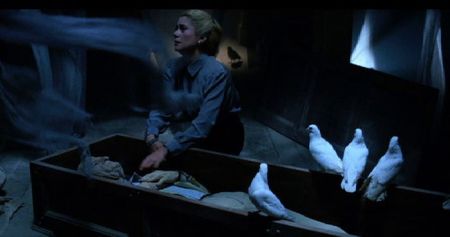
Still from "The Third Day" (2020)

COMMENTS: One of the most beloved tropes of horror is the character who goes somewhere—a room, a house, a portal to hell—that no reasonable, clear-thinking person would dare to tread. Part of the joy of the creepy-town variant is that no place is safe; every entrance you make is a bad idea. When Jude Law motors across the rarely appearing causeway that takes him away from the normal, safe world and into the strange island village of Osea, he’s making the classic horror-movie hero journey—and the classic mistake. And when Naomie Harris repeats the trek three episodes later, the audience has to be flat-out screaming “Don’t go in there!” at the screen. (Osea, incidentally, is a real place. Their public relations reps have much to answer for.)

In some respects, The Third Day is two deliberately different shows. (Actually, three. We’ll get to the third one in a moment.) “Summer”, the first three installments starring Law and directed by Marc Munden, mix a persistent sense of dread with a bizarre color palette. The landscape is a perpetual mossy green and dishwater blue, but other colors are riotously bold, as if the very look of the place is conspiring to keep Law’s discombobulated traveler Sam off balance. (Dropping acid, he will learn, does not help.) It is in this first act that we will learn that this community has a very particular theology that is directly related to Sam and the personal tragedy that his thrown his life into chaos. Though there is violence and shocking imagery, the look of the show reflects the town’s view of itself: a paternalistic flock welcoming a lost sheep back into the fold.

Harris’ arrival in “Winter” (with Philippa Lowthorpe now directing) is a significant contrast. Mirroring the weather, the village has turned cold and cracked, with whatever pleasant disposition that might have existed gone and the entire community in a dither over a forthcoming childbirth. The town is more clearly adversarial now, and unlike Sam, Harris’ Helen is not so easily thrown off her game. Of course, the two outsiders’ fates are intertwined, and it will take a fair amount of recriminations and violence to resolve their situation.

The Third Day falls neatly within the popular “outsider goes to strange little northern European village” genre associated with The Wicker Man or Midsommar, and most of the show’s power comes from an ever-present vibe of discomfort seasoned with folk cult horror that intentionally distances the hero and viewer alike. The island’s faith is a bizarre corruption of Christianity peppered with Continue reading CHANNEL 366: THE THIRD DAY (2020)

CAPSULE: BERBERIAN SOUND STUDIO (2012)

366 Weird Movies may earn commissions from purchases made through product links.

Recommended

DIRECTED BY: Peter Strickland

FEATURING: Toby Jones, Cosimo Fusco, Fatma Mohamed, Antonio Mancino

PLOT: Gilderoy, an English foley artist, takes on a job at an Italian studio to work on a horror film, and his mind begins unspooling.

COMMENTS: My dear Mr Strickland—I so very much wish that you could keep focused! Having now seen half of his feature-length output, it is clear that he’s a man with many, many ideas. Too many, perhaps? More likely, he suffers from too little discipline. Berberian Sound Studio is a fascinating movie, with a creepy vibe that fills like a soap bubble slowly ballooning until it pops two-thirds the way through, leaving a splattered mess of shiny viscosity on the eyes (and ears) of the viewer. Ground this film all you like with a shy, affable performance from Toby Jones; the moment you turn him into a sadistic Italian, all bets are off.

Gilderoy (Toby Jones) is an awkward Englishman with an awkward name who arrives at an Italian sound studio both ready to work and to receive compensation for his flight expenses. The work ahead of him is ample; the reimbursement, less so. Never mind; under the alternately conciliatory and remonstrative guidance of producer Francesco Coraggio, Gilderoy dives into the project. The brainchild of giallo director Giancarlo Santini, The Equestrian Vortex is, from the sound of it, a hyper-violent, hyper-stylized film involving a witch’s academy, featuring plenty of flashes back to horrible (and “historically accurate”) interrogations of suspected witches. Gilderoy finds the on-screen violence increasingly hard to handle.

The “on-screen violence” is never actually displayed. In fact, other than the opening credits for The Equestrian Vortex (its score composed by a “Goblin”-esque band called “Hymenoptera”), we see none of Santini’s opus. But we hear so very much. The droning introduction of the scenes for post-production dubbing almost always involves the phrase “flashback to witch’s interrogation.” Countless fruits and vegetables, both large (chopped watermelon) and small (plucked radish stems), act as the aural stand-ins for violent stabbings, hair-tearing, and everything in between. (The sound effect method for red-hot poker inserted vaginally is almost comically mundane.) Gilderoy’s practical effects team, two gents by the name of Massimo and Massimo, perform their slices, bubble-blowing, and wrenchings with deadpan professionalism.

The “behind the curtains” view of foley in the 1970s is by far the most interesting aspect of Berberian Sound Studio. There are plenty of sinisterly odd characters: aside from Massimo and Massimo, there’s the secretary from hell, the creepily congenial director, and the tragi-cryptic leading lady. But while this homage to giallo and sound becomes rather confusing, this never translates into weird—the sudden onset of head-scratchers undermines the atmosphere at the same time as it blasts a hole in the plot’s coherence.

As in his latest movie, In Fabric, Strickland (who also wrote both films) cannot keep himself from branching out to the point of muddying otherwise compelling experiences. These captivating messes are done with some kind of precision, I have no doubt, but I wish he could turn down the background noise.

WHAT THE CRITICS SAY:

“…utterly distinctive and all but unclassifiable, a musique concrète nightmare, a psycho-metaphysical implosion of anxiety, with strange-tasting traces of black comedy and movie-buff riffs. It is seriously weird and seriously good.”–Peter Bradshaw, The Guardian (contemporaneous)

CAPSULE: THE ANTENNA (2019)

Bina

366 Weird Movies may earn commissions from purchases made through product links.

DIRECTED BY: Orçun Behram

FEATURING: Ihsan Önal, Gul Arici, Levent Ünsal

PLOT: A building supervisor deals with strange occurrences after a satellite antenna is installed in his apartment building to broadcast new government-sponsored news bulletins.

Still from The Antenna [Bina} (2019)

COMMENTS: Set in a Kafkaesque cinder block, but clearly inspired by life in Erdoğan’s Turkey, The Antenna establishes its propaganda theme right away. Mehmet, an unassuming apartment building supervisor, listens to a government-sponsored radio broadcast as he dresses. Posters of a generic middle-aged strongman decorate the concrete pillars he passes as he walks to work through gray, deserted streets. The morning report declares that the government will be rolling out an elaborate communications system intended to integrate all media, one which will require the installation of a satellite dish on the roof of Mehmet’s building. This achievement will be celebrated with a special midnight broadcast—one which all citizens are strongly encouraged to watch.

Although the contemporary relevance is obvious, The Antenna is set in an indeterminately authoritarian time and place. Along with the drab utilitarian architecture, the celebration of satellite antenna television as cutting-edge technology suggest a Communist country in the 1980s. The film’s aesthetic is grimly Stalinist: residents wardrobes are almost all shades of black, white or gray (Mehmet is praised for the “seriousness” of his utilitarian, monochromatic suit). Only the younger characters, not yet fully integrated into this society, wear the occasional splash of brown, or even dull yellow or red. The cinematography favors shallow-focus shots, with background characters blurred, emphasizing each character’s isolation. Strong sound design contrasts with the grim visuals. Horror movie music plays from the pipes in the walls, and the noise of the outside world subjectively mutes when characters are in moments of crisis. At one point Mehmet’s ears are overwhelmed by a welter of staticky, overlapping propaganda broadcasts.

The Antenna builds a strong atmosphere of dehumanization and quiet despair, full of subtle threats, such as the way Mehmet’s boss playfully slaps his face to remind him of their respective ranks in the power structure. It springs some effective horror moments: black goo oozing from the wall and ceiling tiles, Mehemt seeing a column of anonymous identical silhouettes peering out of their compartmentalized windows. Angry synthesizers and VHS quality satellite broadcasts speak to the influence of Videodrome and other 1980s dystopias. For all of these virtues, however, the script lacks some urgency. It spends too long introducing us to the desperately bland lives of the tenement dwellers; even though the first kill comes 30 minutes in, it still feels slow. Nor does the two-hour journey build to a powerful climax. The ending is a series of weird visual and auditory metaphors, which happen to the characters rather than developing as a consequence of their actions. The grand finale is a confrontation with a lackey; we never burrow down to the source of the evil. Despite these reservations, debuting director Behram shows obvious skill in building fear. It’s a talent that might be better harnessed in service of a more propulsive script in the future.

WHAT THE CRITICS SAY:

“…this atmospheric nerve-jangler tips its hat to David Lynch’s gothic surrealism and David Cronenberg’s squirmy body horror, with pleasing detours into Dario Argento-style lurid giallo mania, too… [a] hauntingly weird debut.”–Stephen Dalton, The Hollywood Reporter (festival review)

CAPSULE: THE DEAD ONES (2019)

366 Weird Movies may earn commissions from purchases made through product links.

DIRECTED BY:

FEATURING: Sarah Rose Harper, Brandon Thane Wilson, Katie Foster, Torey Garza

PLOT: Four seniors are locked inside their high school at night as punishment for vandalism; characters dressed as the Four Horsemen of the Apocalypse stalk them.

Still from The Dead Ones (2019)

COMMENTS: I’m not the first one to describe The Dead Ones as some variation of “The Breakfast Club goes to Hell,” and I won’t be the last. It’s hard to ignore the high concept premise: high schoolers alone, sentenced to detention, but done as a horror movie. But The Dead Ones is a good bit more than that belittling description suggests, digging into the issue of teen bullying and its too-frequent apocalyptic consequences, while satisfying the bloodlust of its horror demographic with gore, shocks, and—yes—weirdness.

To continue the Breakfast Club metaphor for a moment… it should be no surprise that this one won’t end with a Don’t-You-Forget-About-Me-fist-pump. (Instead, we get an ironic recitation of the title, which is as close to redemption as The Dead Ones can come.) Rather than collection of brains, athletes, princesses, etc., what we have here are two basket cases and two criminals. Three out of the four are fleshed out with decent, if sad, backstories of abuse, humiliation, and mental illness. Emily, for example, is a cutter, and the bizarrely calligraphed scarring patterns on her arms and back are the first hints of true weirdness in the film (not counting some high school chatter about the ancient Egyptian god Ammit). What begins as a haunted high school spook show is interrupted by scenes of a far more realistic horror: four masked figures (the same ones who have locked the teens inside for the night) go on a daytime shooting rampage. The Dead Ones starts alternating between these two stories, and it’s not clear whether scenes are flashbacks, flash-forwards, or alternate realities altogether. Meanwhile, really weird stuff continues to happen at Midnight Breakfast Club: warping floor tiles, rag-eating ghouls, a precariously perched column made of classroom furniture. The teens’ reactions are rarely commensurate with the horrors they experience: one delinquent responds to being pushed around by a classroom of zombies with a defiant middle finger, rather than by wetting himself in terror.

The acting is not bad, with Sarah Rose Harper holding down the main duties (and delivering one fairly chilling monologue). The sound mix is thick and oppressive; I vacillated over whether it was too intrusive or not. Effects are done on the cheap. Kasten throws a lot of different styles into the film, from horror movie standard like flickering lights, various CGI and post-production tricks, homemade masks, crude stop-motion monsters, and scenes that play out on security cameras or YouTube videos, or on TV monitors that talk back to the characters. The welter of techniques keeps you off balance, but it probably would have been a stronger film had they stuck to a couple of key stylistic motifs. Still, it’s hard to complain about a horror movie that has the courage to go full weird.

Surprisingly divisive, The Dead Ones garnered positive reviews from critics while earning a shockingly low 3.1 rating on IMDB. Based on the few reader reviews available, it seems that most of the detractors missed a couple of relatively obvious clues that left them confused (or perhaps they didn’t watch all the way until the end, by which time everything should be crystal clear). Zach Chassler’s script is full of classical allusions that may fly over heads of those seeking a slash-’em-up teen thriller, so maybe it’s just a case of the film not finding its way to the proper audience yet. (Our readers are the proper audience.)

The Dead Ones was shot way back in 2009; some have speculated that the sad plague of school shootings in the following years scared off investors and distributors who thought the subject matter was too raw for the moment. Once finally completed, it only played a couple of stops on the festival circuit, but Artsploitation rescued it and put it out on the Internet and Blu-ray. The disc comes with two short behind-the-scenes featurettes and two commentaries, which are worth listening to in order to catch all the tiny, almost subliminal details that will probably escape you on a first viewing.

WHAT THE CRITICS SAY:

“From within this structure, though, a weirdly intriguing picture flows… The Dead Ones is quite the madhouse and you have to admire Kasten’s journey into teen darkness.”–Elias Savada, Film International (Blu-ray)