Tag Archives: Drama

PHILOMENA (2013)

There is a potentially exploitative blockbuster at the heart of Philomena (2013), and as it unfolds we expect, at any moment, to be drawn into yet another example of cinema as propaganda. A film with the theme of abusive nuns in an Irish Catholic asylum lording over unwed mothers is an invitation for at least one audience-as-silly-putty moment, molded by hackneyed writing and line delivery. It never happens. Instead, we are treated to a sensitively written, smartly balanced drama, which never succumbs to overt sentimentality or cynicism.

Such restraint takes a collaborative effort, and Philomena benefits from the directing of Stephen Frears, Steve Coogan and Jeff Pope’s screen treatment of Martin Sixsmith’s book, along with Judi Dench’s astute performance.

Dench’s portrayal of a devout, elderly survivor of convent abuse is one of touchingly nuanced wisdom. Sadistically dehumanized for actually experiencing puberty and having a child out of wedlock, Philomena Lee spends fifty years searching for the son that her religious superiors sold to an American couple.

After a chance meeting with the recently disgraced journalist (and atheist) Martin Sixsmith, Philomena embarks on a search for her son, which leads them both to Washington, D.C. and a heartbreaking discovery.

Still from Philomena (2013)Sixsmith (Coogan), a lapsed Catholic himself, paradoxically (and complexly) proves to be both Philomena’s foil and means to the truth. Aptly, it is not closeted prayer, but aid from a fellow human that manifests Philomena’s invocation.

Although cinematic treatments of religion have traditionally been fodder for mainstream audiences, Philomena somewhat slipped under the radar in its opening run. The reason for that is simple. To quote Paul Gauguin: “In every generation the least cultivated taste has the largest appetite.” However, after receiving a plethora of good reviews and (later) awards, Philomena found its audience and, even with its nonpartisan approach, still managed to provoke a good percentage of them.

Accusations that the film was arty, anti-Catholic, anti-Christian, anti-Reagan, pro-gay, and had a liberal agenda flew fast and furious, despite the fact that the film, like the book, was nonfiction. The “silence is golden” species of nuns serve, albeit unintentionally, as the model for this defensiveness. Upon hearing the confession of the nun Mary Johnson, who had engaged in a lesbian relation, Mother Teresa told her charge: “Talking about the sin is as great as the sin itself.”

In the Washington Post review of Philomena, critic Ann Hornaday describes a portrayal of “unfathomable cruelty.” One supposes she is blessed for thinking so, but it is completely fathomable to anyone who has been subjected to the abuses of organized religion.  In addition to the religious, predatory aggression vented against young, stained, single mothers, a second sin is lensed here: the sin of “not talking about it.”

The offended faction of Philomena’s audience echoes the shadowy nuns here. Any mention of wrong deeds perpetrated in the name of religion, or all spoken criticisms, are a sinful blemish on the pedestaled institution and an insult to the faith.

Even the secular worshipers of the iconic Ronald Reagan jumped into the film’s maelstrom. Outraged that the film made a passing reference to that administration’s cutting of AIDS funds (which it did), the extremists labeled the film as having a liberal agenda, despite the fact that Philomena’s lost son worked for President Reagan and Philomena herself is, primarily, a religious conservative. One is forced to conclude, from said reactions, that the coveted outcome for AIDS victims is “let them die in the streets.”

Hornaday identifies with Martin Sixsmith’s sense of outrage. She is less understanding of Philomena’s tenacious faith and her (seemingly) having turned a blind eye to the vestals’ crimes. In this, Hornaday mirrors the secular world at large in failing to grasp the pulse of many abuse victims who insist that the abusers, the silent elite, or the self-appointed keepers of the flame will not solely own the religious tradition or have access to the Kingdom’s keys.

In sharp contrast, those who desire nothing less than a perfectly polished veneer for the religious establishment will indeed find room for offense, regardless of the film’s inevitably impartial approach. Philomena‘s right-wing critics are predictably hypocritical in their complaints of the film’s nonchalant portrayal of a deceased gay man. These same critics have made no, or damn little, reference to guilty heterosexual fornicators because, in the 21st century, hell, we are all convicted of that.

CALVARY (2014) AND I CONFESS (1953)

John Michael McDonagh’s Calvary was one of 2014’s best films, with  a central performance that is authentic in the rarest of ways. is a welcome throwback to a specialized breed of cinematic actors: big, erudite men (Robert Shaw was such an actor). Gleeson began his acting career  at a young age, appearing in the plays of Samuel Beckett and William Shakespeare. He was an English teacher for over a decade before embarking on a film career. Naturally, he has specialized in playing Irish patriarchs, mentors and historical figures, which makes his casting as Father James, a potential martyr, shrewd.

Traditionally, the role of a Catholic priest has been thought of as an actor’s plum. It is easy to see why, especially in the contemporary world. The Roman Catholic priest, with his vows of  poverty, chastity, and obedience, has willfully chosen a subculture that is shockingly in direct opposition to the precepts of modernism’s worldview. The priest believes, whether he inevitably lives up to it or not, that he has an existential calling. He does not take the honor unto himself. Rather, he regards that his is a vocation called by something inward. His rejection of materialism is, hypothetically, inclusive. Capital, desire, and ego, theoretically are tenets of a status quo path that he has chosen to reject. The priesthood is the quintessential revolt against all that which is temporal.

Still from I Confess (1953)‘s I Confess (1953) features a performance by Montgomery Clift, as Father Michael Logan, which takes the psychology of the priestly vocation to an icy extreme. Clift’s performance, born of primordial method acting, parallels the film’s inert aesthetic.

Robert Burks’ shimmering cinematography exudes a Genesis-like potency. This, combined with Clift’s acting achievement, rendered I Confess a cult favorite among New Wave filmmakers and French critics.

American critics and audiences found it a more curious affair. It is akin to Gabriel Fauré’s music. Its appeal is primarily provincial; so subtle that invoking its aesthetic content proves to be a task.  Critics deemed this theological drama from the Jesuit-schooled Hitchcock too inaccessible, an inside affair amidst the director’s populist oeuvre. With introverted themes of Eden-esque transgressions, annihilation of carnality, and dogmatic devotion, I Confess was too bound in the interior of an orthodox landscape. Had Hitchcock’s film taken a more commercial approach, Western reception would have been considerably broader. Local critics predominantly panned Continue reading CALVARY (2014) AND I CONFESS (1953) →

CAPSULE: MEMPHIS (2013)

DIRECTED BY: Tim Sutton

FEATURING: Willis Earl Beal

PLOT: An R&B singer wanders through Memphis, Tennessee, struggling to find inspiration to complete a second album after a successful debut.

Still from Memphis (2013)
WHY IT WON’T MAKE THE LIST: It’s only slightly weird, and while there are moments of unquestionable beauty, its vast empty spaces make it a real wristwatch checker.

COMMENTS: Although anyone who’s ever worked in any creative medium can identify with its torments, writer’s (or musician’s) block is a hard thing to convey to an audience in a fascinating way. Although the cinematography here is sublime, and Willis Earl Beal has a weird funky charisma, Memphis is not up to the challenge of engaging us with this artist’s disengagement. What Memphis is best at is depicting the African American communities of it’s title city as a throwback to the ancient world of the blues, a place where men still wear felt hats and play dominoes and drink out of paper bags (I know men still play dominoes and drink out of paper bags, but not while wearing porkpie hats). With tree boughs hanging over the boulevards and weed-choked lots separating the bars from the churches, these neighborhoods look simultaneously urban and rural, like postcards from a pre-smart phone era.

Beale is a man out of time, too; he fits in better with the grizzled old men sitting on their porches than he does with folk his own age. As the movie progresses—to whatever degree such a deliberately static work can be said to progress—it becomes increasingly unclear whether the singer might actually be suffering from some form of mental illness. When he says in the opening scenes that he’s a wizard who conjures his own reality, it sounds like a metaphor for artistic creation, but the more he rambles about envying the trees or copulating with the dirt, the more you consider the frailty of the line between genius and madness. There are parallels between his alienation from his own creativity and alienation from God (and thus from his own church-centered culture). He refuses to sing at Sunday revival, and an old man’s midnight advice to him is chilling: “Using your talent is what God wants you to do. He gave it to you for a reason… I’d hate to be in your shoes, where you owe God.”

There are some very good shots in this sprawling, strange and obscure movie. Beale composes in a strange polygonal room with neural ductwork. He slow dances with his sweetie in a neon nightclub, continuing in a trance even when she withdraws. These are moment of poetry that will reward a certain breed of contemplative cinemagoer. Typical audiences are going to find this affair far too slow and inconclusive, however. Beale’s musical talent is only glimpsed in frustrating snatches. The movie is only seventy-five minutes long, but scenes of the melancholy protagonist walking around whistling or practicing his stick-fighting moves with a broom seem interminable. Memphis‘ non-story could have been conveyed with as much impact at a third of the length.

WHAT THE CRITICS SAY:

 “…Sutton at least keeps the running time trim. Perhaps he knew that the strange magic he and Beal occasionally conjured was destined to have a short shelf life. Better to leave the few audience members plugging into this cryptic oddity wanting more.”–Film Journal International (contemporaneous)

CAPSULE: THE DUKE OF BURGUNDY (2014)

DIRECTED BY: Peter Strickland

FEATURING: Sidse Babett Knudsen, Chiara D’Anna, , Eugenia Caruso

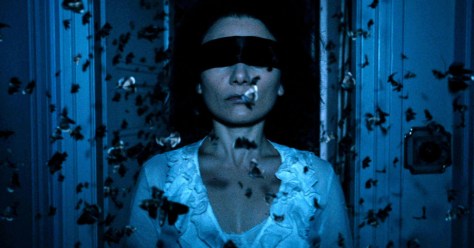
PLOT: An entomology professor and her student are very much in love, but their romance is threatened by the latter’s preference for BDSM practices in the bedroom.

18BURGUNDY2-facebookJumbo

WHY IT WON’T MAKE THE LIST: Though the subject matter might seem strange or unusual to some viewers, the film itself is simply an examination of two women who are going through a trial in their relationship. There is some bizarre dream imagery and a choppy narrative style, but nothing truly Weird.

COMMENTS: The Duke of Burgundy opens with a drawn-out sexual role play as the wide-eyed Evelyn (Chiara D’Anna) enters the house of domineering mistress Cynthia (Sidse Babett Knudsen) to act as housekeeper. Evelyn scrubs and shines and soaks as Cynthia thinks of more demeaning tasks for her to do, ending the day with punishment for unsatisfactory work in the form of urination into Evelyn’s mouth. This scene returns in multiple forms later, as we see different perspectives and points in time, serving as an anchor for our understanding of their relationship. The film unfolds over a semester at the isolated women’s school where Cynthia lectures and Evelyn studies, but most of the focus is on their private moments at home. As the persistent Evelyn comes up with new ways to be dominated, she believes she’s found the perfect partner in Cynthia, who is willing to act the dominatrix if it makes her lover happy. However, it soon becomes clear that the older woman is uncomfortable with the parts Evelyn creates for her, struggling to emotionally and physically abuse her lover even in the context of role playing, and then growing to resent her for her increasing demands.

Strickland made waves two years ago with his stunning, unnerving ode to giallo, Berberian Sound Studio, in which a British sound technician sinks into a paranoid fever dream while shooting a gory horror in Italy. Here, the director again treats the eyes to a sultry palette, ornate settings, and thoughtful camerawork, matched by an effective soundtrack that pairs fuzzy synths with the hum of insects. The opening credits use freeze-frame and oversaturation to reference vintage softcore film, but thanks to the soundtrack and visceral color choices, other moments are more reminiscent of a slasher. The retro vibe is heightened by the somewhat ambiguous setting and time period. Fashions and hairstyles suggest the 1950s or 60s, the aesthetic is more 70s, the landscape and architecture is classical, evoking rural Italy (though filmed in Hungary), and everyone speaks English with different European accents. He clearly devotes much of his time to mixing and matching different film references, from art house to grindhouse, but ultimately the focus is on the characters. Even the weirder touches, including frequent close-ups of insects and stark shots of architecture, are meant to communicate the sense of dread that is hanging over Cynthia and Evelyn’s relationship as they move into darker sexual territory. There is a palpable feeling of intimacy in Strickland’s approach, utilizing close-ups and lingering shots to effect a kind of quietude over most of the proceedings. It is easily to believe in this relationship, though the world around them is often hazy.

On paper The Duke of Burgundy sounds like it should be a sleazy straight male fantasy about lesbian kink, and yet Strickland forgoes all sensationalism—there isn’t that much (explicit) sex or even nudity shown. Evelyn’s mental stimulation is highlighted, as she derives pleasure from being locked in a chest, verbally berated, and sat on by Cynthia. The BDSM scenes are often treated with humor, not to make fun of those practices but to reveal the kind of goofy accidents or strange conversations that might come with it, and to break the tension for an unfamiliar audience. At other times they are presented in a cold, almost sterile manner, with Cynthia eventually injecting a form of revenge into their role play. What is both wonderful and striking about this film is its undertone of normalcy, its relatable and honestly touching portrayal of a romantic struggle, despite its apparently sexploitative premise. The basic story could easily be rewritten with different conflicts, with different genders, with different settings; the BDSM elements are both central to the narrative and secondary to the overarching theme. The film asks if sexual preferences can damage an otherwise strong relationship, and if personal contentment can exist without complete sexual fulfillment. It allows us to peek into something extremely personal, but universal, intermingling with our own insights and experiences, with a dreamlike style so lush and distinctive we still walk away feeling like we’ve left behind a world of fantasy. It might not be List-worthy, but it is certainly worth seeing.

WHAT THE CRITICS SAY:

“…the question of who’s really in charge of these scenarios is complicated. Exactly the same deceptive quality can be found in the dreamlike artifice of Strickland’s film itself, set in a lush and aristocratic European fantasyland that’s entirely nonspecific as to geography and chronology… But while Strickland’s films already aren’t like anyone else’s, his real secret is that even in this strange constructed world, his characters feel like real people struggling with issues that aren’t exotic at all.”–Andrew O’Hehir, “Salon” (contemporaneous)

CAPSULE: WINTER IN THE BLOOD (2013)

DIRECTED BY: Alex Smith, Andrew J. Smith

FEATURING: Chaske Spenser, , Saginaw Grant, , Casey Camp-Horinek, Julia Jones

PLOT: Virgil First Raise, an alcoholic half-breed Blackfoot, wakes up from a blackout and is told that his wife has left him, taking his rifle and electric razor with her and setting him off on a boozy, hallucinatory quest to recover the items.

Still from Winter in the Blood (2013)
WHY IT WON’T MAKE THE LIST: A vision quest seems like the perfect plot structure for a weird movie, but although there is a lot to enjoy in this slightly surreal, unusual Indian-themed movie, it isn’t strange enough to overcome its narrative shortcomings.

COMMENTS: Waking up from a bender in a ditch, seeing visions of his dead father, Virgil First Raise complains he is “caught in an in-between place… vulnerable to the spirits.” Though not entirely successful as cinematic psychoanalysis, Winter in the Blood does capture Virgil’s physical and psychological tipsiness and vulnerability to the spirit world, which bleeds into reality. Flashbacks frequently interrupt the present-day action, often introduced in interesting ways; for example, Virgil fishes in a river and sees his childhood self and his (now absent) brother frolicking on the opposite bank. The movie also incorporates the rhythms of hard drinking; we see Virgil tippling in a bar, following up on a lead, and suddenly he wakes up in a strange bed, leaving us with a suspicion that crucial plot information may have been irretrievably lost to a blackout. That structure of memories and ellipses would be confusing enough for the average viewer, but then there are also entire subplots that are probably imagined, such as Virgil’s dalliance with a Canadian “airplane man” who is being tailed by mysterious men in suits and who wants to enlist the Indian in an obscure smuggling plot, the details of which keep shifting. The quirky and sinister airplane man scenes, particularly one where Virgil finds a fellow diner at a lunch counter inexplicably falls face-first into his soup, give the film an exciting Twin Peaks-on-the-reservation sensibility that it could have used more of.

Virgil suffers from a horde of demons—too many for a single movie—from alcoholism to survivor guilt to incompetent parents to the manhood ritual he never completed to fretting over the Caucasian impurities in his blood. His troubles materialize in an equally numerous series of symbols: the rifle, a mysterious blonde barmaid who sometimes has a tattoo and sometimes doesn’t, the airplane man, a stuffed teddy bear, a rabbit in a haystack. As a work of Native American cinema, a field that’s not overly crowded, Winter in the Blood ranks as a minor standout. The performances are mixed but generally good, the soundtrack is alt-melancholy, and the excellent widescreen cinematography captures the agrarian grandeur of Big Sky country. But all of the floating symbolism, subplots and narrative loose ends, together with the impressionistic style and some fumbling at the finale (the emotional climax feels misplaced, with Virgil’s despair unexpectedly peaking after the scene that should have brought him insight and redemption) result in a film that ends with an unfortunate lack of closure.

WHAT THE CRITICS SAY:

“Real and surreal weave together, and an impeccably chosen soundtrack — by, among others, the Heartless Bastards and Robert Plant — reinforces a mood that veers from dreamy to violent with shocking suddenness.”–Jeanette Catsoulis, The New York Times (contemporaneous)