Tag Archives: Cult film

107. HEDWIG AND THE ANGRY INCH (2001)

“I fear that in the speech which I am about to make, instead of others laughing with me, which is to the manner born of our muse and would be all the better, I shall only be laughed at by them… the original human nature was not like the present, but different. The sexes were not two as they are now, but originally three in number; there was man, woman, and the union of the two, having a name corresponding to this double nature, which had once a real existence, but is now lost, and the word ‘Androgynous’ is only preserved as a term of reproach.”–Aristophanes in Plato’s “Symposium”

Must See

DIRECTED BY: John Cameron Mitchell

FEATURING: John Cameron Mitchell, Michael Pitt, Miriam Shor, Andrea Martin

PLOT: We first meet Hedwig as she and her band the Angry Inch are performing at a seafood buffet in Kansas City. In flashback, and in music videos, we learn that she was born a boy named Hans in East Berlin, and underwent a (botched) sex change operation so she could marry an American G.I. and leave for the West. Now, she and her band are shadowing the cross-country tour of Tommy Gnosis, Hedwig’s ex-boyfriend turned arena rock star, whom she accuses of having stolen her songs.

Still from Hedwig and the Angry Inch (2001)

BACKGROUND:

  • John Cameron Mitchell, then a professional stage actor, debuted the character of Hedwig in 1994 at a drag show at a punk nightclub in New York City. With the help of songwriter Stephen Trask, he built an off-Broadway play—originally staged in the ballroom of a fleabag hotel in Manhattan’s meat packing district—around the androgynous chanteuse.
  • In the early drafts of the play Tommy was the main character and Hedwig a supporting player.
  • Mitchell’s father was U.S. Army Major General John Mitchell, and the younger Mitchell spent much of his childhood in Berlin where his father was stationed during the later part of the Cold War.

INDELIBLE IMAGE: Is it Hedwig’s androgynous Aryan visage, half-hidden under a pound of glittery makeup and a sculpted blond wig big enough to double the diameter of her head? Or is it the animated retelling of Aristophanes fable in “The Origin of Love,” with a squiggly line drawing of Zeus cutting the legs off whales? Fortunately, thanks to split-screen technology, we don’t have to choose; we can get Hedwig’s glacial glam mug on the left and a severed half-moon face yearning to swallow her up on the right together in one still.

WHAT MAKES IT WEIRD:  Well, it does feature a rock star who’s the victim of a botched sex


Original trailer for Hedwig and the Angry Inch

change searching for love and vengeance and telling her life story through song while playing on a tour of discount seafood restaurants with her band of Eastern European refugee musicians, which is a plot you don’t see everyday. If that’s not enough to satisfy your weird desires, however, stick with it until the end, when it drifts into a dreamlike series of music videos that see characters swapping sexes and changing into other characters.

COMMENTS: He may not be widely acknowledged as the West’s weirdest philosopher, but Continue reading 107. HEDWIG AND THE ANGRY INCH (2001)

CAPSULE: SHOCK TREATMENT (1981)

DIRECTED BY:

FEATURING: , Cliff De Young, Barry Humphries, , Charles Gray, Ruby Wax,

PLOT: A young married couple end up in a town that’s actually a giant television network; Janet is groomed as a celebrity, while Brad becomes a mental patient in a hospital show.

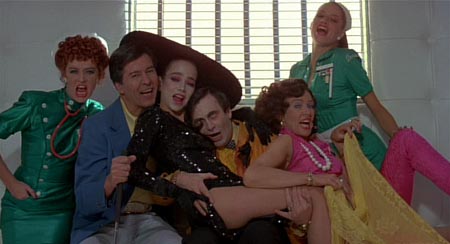
Still from Shock Treatment (1981)

WHY IT WON’T MAKE THE LIST: Shock Treatment is a cult film even among the tiny subset of cult film enthusiasts. This “sequel” was rejected as a confounding disappointment by most fans of The Rocky Horror Picture Show, but is still vehemently defended by a segment of that fan base. It’s a peculiar exercise in wacky musical satire, for sure, but it lacks the kind of résumé necessary to place it among the most significantly weird movies of all time.

COMMENTS: What would you get if you took The Rocky Horror Picture Show and stripped out Tim Curry‘s domineering performance as the mad scientist transvestite dominatrix, leaving behind only the theater-rock musical numbers and campy supporting players? (On the off-chance you don’t see where I’m going yet, the answer is Shock Treatment). Whereas Rocky Horror was a theatrical flop that organically grew into a cult movie, Shock Treatment was pitched as a deliberate cult movie, but became an instant flop. This delayed follow-up is full of amped-up ideas and energy, but it comes off as cocksure; it’s so convinced its madness is entrancing that it forgets to ground us in its quirky universe. The (confusingly executed) idea is that the entire town of Denton, U.S.A. is a TV studio, with the audience as regular citizens, the stars and staff as sorts of metro officials, and the sponsors as big-money villains manipulating studio politics behind the scenes. The movie throws so many colorful eccentrics at us that every character turns into a minor character, even the leads. Janet (not necessarily the Janet Susan Sarandon played in the previous movie) and Brad (again, a character with the same name but little connection to the original) enter the town’s audience, for unclear reasons, and wind up on a marriage counseling show run by a blind Austrian in an orange thrift-store tuxedo. He hands Brad off to a brother/sister pair of psychiatrists (writer Richard O’Brien, wearing uncomfortable- Continue reading CAPSULE: SHOCK TREATMENT (1981)

HOUSE OF EVIL (1968)

* This is the second installment in the series “Karloff’s Bizarre and Final Six Pack.”

‘s series of Mexican films is anything but routine.  Of the entire ill-reputed group, House of Evil (1968) has something that most resembles a traditional plot.  It is orthodox only in that it is a retread of the old dark house scenario.  However, that genre is filtered through such bizarre ineptness that it would be an incredulous stretch to claim House of Evil is a film bordering on coherency.  The movie is available via that valuable distributor, Sinister Cinema.  Their brief assessment of House of Evil is telling: they describe it as simply “not bad.”

As with Fear Chamber, House was co-directed by and  and co-stars south of the border sexpot . A murdered girl has been found by local villagers and, just like another recent victim, her eyes have been torn out.  Upon hearing the news, Matthias Morteval (Karloff) is mightily upset.  His friend and doctor, Emery (Angel Espinoza), tries to simultaneously caution and calm Matthias.  Dr. Emery reminds Matthias of similar murders in Vienna, involving Matthias’ brother Hugo.  Before a painting of his late father, Matthias pulls himself together and vows to rid their garden of the evil weed that has sprung up.  As the camera pans, we see that the eyes have been cut out of the fatherly figure in the painting.

Still from House of Evil (1968)With the aid of Dr. Emery, Matthias calls all of his relatives to spend the weekend at Morhenge Mansion.  Most of the greedy relatives believe the aged Matthias is going to include them in his will.  Lucy Durant (Julissa) is Matthias’ niece and, although she is not given to avarice, she  too arrives for the weekend with her fiancee, the bland Charles (Andres Garcia), who also happens to be an inspector investigating the recent murders of young girls.

Given Karloff’s health, his portrayal of Matthias is surprisingly sprightly, and he imbues the Continue reading HOUSE OF EVIL (1968)

104. WILLY WONKA AND THE CHOCOLATE FACTORY (1971)

“What is this, a freak out?”–Violet Beauregarde

Must See

DIRECTED BY: Mel Stuart

FEATURING: , Peter Ostrum, Jack Albertson, Julie Dawn Cole

PLOT:  Charlie is a poor boy supporting his mother and four bedridden grandparents with the earnings from his paper route.  When eccentric chocolatier Willy Wonka announces he will be awarding a lifetime supply of chocolate and a tour of his mysterious candy factory to the finders of five golden tickets, Charlie wants to win more than anything.  When he, along with four bratty companions, finally meets the exceedingly odd Mr. Wonka,  Charlie finds the factory, and its owner, far stranger and more magical than anything he could have imagined.

Still from Willy Wonka and the Chocolate Factory (1971)

BACKGROUND:

  • A note for those who believe product placement and corporate tie-ins are a recent phenomenon in movies: although this film was based on Roald Dahl’s bestelling children’s novel “Charlie and the Chocolate Factory,” it was retitled to incorporate the Wonka name in order to promote the release of real-life Wonka candy bars (which were still made up until 2010) by Quaker Oats, who financed the production.
  • Dahl himself wrote the original script, but it was extensively rewritten by an uncredited David (The Hellstrom Chronicles) Seltzer, reportedly to Dahl’s displeasure.  (It’s worth noting that Dahl, like most authors, pretty much hated every adaptation of his work).
  • This was the only movie Peter Ostrum (Charlie) ever acted in.
  • The movie just broke even at the box office, but became a cult sensation thanks to television screenings and home video.  In 2003, Entertainment Weekly ranked Willy Wonka and the Chocolate Factory as the 25th biggest cult movie of all time.
  • The score was nominated for a “Best Music, Scoring Adaptation and Original Song Score” Oscar but lost to Fiddler on the Roof.
  • Despite the fact that he was rejected for the role of the candy shop owner in the film, Sammy Davis, Jr.’s 1972 rendition of the film’s first musical number, “The Candy Man,” became a #1 hit and a staple of his live shows.
  • Charlie and the Chocolate Factory, Tim Burton‘s 2005 adaptation of the same material with as Wonka, is somewhat closer to Dahl’s original novel.

INDELIBLE IMAGE: Wonka’s face, bathed in flashing red and green lights, as he shrieks incoherently at the end of his terrifying trip down a psychedelic tunnel of horrors.  It’s the capping image of a horrifying scene that’s been scarring unsuspecting children for 40 years now.

WHAT MAKES IT WEIRD:  Is it Gene Wilder’s ultra-eccentric performance as the charming but vaguely demonic candyman in a purple velvet jacket and burgundy top hat who suavely arranges for wicked children to hang themselves with the licorice ropes of their own vice? Or the chorus of orange-faced, green haired, dwarf laborers who sing moralizing “Oompah Loompah” tunes after each victim ironically offs him or herself? No, we all know it’s the bad trip boat ride, where Wonka recites Edgar Allan Poe inspired verse (“By the fires of Hell a’ glowing/Is the grisly reaper mowing?”) as the craft careens down a tunnel of horrors while colored strobe lights flash and avant-garde footage plays on the walls that tips this celebration of imagination into the weird column.


Original trailer for Willy Wonka and the Chocolate Factory

COMMENTS: When I was a kid, they used to play Willy Wonka and the Chocolate Factory on Continue reading 104. WILLY WONKA AND THE CHOCOLATE FACTORY (1971)

GUEST REVIEW: JOHNNY GUITAR (1954)

Guest review by Kevyn Knox of The Cinematheque

Directed by Nicholas Ray

“There was theatre (Griffith), poetry (Murnau), painting (Rossellini), dance (Eisenstein), music (Renoir). Henceforward there is cinema.  And the cinema is Nicholas Ray.” – Jean-Luc Godard

Johnny Guitar is one of those films one must not take too seriously.  Now don’t get me wrong, the film is indeed a great work of cinematic art (possibly director Nick Ray’s best work) and its classically gorgeous look and progressive visual style make it a wonder to behold, but its over-the-top giddiness and the way it verges on camp (especially in the dialogue and performances) make the film something altogether different.  Something almost dreamlike—almost as if you are not watching a movie so much as hallucinating what you might think a movie could or should be.

Johnny Guitar, the film that Truffaut once called “Hallucinatory Cinema,”  is almost magical in its approach to what film is and still should be.  This strange characteristic turns this redefined western into almost an experimental work of art.  Something that defines not what the western genre is, nor even what it could be, but what it might be if torn asunder and flipped onto its proverbial backside.  Something one could see Quentin Tarantino attempting today, but made instead back in the mid-fifties when life was staid and suburban and everyone was just crazy about Ike.
Still from Johnny Guitar (1954)
Derek Malcolm of The Guardian said of the film, “This baroque and deliriously stylised Western, along with Fritz Lang’s Rancho Notorious and Raoul Walsh’s Pursued, proves it is possible to lift the genre into the realms of Freudian analysis, political polemic and even Greek tragedy.”  Amen brother.

Other westerns of the time delve deeper than the typical genre-specific Hop-a-long Cassidy territory of the earlier mode—The Searchers is a Freudian masterpiece for sure and the films of Anthony Mann (and to a lesser degree Budd Boetticher) have stretched the ideas of right and wrong to Continue reading GUEST REVIEW: JOHNNY GUITAR (1954)