
After a swell date with his girlfriend and her parents, Richard realizes he’s being followed. While trying to outrun his aggressors, he finds himself in the presence of the child king and the king’s stooge, played by Jim Carrey.
Tag Archives: 2014
SATURDAY SHORT: ELMS (2014)
Guy Maddin and co-director Evan Johnson created this impressionistic experimental short to accompany the Criterion Collection release of My Winnipeg.
AND THE WINNERS OF THE 5TH ANNUAL WEIRDCADEMY AWARDS ARE…
In just a few hours, the telecast of the Oscars (or, as we refer to them, the “Weirdcademy Awards for squares”) will begin. We are happy to steal the Academy’s Thunder by announcing cinema’s weirdest winners of 2014.
In the category of “Weirdest Short Film,” in a shocking upset, the Weirdcademy Award goes to Alasdair Brotherston for “Earthworm Heart.”
In the category of “Weirdest Scene,” the Weirdcademy Award goes to The Dance of Reality for the scene where Mrs. Jodorowsky decides that her urine has the power to cure the plague.

In the category of “Weirdest Actress,” the award goes to buxom soprana Pamela Flores, for singing every one of her lines throughout her role as Alejandro Jodorowsky‘s mother in The Dance of Reality.
In the category of “Weirdest Actor,” the Award goes to Michael Fassbender for the title role in Frank as an ecentric musical genius in a giant papier-mâché head.
And the award for Weirdest Movie of 2014 goes to The Dance of Reality, the Alejandro Jodorowsky psychomagical autobiography that is every bit as weird as you’d think it would be.
Thanks to all members of the Weirdcademy, and see you again next year!
CALVARY (2014) AND I CONFESS (1953)
John Michael McDonagh’s Calvary was one of 2014’s best films, with a central performance that is authentic in the rarest of ways. Brendan Gleeson is a welcome throwback to a specialized breed of cinematic actors: big, erudite men (Robert Shaw was such an actor). Gleeson began his acting career at a young age, appearing in the plays of Samuel Beckett and William Shakespeare. He was an English teacher for over a decade before embarking on a film career. Naturally, he has specialized in playing Irish patriarchs, mentors and historical figures, which makes his casting as Father James, a potential martyr, shrewd.
Traditionally, the role of a Catholic priest has been thought of as an actor’s plum. It is easy to see why, especially in the contemporary world. The Roman Catholic priest, with his vows of poverty, chastity, and obedience, has willfully chosen a subculture that is shockingly in direct opposition to the precepts of modernism’s worldview. The priest believes, whether he inevitably lives up to it or not, that he has an existential calling. He does not take the honor unto himself. Rather, he regards that his is a vocation called by something inward. His rejection of materialism is, hypothetically, inclusive. Capital, desire, and ego, theoretically are tenets of a status quo path that he has chosen to reject. The priesthood is the quintessential revolt against all that which is temporal.
 Alfred Hitchcock‘s I Confess (1953) features a performance by Montgomery Clift, as Father Michael Logan, which takes the psychology of the priestly vocation to an icy extreme. Clift’s performance, born of primordial method acting, parallels the film’s inert aesthetic.
Robert Burks’ shimmering cinematography exudes a Genesis-like potency. This, combined with Clift’s acting achievement, rendered I Confess a cult favorite among New Wave filmmakers and French critics.
American critics and audiences found it a more curious affair. It is akin to Gabriel Fauré’s music. Its appeal is primarily provincial; so subtle that invoking its aesthetic content proves to be a task. Critics deemed this theological drama from the Jesuit-schooled Hitchcock too inaccessible, an inside affair amidst the director’s populist oeuvre. With introverted themes of Eden-esque transgressions, annihilation of carnality, and dogmatic devotion, I Confess was too bound in the interior of an orthodox landscape. Had Hitchcock’s film taken a more commercial approach, Western reception would have been considerably broader. Local critics predominantly panned Continue reading CALVARY (2014) AND I CONFESS (1953)
CAPSULE: THE DUKE OF BURGUNDY (2014)
DIRECTED BY: Peter Strickland
FEATURING: Sidse Babett Knudsen, Chiara D’Anna, Fatma Mohamed, Eugenia Caruso
PLOT: An entomology professor and her student are very much in love, but their romance is threatened by the latter’s preference for BDSM practices in the bedroom.
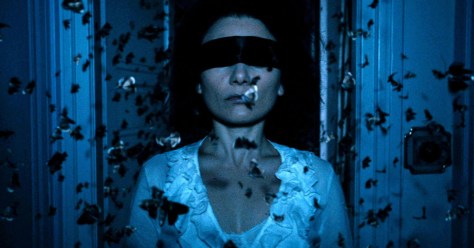
WHY IT WON’T MAKE THE LIST: Though the subject matter might seem strange or unusual to some viewers, the film itself is simply an examination of two women who are going through a trial in their relationship. There is some bizarre dream imagery and a choppy narrative style, but nothing truly Weird.
COMMENTS: The Duke of Burgundy opens with a drawn-out sexual role play as the wide-eyed Evelyn (Chiara D’Anna) enters the house of domineering mistress Cynthia (Sidse Babett Knudsen) to act as housekeeper. Evelyn scrubs and shines and soaks as Cynthia thinks of more demeaning tasks for her to do, ending the day with punishment for unsatisfactory work in the form of urination into Evelyn’s mouth. This scene returns in multiple forms later, as we see different perspectives and points in time, serving as an anchor for our understanding of their relationship. The film unfolds over a semester at the isolated women’s school where Cynthia lectures and Evelyn studies, but most of the focus is on their private moments at home. As the persistent Evelyn comes up with new ways to be dominated, she believes she’s found the perfect partner in Cynthia, who is willing to act the dominatrix if it makes her lover happy. However, it soon becomes clear that the older woman is uncomfortable with the parts Evelyn creates for her, struggling to emotionally and physically abuse her lover even in the context of role playing, and then growing to resent her for her increasing demands.
Strickland made waves two years ago with his stunning, unnerving ode to giallo, Berberian Sound Studio, in which a British sound technician sinks into a paranoid fever dream while shooting a gory horror in Italy. Here, the director again treats the eyes to a sultry palette, ornate settings, and thoughtful camerawork, matched by an effective soundtrack that pairs fuzzy synths with the hum of insects. The opening credits use freeze-frame and oversaturation to reference vintage softcore film, but thanks to the soundtrack and visceral color choices, other moments are more reminiscent of a slasher. The retro vibe is heightened by the somewhat ambiguous setting and time period. Fashions and hairstyles suggest the 1950s or 60s, the aesthetic is more 70s, the landscape and architecture is classical, evoking rural Italy (though filmed in Hungary), and everyone speaks English with different European accents. He clearly devotes much of his time to mixing and matching different film references, from art house to grindhouse, but ultimately the focus is on the characters. Even the weirder touches, including frequent close-ups of insects and stark shots of architecture, are meant to communicate the sense of dread that is hanging over Cynthia and Evelyn’s relationship as they move into darker sexual territory. There is a palpable feeling of intimacy in Strickland’s approach, utilizing close-ups and lingering shots to effect a kind of quietude over most of the proceedings. It is easily to believe in this relationship, though the world around them is often hazy.
On paper The Duke of Burgundy sounds like it should be a sleazy straight male fantasy about lesbian kink, and yet Strickland forgoes all sensationalism—there isn’t that much (explicit) sex or even nudity shown. Evelyn’s mental stimulation is highlighted, as she derives pleasure from being locked in a chest, verbally berated, and sat on by Cynthia. The BDSM scenes are often treated with humor, not to make fun of those practices but to reveal the kind of goofy accidents or strange conversations that might come with it, and to break the tension for an unfamiliar audience. At other times they are presented in a cold, almost sterile manner, with Cynthia eventually injecting a form of revenge into their role play. What is both wonderful and striking about this film is its undertone of normalcy, its relatable and honestly touching portrayal of a romantic struggle, despite its apparently sexploitative premise. The basic story could easily be rewritten with different conflicts, with different genders, with different settings; the BDSM elements are both central to the narrative and secondary to the overarching theme. The film asks if sexual preferences can damage an otherwise strong relationship, and if personal contentment can exist without complete sexual fulfillment. It allows us to peek into something extremely personal, but universal, intermingling with our own insights and experiences, with a dreamlike style so lush and distinctive we still walk away feeling like we’ve left behind a world of fantasy. It might not be List-worthy, but it is certainly worth seeing.
WHAT THE CRITICS SAY: