Tag Archives: 2010

CAPSULE: DAYDREAM NATION (2010)

DIRECTED BY: Michael Goldbach

FEATURING: , Reece Thompson, Josh Lucas, Andie MacDowell, Ted Whittall

PLOT: A teenage girl and her dad move to a small town populated with drug-addled teenagers and a mysterious serial killer. Feeling alienated and struggling to make friends, she sees a fellow intellectual outcast in her English teacher and decides to seduce him, while her bumbling classmate Thurston starts to fall for her.

Still from Daydream Nation (2010)

WHY IT WON’T MAKE THE LIST: Though its dark undertones, nonlinear format, and attempts to comment on the violence and sexiness apparently inherent to small-town teenagers have garnered comparisons to Donnie Darko and Twin Peaks, this is just an angsty, poorly-scripted knockoff with very little true weirdness.

COMMENTS: Narrated by the gorgeous Kat Dennings, who switches back and forth between her recent past and the present, Daydream Nation attempts to mesh poignant high school drama with erratic comedy and suburban darkness.  Caroline, our protagonist, is intelligent and disaffected, often sneaking in awkwardly sophisticated references that her peers don’t understand.  She embarks on a relationship with her teacher on a lark, in an effort to try something new and become a different person for a while; the unstable Mr. Anderson quickly becomes obsessively infatuated with her.  Their relationship falters as Caroline starts responding to the advances of Thurston (Reece Thompson), a druggie classmate mourning the recent death of a friend.  These core proceedings are surrounded by a lingering industrial fire, serial killings, parental interventions, and a ghost or two.

Seemingly shot entirely through a high-contrast haze, the film offers a few visual treats but nothing in the way of ingenuity.  The same can be said for the script, which has a few shining moments of interest but lingers in derivative mediocrity for most of the runtime.  Writer/director Michael Goldbach doesn’t seem to have much confidence in his ability to tell a story, inundating us with unnecessary amounts of narration and several needless plot devices.  The central character of Caroline—while played wonderfully by Kat Dennings—suffers the most. The best parts of the film involve her speaking her mind, calling out the hypocrisy and sexism of those around her, but these scenes are immediately followed by the character chastising herself in private, thinking herself a “bitch” just because she spoke the truth. It’s as if Goldbach wanted to write a strong female character, but then lost his momentum and copped out to typical gender stereotypes.

Daydream Nation aims for subtlety, but comes out with blaring obviousness thanks to the clumsy pacing and script. The performances from Dennings, Thompson, Lucas, and MacDowell are solid, but can’t save the ridiculous dialogue or self-indulgent shooting style (not that I’m complaining about the myriad drawn-out, close-up shots of Dennings, but really, it’s all a bit much). And it isn’t even that weird!

WHAT THE CRITICS SAY:

“…rolls elements of ‘Juno,’ ‘American Beauty,’ ‘Donnie Darko’ and ‘Twin Peaks’ into a potent blunt.”–Stephen Holden, The New York Times (contemporaneous)

90. BLACK SWAN (2010)

“It’s a Polanski movie, and then it becomes a Dario Argento movie. And maybe a little bit of David Cronenberg too.”–Vincent Cassell

Must See

DIRECTED BY: Darren Aronofsky

FEATURING: Natalie Portman, Mila Kunis, , Barbara Hershey, Winona Ryder

PLOT: Nina, a goody two-shoes ballerina, wants to dance the lead role in a production of “Swan Lake,” but although she’s perfect for the role of the White Swan, she lacks the seductiveness to portray the Black Swan. Lily, a sexy, irresponsible dancer newly arrived from a San Francisco troupe, becomes her primary competition for the part, but also helps her loosen up by talking her out on the town for a night of drinking and meeting guys. Nina starts physically break down and hallucinate as the stress of preparing for the role takes its toll; by opening night, she can’t distinguish reality from the story she dances of the princess trapped in the body of a swan who takes her own life.

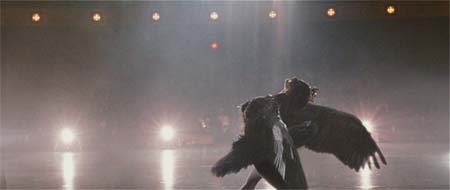
Still from Black Swan (2010)

BACKGROUND:

  • Natalie Portman danced many of her own parts, and actually dislocated a rib while dancing during the shoot. More difficult moves were performed by professional ballerinas, and for two sequences Portman’s face was digitally superimposed on dancer Sarah Lane’s body. There was a minor controversy over how much of the dancing Portman actually did herself and how much was performed by doubles; Aronofsky estimated that the actress executed more than 80% of the dance moves that appear onscreen.
  • Portman won the 2010 Best Actress Oscar for her role as Nina. The film was also nominated for Best Picture, Director, Cinematography and Editing.
  • Aronofsky received “The Understudy,” the original script that became Black Swan, while he was making Requiem for a Dream (2000). He described the script as Dostoevsky’s “The Double” meets All About Eve. Aronofsky combined that script, which was set in an off-Broadway production, with an idea he had to shoot a movie in the New York ballet world to create Black Swan.
  • Aronofsky and Portman had discussed doing a ballet movie together 8 years prior to shooting.
  • Made on a relatively small budget of about $12 million, Black Swan has grossed more than $300 million worldwide as of this writing.

INDELIBLE IMAGE: Nina’s “triumphant” onstage transformation into the Black Swan: as she pirouettes, feathers sprout from her arms, thickening with every swirl, until her limbs have been replaced by wings.

WHAT MAKES IT WEIRD:  Up until opening night, Black Swan is a backstage melodrama about backstabbing ballerinas, with an exaggerated, lurid psychopathology that’s thrust even further over-the-top by lesbian love scenes, hints of horror, and mirrors, mirrors, mirrors.  When the curtain rises on the big night, we experience the performance through the subjective perspective of an overworked, paranoid, demented dancer, whose psychology has been shattered by the film’s sledgehammer symbolism.  No avant-grade choreographer could stage as disorienting a “Swan Lake” as the one she hallucinates for us through her obsessed eyes.

Promotional Music Video for Black Swan

COMMENTS: Black Swan is the weirdest movie ever to win a major Academy Award (Natalie Continue reading 90. BLACK SWAN (2010)

366 UNDERGOUND: SLIMED (2010)

366 Underground is an occasional feature that looks at the weird world of contemporary low- and micro-budget cinema, the underbelly of independent film.

DIRECTED BY: Eric Manche and Jeff Nitzberg

FEATURING:  Jordan Lee, Dustin Triplett, Jessica Borusky, Chris Gorges, Mewgen, Ben Powell

PLOT: Atheist park ranger Rock Rockerson is forced into an unlikely partnership with Bible

Still from Slimed (2011)

salesman PePe in an attempt to save his beloved national park, but they both accidentally discover a sinister and slimey conspiracy that threatens the entire world.

COMMENTS: This did not turn out anything like I expected.  What I expected was another clone of the Evil Dead 2/Troma-esque type of low-budget film, with nudity and pointless gore. Fortunately, Slimed turned out to be much lighter than that.  As a student project/calling card, it’s pretty OK, although at 60 minutes long it would be a much more effective film if it was either shorn about 2/3 of its running time, or had just gone for broke and added 15 more minutes or so to make a full feature.  A good portion of the film’s midsection (where the super-villain and his plan are revealed, leading to an escape and battle with child minions) goes on for far too long, time which could’ve been spent in more escapades with the main characters.

The highlights in terms of weirdness: there’s a magical gateway to a corporation guarded by a depressed wizard cat, the evil super-villain is a puppet mouse who believes he’s human, and his corporate minions are children who have the ability to fly like bats and who explode upon impact.  Additionally, the performances are deliberately skewed and exaggerated, but it comes from trying too hard, rather than any sort of intrinsic weirdness.  It’s like a would-be cult film looking for its cult members, but it’s definitely on the borderline of being a weird film.

Slimed official site

CAPSULE: DEAD AWAKE (2010)

DIRECTED BY: Omar Naim

FEATURING: Nick Stahl, , Amy Smart

PLOT: Haunted by the memory of a car crash, a lonely funeral assistant fakes his own

death. Tracking a mystery mourner, he finds himself tangled in intrigue while suffering from bizarre, piecemeal flashbacks from his discordant, seemingly supernaturally influenced past.

WHY IT WON’T MAKE THE LIST:  While Dead Awake captures our imagination at first with ominous flashbacks and peculiar visions which emphasize details in a way that foreshadow profound significance, none of these clues pan out to reveal an extraordinary plot.  The method of revelation builds interest in previous events that turn out to be not very mysterious once we are let in on their meaning.  Worse, at about the halfway point, the story becomes a derivative, conventional chiller.

COMMENTS:  The setup:  Nick Stahl plays sullen, skulking  funeral director who stages his own death to see if old friends will arrive at his funeral.  When an enigmatic young woman comes to mutter cryptic utterances over his “corpse,” he follows her and has some unusual misadventures.  In the meantime, he flirts with an ex-girlfriend who also came to his viewing, unlocking a cascade of strange memories and guilt about some mysterious, previous tragedy that broke them apart.  Eventually, we find out how both women are connected to  Nick’s past and to his haunting recollections.

Sounds like the makings of a real whiz-bang chiller-thriller, right?  Wrong!  What a massive disappointment. I was expecting something clever, brooding and supernatural like Dark Corners, and that’s how Dead Awake starts out. There is a mysterious car crash, a mortuary attendant faking his own funeral, a mysterious griever talking in riddles, indications that half the characters may be dead and not know it, and eerie flashbacks wrought with hidden symbolic meaning.

The non-linear plot, dark tone and twists and turns made me think I was in for a real doozy of a story.  And then the film peters out.  The flashbacks reveal no great mystery, the symbolism turns out to be arbitrary and empty, and real ideas are replaced with melodrama, over-acting and a grandiose musical score that is more fitting of a sweeping historical epic.  The score seems calculated to try to fool the viewer into thinking he is watching something more important than he really is (it didn’t work).

The movie wraps up with an unlikely stretch of a “climax” (more of an anti-climax) and a corny, happy (more like sappy) ending with a lame and very mild twist that opens up a bunch of plot holes.

I paid money for this???  I swear, no more poppy juice and Colt .45 before I read DVD jackets at the video store.

I saw that Nick Stahl was in this and so far, I have seen him in three other movies that turned out to be artistic, independent, and pretty good, so I took a gamble.  Mind you, Dead Awake is not a bad movie.  It doesn’t smack of major studio schlock.  The problem is that is promises to be so darned intriguing and then drops the ball, almost as if a writers strike led to someone with no imagination completing the script from the halfway point.

Rose McGowan, formerly a delicious woman, looks just . . . awful, post plastic surgery.

WHAT THE CRITICS SAY:

“A poorly structured and even more poorly shot mixture of a gothic suspense thriller with a vanilla romance filmed in Des Moines, “Dead Awake” never comes close to springing to life.”–Mark Olsen, The Los Angeles Times (contemporaneous)

Dead Awake trailer