Tag Archives: 1971

CAPSULE: DAUGHTERS OF DARKNESS (1971)

366 Weird Movies may earn commissions from purchases made through product links.

DIRECTED BY: Harry Kümel

FEATURING: Delphine Seyrig, John Karlen, Danielle Ouimet, Andrea Rau

PLOT: After marrying on a whim in Switzerland, Stefan and Valerie find themselves in a grand hotel where the mysterious Countess Báthory and her companion Ilona are the only other guests.

COMMENTS: It’s just as well that Olstend’s “Grand Hotel Thermes” is nearly empty during the off season—its cavernous hallways, regal stairways, and spacious suites can barely contain the thick layers of Eurotrash that pile up the moment Stefan, Valerie, the Countess, and her “secretary” come in from the rain. This gang of sex-dripping ’70s stereotypes jostle with one another for the title of Maximus Libidinosus. Is it the new bride, Valerie, often topless and presenting an innocence that belies her eagerness? Is it creep-hunk Stefan, who nearly loses it when recounting the sadistic methods of a medieval Hungarian noblewoman? Is it deer-in-headlights Ilona, when she lingers in the nude outside of Valerie’s window the first night she meets her?

No, no, and no. This is Countess Elisabeth Báthory’s party, despite the fact she doesn’t appear until the second act. Aged somewhere between twenty-five and one-hundred or more, this long-lived, ever-beautiful femme out-fatales all the wavy-haired blonde bomb-shells that came before her. With cryptic mannerisms and more-cryptic asides, Delphine Seyrig owns the screen whenever she graces it, for better or worse. The jalopy of a plot putters along with just enough horsepower to sustain its goings on, which themselves have just enough obligatory allusions to a story that it could be argued to have one. But Daughters of Darkness is allegory, and a very lesbian kind of allegory. The “V” of seduction (with the Countess at the hub) may just as well conjure the word “vaginal”… or, if one is so inclined, “vampyre.” This is a gloriously shameless exploration of sapphic love, layered thick with electronic musical cues, heightened acting, colored lighting, and, whenever the filmmakers remember it, arcane overtones.

It’s a good midnight movie, with an atmosphere you could hang a heavy jacket on. But it is a product of its time, and its budget. Amidst the array of sensuality, sex, and sadism, there is one item that stands out, and which remained, perhaps woefully, underexplored. A key plot point—and impending film spoiler—involves Stefan’s reticence in telling his mother that he has married a young woman in Switzerland. The excuse for this trepidation is that his family is very aristocratic, and his mother would be damned before recognizing such an off-the-cuff flight of matrimonial whimsy. However, we finally meet Stefan’s mother at the film’s halfway point, and find him to be not quite what we might expect. A middle-aged man, in a woman’s lounging dress, decorated in make-up, reclining on a hammock in the middle of a conservatory. He describes Stefan’s wedding gambit not so much as inappropriate as “unrealistic”. Who is this? What are he and Stefan? And how about that butler kneeling for a much-appreciated pat on the head upon delivering Mother the telephone? No matter. Within moments, we’re back to the gauzy layers of obvious questions weaving gracefully around this new and unexpected one. Class, discuss.

Blue Underground released a remastered special edition Blu-ray of Daughters of Darkness in 2022 with three separate commentary tracks and numerous special features.

WHAT THE CRITICS SAY:

“Strange and beautiful, it’s a perfect cocktail of the weird, the horrible, and the oh-so-sexy. “–Cait Kennedy, But Why Tho? (2020 festival rerelease)

CAPSULE: THX 1138 (1971)

366 Weird Movies may earn commissions from purchases made through product links.

“You are a true believer, blessings of the State, blessings of the masses. Work hard, increase production, prevent accidents, and be happy!” — automated life coach booth in THX 1138

Recommended

DIRECTED BY: George Lucas

FEATURING: , , Maggie McOmie,

PLOT: A citizen of a future dystopia rebels against his society and must flee the consequences, hobbled by the people he genuinely cares about.

Still from THX 1138 (1971)

COMMENTS: The first thing we must do is firmly separate the subject of THX 1138‘s creator from the discussion of THX 1138. That alone makes this a challenging movie to view objectively. We’re here today to decide whether THX 1138 is a weird movie. Would the discussion be the same if its famous director wasn’t also the guy who made Star Wars?

George Lucas sows creative seeds here which will later bear fruit in Star Wars. The legions of android cops who chase the title character and company around brings to mind future Stormtroopers; their shiny metallic faces would later update into the countenance of C-3PO. The society is that of a hivemind of stoic drones, like many worlds in the Star Wars universe. Lucas, the world’s champion in the Second-Guessing-Yourself Olympics, would re-release new cuts of THX 1138; new versions opened with a brief trailer for the classic serial Buck Rogers series, which Lucas indicated was a huge influence on Star Wars (as if we couldn’t guess).

When it comes to THX 1138, Buck Rogers is far from its main influence. THX 1138 is about a futuristic dystopian society where one citizen rebels and tries to either escape the system or bring it all crashing down. Other movies in this genre using this exact same story template include (*deep breath!*): Metropolis, The 5,000 Fingers of Dr. T,  Alphaville, Fantastic Planet, Brazil, Akira, Zardoz, The Apple, Snowpiercer, High-Rise, The Platform, and Greatland, just to mention a few already reviewed here. Now consider the literature: “1984,” “Brave New World,” and the never-adapted, shamefully underrated Ira Levin novel “This Perfect Day.” These literary works share a ton of DNA with THX 1138.

The dystopian genre produces both some of mainstream cinema’s most beloved masterpieces and some titles from the crème de la crème of the List. But it’s been done. Every kind of batty off-the-wall dystopia idea has been done ten times.

So THX 1138 fails at originality. However, it is strong in execution. Like all the great sci-fi classics from the mid-20th century, it has a distinct look and feel all its own. The movie’s entire society is housed underground, so it has a claustrophobic mentality from start to finish. Even though it’s a color film, the palette is, pathologically, a glaring white with gray and black accents. Everyone is shaved skinhead-bald, regardless of gender, which together with the pure white pajamas they wear makes them all appear like laboratory rats frantically Continue reading CAPSULE: THX 1138 (1971) →

CAPSULE: THE POINT (1971)

366 Weird Movies may earn commissions from purchases made through product links.

Recommended

DIRECTED BY: Fred Wolf

FEATURING: Voices of Ringo Starr, Mike Lookinland, Lennie Weinrib,

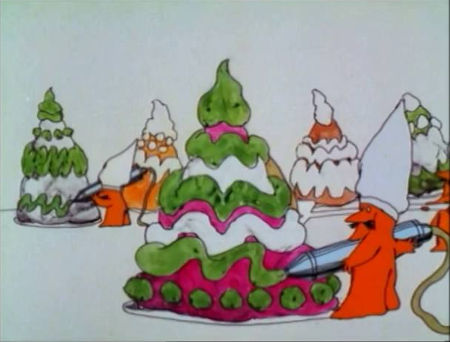
PLOT: The Pointed Village is going about its business, as it has for as long as anyone can remember, with pointed people making pointed buildings and pointed goods, until Oblio, a round-headed boy, is born.

Still from The Point (1971)

COMMENTS: I can tell you from experience that The Point is a good way to get on the path toward discovering, discussing, and dissecting weird movies. During my formative years, I watched it again and again (though at the time, I must admit that I was frightened by one of the sequences, therefore using the fast forward button regularly). As with so much of what 366 reviews, in my less aware moments I’d regard this Nilssonian flight of fancy as “normal,” but it is in actuality a strange combination of children’s cartoon and beatnik daydream.

In fine musical style, we are introduced to the “Land of Point”: more specifically, the Pointed Village, the town where everbody’s got ’em (and couldn’t do without ’em). Couched in the framing story of a father (voiced by Ringo Starr at his most paternal) reading to his son (Mike Lookinland), The Point concerns Oblio (also Lookinland), a boy born without a pointed head. Oblio makes the mistake of making a fool of the Count’s bully son in a game of Triangle Toss. When the defeated youth complains to his powerful father, a sham trial results in Oblio’s banishment to the “Pointless Forest.” Oblio’s adventures (with his trusty dog Arrow by his side) bring him in contact with a magical assortment of guides—beatnik Rock Man, capitalist-extraordinaire Leaf Man, the bouncing Jelly Women, among others—and he learns that nothing is without a point.

Nilsson’s concept album is primarily a vehicle for his catchy and charming songs concerning love, life, and death. Fred Wolf’s movie alternates between straight-up story (marked by Starr’s narration) and song animations. This coexistence is impressively seamless, as the tunes bring Oblio’s contemplations to life. Some of them are heady things for a small boy—one of the things that kept me coming to this, aside from my limited video menu at the time, was that it didn’t speak down to me—and in its post-psychedelic way, everything has a fresh, oddball feel to it. Watching it again for the first time in decades, I also noticed the many odd things the filmmakers got up to: drug culture (the Rock Man character, both as a whole, and particularly with the line, “us stone[d] folks are everywhere”), anti-capitalism (the ridiculousness of the “leaf manufacturing” Leaf Man), right down to the strangely vulvic foliage where the fat, naked, jolly Jelly Women cavort mischievously.

With its minimalist-but-quirky animation (and gloriously pointo-gothic-brutalist architecture), mental digressions (contemplating a tear’s life cycle through an ancient whale), and moments of Shakespearean grandeur (the villainous Count could be Iago’s closest friend), The Point hits a lot of great notes, particularly for a primetime-broadcast, made-for-TV cartoon. That such a quirky little movie like this slipped past the watchful eye of the normality police makes it all the more laudable.

Previously available on DVD, MVD Rewind released The Point on Blu-ray in 2020. Although full of extra features and billed as “The Ultimate Edition,” many hardcore fans were disappointed that it lacks the original Dustin Hoffman broadcast narration (Hoffman’s contract was for a one-time performance, and subsequent broadcasts and home video releases used different narrators).

WHAT THE CRITICS SAY:

“Whether Wolf, best known for his work on The Flintstones, took inspiration from Dr. Seuss, I couldn’t say, but there’s a similar sensibility at work in terms of the quasi-surrealistic look of the thing… It’s that unique combination of the expectedly childlike, the surprisingly adult, and the just-plain weird that makes The Point! work as well for me now as it did in grade school when I’d play the album over and over again, flipping the pages of the illustrated booklet all the while.” -Kathy Fennessy, Seattle Film Blog

(This movie was nominated for review by Jeffery, who commented “My favorite scene in it is the one with the fat ladies.” Suggest a weird movie of your own here.)

CAPSULE: LET’S SCARE JESSICA TO DEATH (1971)

366 Weird Movies may earn commissions from purchases made through product links.

DIRECTED BY: John D. Hancock

FEATURING: Zohra Lampert, Barton Heyman, Kevin O’Connor, Mariclare Costello

PLOT: Jessica is fresh out of the psych ward after a mental illness when her husband moves her out to the New England countryside, but the house they have purchased and the surrounding town have a Dark Secret™️.

Still from Let's Scare Jessica to Death (1971)

COMMENTS: Let’s Scare Jessica To Death (1971) is the directorial debut of John Hancock; nothing in his career would resemble anything like this movie ever again. Reportedly the script was originally written as a satire of horror movies, but Hancock wanted it reworked as a serious horror movie inspired by psychological thrillers like The Turn of the Screw and The Haunting of Hill House. Horror veterans may groan at this point, because movies like The Incredible Shrinking Man (1957) taught us that converting a horror satire into straight horror is a precarious proposition. Amazingly, this movie outshines these modest expectations as well as its low budget—though not by much. It’s a dubious mix of giallo and Gothic set in a Connecticut location just south of Lovecraft country. True to Hancock’s aim, the tone does land somewhere between Shirley Jackson and Howie P. Right from the opening monologue, we have the title character adrift in a rowboat raving madly to herself while Atlantic seagulls fuss off-screen, followed by our opening theme in somber piano notes. You’ll be double-checking to see if Aaron Spelling produced this for TV.

Jessica (Zohra Lampert) is a bubbly gal recently released from the mental hospital, whose hobby is riding around in the back of a hearse touring cemeteries so she can do charcoal rubbings of headstones—but don’t worry, she’s going to be right as rain! Her concerned husband Duncan (Barton Heyman) has bought a home out in the country for her, based on the old “fresh air and simple living” cure for the mentally twitchy. Duncan’s buddy Woody (Kevin O’Connor), along to help them move in, ends up staying on. Despite the fact that Jessica hears voices in her head every two seconds and sees phantoms that disappear in the space of a jump cut, she’s optimistic for her recovery. The strawberry blonde vagrant they discover squatting at this home when they move in (you better believe she’s revealed with a jump scare) isn’t helping matters any. Emily (Mariclare Costello) offers to pack her things and hit the road, but Jessica begs her to stay for dinner, then indefinitely. No sooner does Emily play her guitar over after-dinner wine (Duncan is a retired Philaharmonic orchestra player, so he brings out his double-bass for accompaniment) than Woody puts the moves on her. You see, this clan is set up to be hippies, or at least part of the counterculture, although the usual Hollywood portrayal of Flower Children is muted Continue reading CAPSULE: LET’S SCARE JESSICA TO DEATH (1971) →

CAPSULE: GODZILLA VS. HEDORAH (1971) AND THE “GODZILLA: THE SHOWA-ERA FILMS, 1954–1975” BOX SET

366 Weird Movies may earn commissions from purchases made through product links.

DIRECTED BY: Yoshimitsu Banno

FEATURING: Akira Yamauchi, Toshie Kimura, Hiroyuki Kawase, Toshio Shiba, Keiko Mari

PLOT: Hedorah, a monster created from earth’s excessive pollution, wreaks havoc on Japan.

Still from Godzilla vs. Hedorah (1971)
COMMENTS: “Hedorah is a monster of our own making.” In the intro we see Hedorah rise from some sludgy gloop floating in the ocean. The creature attacks freighters and factories and at the same time inhales the pollution they emit to grow larger and more powerful. A young boy and his marine biologist father are on the case, and soon discover the origins of the creature and why and how it is evolving.

The child is the film’s protagonist. He seems to have a connection with Godzilla. He knows Godzilla is coming before he appears. Like the original 1954 Godzilla, Godzilla vs. Hedorah comes with a strong message about the harm man can do: Godzilla was awoken by hydrogen bomb tests, Hedorah is an alien being made massive and powerful by pollution.

At this point in the Godzilla series, the King of the Monsters has been both an enemy of mankind, and sometimes somewhat of a hero. At the story’s climax walls of electricity are set up in hopes of frying Hedorah. When the generator fails, Godzilla lends man a hand with his breath. As a child, I loved Godzilla as the hero; it’s something I’ve never grown out of.

There is, of course, also a final battle between the two creatures. If you come to Godzilla flicks for the creature fights, you will be rather disappointed here. This Godzilla reminds me a little of one of the Three Stooges putting on goofy moves, shrugging and shuffling about. And Godzilla flying through the air?! What was that? I suppose Hedorah would be a slippery sucker to grab at, being a pollution monster. He starts out looking like a giant sperm, but evolves into a flying saucer shape, and eventually takes an upright form. Hedorah is not one of Toho’s more effective monsters, visually, but he does more damage than most.

Godzilla vs. Hedorah is a unique entry among the Godzilla Showa era films. It is the only film in the series that I am aware of that includes psychedelic imagery and animated sequences. These elements are unusual for Godzilla, but there is nothing particularly weird about them for a film from the late 1960s or early 1970s.

Godzilla vs. Hedorah has its goofy moments, but at times is actually quite grim. The poisonous toxin emitted by Hedorah kills instantly and the film has a significant body count . The harsh message of the animated sequences gives the pleasing and colorful animation a disturbing quality. I loved the addition of animation.  I also loved the attractive young couple they added in as secondary characters. All the Continue reading CAPSULE: GODZILLA VS. HEDORAH (1971) AND THE “GODZILLA: THE SHOWA-ERA FILMS, 1954–1975” BOX SET →