STANLEY KUBRICK’S THE SHINING (1980)

There is a story, possibly apocryphal, which claims that telephoned author Stephen King shortly before filming commenced on The Shining (1980). Allegedly, Kubrick asked King: “Do you believe evil exists, as an entity?” “Yes, I do,” King answered. “Well, I don’t,” Kubrick replied as he slammed down the phone. According to the anecdote, King then knew his pulp novel had been “taken away” from him. His budding 1980 fan base agreed, feigning outrage at cinematic liberties Kubrick was to take. Despite King’s fans, The Shining was largely a hit with audiences and critics, though hardly unanimous. Since then, it has developed an epic cult reputation and is considered by many to be one of the greatest horror films of all time. As per the norm with extreme opinions, both views are off-kilter.

Underrated by literary critics and overrated by housewives, Stephen King was already a household name by 1980, and a film version of his novel about a possessed hotel was inevitable. What King was not prepared for was a forceful filmmaker with his own ideas. To be certain, this is Stanley Kubrick’s Shining, not King’s, and for that we can be thankful (King later proved the point in a dreadfully faithful 1997 television remake).

In Kubrick’s The Shining, the face of evil is not the hotel. Rather, it is the bourgeoisie husband/father Jack Torrance (), with the Still from The Shining (1980)hotel standing as an obvious symbol for man’s eternal evil. That very simple decision confused the hell out of its hyper-linear 1980 audience, although contemporary viewers seem less troubled by it. Yet, there are drawbacks; Kubrick does not make good on all of his promises. There is no substantial character arc for Jack. He is most interesting in the first half before being reduced to a monotone Looney Tune archetype. In sharp contrast, his wife Wendy () emerges from her bedside banality, like a figure jumping off a Symbolist canvas, to become a torrent. Channeling modernist painters (Gustav Klimt, Egon Schiele, Amedo Modgiglini) is a recurring Kubrick theme. Casting Duvall was shrewd. Footage from a “making of” documentary  reveals Kubrick was tyrannical when directing her. It paid off.  Unfortunately, the development of the patriarchal antagonist is not as layered. Kubrick fails to reign in Nicholson, whose character solicits identification and sympathy only from the film’s thug demographic (much in the same way that the Al Pacino’s Tony Montana does). In painting Jack two-dimensionally, Nicholson and Kubrick open wide the door of identification for simpletons. The film falters in allowing the ink to dry on Jack. The banality of evil theme is as subtle as the second half of Nicholson’s performance, but of course, Kubrick’s The Shining is not relegated to a single character.

Kubrick’s The Shining is a far more complex machine than the source Continue reading STANLEY KUBRICK’S THE SHINING (1980) →

222. SPIRITED AWAY (2001)

Sen to Chihiro no Kamikakushi

“It was just too bizarre.“

“Honestly, when I watched Spirited Away for the first time back in 2008, I didn’t like it for the same reason as you. I just found it too weird.”

–IMDB message board dissenters on Spirited Away

Must See

DIRECTED BY:

FEATURING: Voices of Rumi Hiiragi, Miyu Irino, Mari Natsuki; , Jason Marsden, (English dub)

PLOT: While moving to a new town, ten-year-old Chihiro and her parents take a detour to a seemingly abandoned amusement park in rural Japan. Once the sun sets, the park transforms into an otherworldly resort for spirits and gods overseen by the cruel witch Yubaba. Now separated from her parents, Chihiro must learn to survive among an array of weird creatures as she attempts to reunite her family and return home.

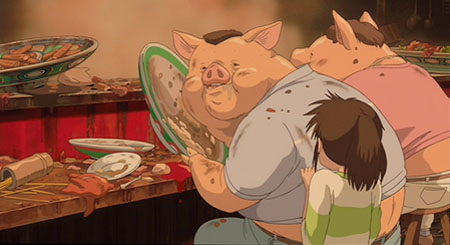
Still from Spirited Away (2001)

BACKGROUND:

  • Hayao Miyazaki had announced his retirement from feature filmmaking in 1998, after completing Princess Mononoke. He came out of retirement in 2001 to make Spirited Away.
  • Disney Studios had distributed Studio Ghibli’s previous film, Princess Mononoke, in the United States, with disappointing results. They put little money into marketing the film, but strong reviews and word of mouth turned it into a hit, and Disney’s partnership with Ghibli was cemented from that point on.
  • Spirited Away won the Academy Award for Best Animated Feature (along with 52 wins granted by other organizations).
  • Spirited Away is the highest-grossing film of all time in Japan.
  • Hayao Miyazaki had announced his retirement from feature filmmaking in 2001, after completing Spirited Away. He came out of retirement in 2004 to make Howl’s Moving Castle.

INDELIBLE IMAGE: Lured into the park by a delicious scent, Chihiro’s parents come upon a vacant restaurant filled with sumptuous, exotic dishes. The two immediately begin to fill their plates, ignoring their daughter’s worries that they’ll be punished for taking the food. After the park begins its transformation, Chihiro returns to find her parents bloated and hunched over piles of scraps. She tries to warn her father about what is happening, but when he looks at her she sees only the sweating, engorged face of a pig. The grunting pig ignores Chihiro and climbs over the restaurant’s counter, only to be swatted away by an unseen figure’s reptilian arm. The pig then crashes to the ground with a primal squeal, frightening Chihiro as she cries out for her parents and runs into a street filled with tall, anonymous ghosts.

THREE WEIRD THINGS: Pig parents; “No Face” eats; three heads and a giant baby

WHAT MAKES IT WEIRD: In Spirited Away, Hayao Miyazaki plays on the normal fears of lost children as the basis for an outlandish, frightening fantasy about a young girl being thrust into the incomprehensible life of an adult. The imagination of the setting is so immense that it seems to dwarf the film itself, suggesting a fully realized universe of magic and monsters with borders that extend far beyond the frame of the story.


Disney Trailer for Spirited Away

COMMENTS: Spirited Away begins with the main character, Chihiro, Continue reading 222. SPIRITED AWAY (2001) →

CAPSULE: THE SUICIDE THEORY (2014)

DIRECTED BY: Dru Brown

FEATURING: Steve Mouzakis, Leon Cain

PLOT: A suicidal man hires a hitman to off him, but there’s a catch: the intended victim claims he’s under a curse and can’t be killed, and he miraculously survives every attempt on his life.

Still from The Suicide Theory (2014)

WHY IT WON’T MAKE THE LIST: The Suicide Theory is a psychological thriller with an intriguing Twilight Zone-ish premise, but it’s not weird enough by a long shot.

COMMENTS: A hitman who can’t kill and a suicidal man who can’t die star in a psychological thriller that can’t… wait, we’ll cut that gibe short, because although The Suicide Theory doesn’t ultimately hit the mark it aims at, there is enough here to count as an interesting attempt. First, there is the macabre scenario, which offers opportunities for moments both chilling and blackly comic. Even more beneficial are the performances by the two leads, who forge a bond that is both sick and touching. Steve Mouzakis’ troubled assassin come off like a seedy, psychotic . Leon Cain’s role is less demonstrative, but the desperate resignation he shows as a suicidal immortal provides the appropriate counterpoint to Mouzakis’ fury.

That said, The Suicide Theory has a script whose ambitions exceed its ability to meet them. Although plot strands meet up at the end, they are more crammed into place than flowing together naturally. The resolution works, in one sense, but it doesn’t wholly satisfy, either on a literal level or a metaphorical level. Potential plot holes come to mind. If Steven were truly as ruthless as portrayed, it seems like there are at least a couple of more severe, less avoidable options for disposing of Percy that come to mind: decapitation, for example, or dissolving his body in acid. An arbitrary rule (Percy’s “theory”) requires Steven to spend time getting to know his victim; a useful contrivance from a dramatic standpoint, but it’s not successfully sold to us as a necessity. The story also arguably goes one twist to far at the end, and ultimately, the lattice of guilt the film proposes can’t support the weight of the premise. A great setup, and well-acted, but it runs out of steam at the end; it doesn’t slay, but call it a near-miss.

WHAT THE CRITICS SAY:

“…a contrived but weirdly compelling thriller…[l]arded with bizarre twists…”–Justin Chang, Variety (contemporaneous)

(This movie was nominated for review by “michael.” Suggest a weird movie of your own here.)

CAPSULE: BURNT OFFERINGS (1976)

366 Weird Movies may earn commissions from purchases made through product links.

DIRECTED BY: Dan Curtis

FEATURING: , Oliver Reed, Lee Montgomery,

PLOT: A family of three, and their elderly aunt, find a deal allowing them to stay in an old country mansion for the summer, providing they keep the place up and leave out a plate of food for the house’s reclusive matron, who never leaves her room.

Still from Burnt Offerings (1976)

WHY IT WON’T MAKE THE LIST: It’s too mild, with some slight ambiguity but no significant weirdness.

COMMENTS: Burnt Offerings was the beginning of a late 1970s/early 1980s haunted house cycle that encompassed three Amityville Horror movies; the mini-movement climaxed commercially with 1982’s Poltergeist and artistically with 1980’s The Shining. In fact, Offerings is most interesting when considered as a precursor to The Shining, which would take its theme of a parent possessed by an evil spirit and catapult it into the horror stratosphere. Offerings, on the other hand, suffers from poor pacing. It’s too leisurely getting started: it’s over a half hour into the film before we see the first incident which might be categorized as “supernatural.” Up until then, the focusing on spooky shots of light bulbs while horror movie music plays just doesn’t cut it. Even when things do finally start to happen—swimming pool roughhousing that gets dangerously out of hand, a recurring nightmare about a smiling chauffeur—events occur in fits and starts, with husband and wife spending the interim discussing how each previous manifestation of evil is affecting their relationship. Offering a few creepy moments along the way, the movie crawls to a non-surprise ending.

The film’s biggest virtue is its cast. Karen Black, by now no longer a sex kitten but not yet a matron, centers the film. Her sensuality is perfectly constrained, and we are not surprised at hints that the couple’s sex life may be well past the honeymoon phase. Son Lee Montgomery is acceptable; he doesn’t sink the film, which is the most you can really hope from a young actor. Bette Davis is unremarkable here, but she is Bette Davis; her very presence adds legitimacy. Of all the actors, Reed may understand the material’s urge vto break through into camp the best; the moments when his face goes spastic as he fights off the evil inside him give it the film some melodramatic tics of life.

Burnt Offerings was based on a 1973 novel by Robert Marasco, although director Dan Curtis (of TVs “Dark Shadows” fame) rewrote it significantly. The movie was not a critical success, but it has a small but devoted fan base (probably enough to categorize it as “fondly remembered,” but below the threshold that would make it a true cult movie). The 2015 Blu-ray contains a number of new interviews with the surviving cast and adds a new commentary track from critic Richard Harland Smith to the old one from Curtis, Black and co-writer William F. Nolan that has been ported over from the DVD release.

WHAT THE CRITICS SAY:

“Most of the cliches of the Gothic genre are encompassed in the plot about Karen Black, Oliver Reed, Bette Davis, and young Lee H. Montgomery having a weird summer after moving into a home owned by batty Burgess Meredith and Eileen Heckart… might have been interesting if director Dan Curtis hadn’t relied strictly on formula treatment.”–Variety (contemporaneous)

(This movie was nominated for review by “sunspotbaby.” Suggest a weird movie of your own here.)

Burnt Offerings (Special Edition) [Blu-ray]
  • This terrifying thriller does for summer homes what Jaws did for a dip in the surf

Celebrating the cinematically surreal, bizarre, cult, oddball, fantastique, strange, psychedelic, and the just plain WEIRD!