Category Archives: Canonically Weird (The List)

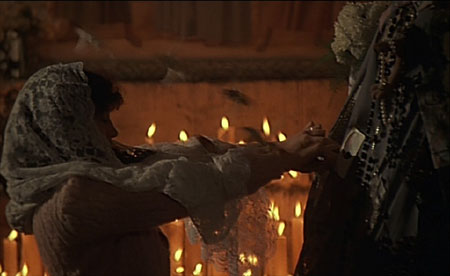
26. THE MILKY WAY [LA VOIE LACTEE] (1969)

“Think not that I am come to send peace on earth: I came not to send peace, but a sword.

For I am come to set a man at variance against his father, and the daughter against her mother, and the daughter in law against her mother in law.

And a man’s foes shall be they of his own household.”–Matthew 10:34-36

DIRECTED BY: Luis Buñuel

FEATURING: , Laurent Terzieff, Bernard Verley, Edith Scob, ,

PLOT:  Two tramps follow the ancient pilgrimage road leading from France to the Spanish city of Santiago de Compostela, where the bones of the apostle James are supposed to be interred.  Along the way they meet strange characters from various times who debate ancient Catholic heresies, a child with a stigmata, an angel of death, and a nun voluntarily undergoing a crucifixion.  Also scattered throughout the film are recreations of fictional and historical events, including dramatization of an Inquisition trial, a cameo by the Marquis de Sade, and scenes from the Gospels.

milky_way_coie_lactee

BACKGROUND:

  • In retrospect, director Luis Buñuel realized that The Milky Way formed the first part of a trilogy about “the search for truth” along with The Discreet Charm of the Bourgeoisie (1972) and The Phantom of Liberty (1974). The subsequent two films use the same fragmented, non-linear narrative style pioneered in The Milky Way.
  • The film is exhaustively researched, with many of the episodes composed of direct quotes from the Bible or the writings of heretics.
  • Released while the general strike and student protests of May 1968 were still fresh in France’s mind and a spirit of liberal revolution was in the air, some leftists were not happy that one of their own had chosen this moment to make a non-political film about the history of heresy in the Catholic church.  According to anecdote, Buñuel’s novelist friend Julio Cortazar accused the director of having completed the film with financing from the Vatican.
  • Although the film is often blasphemous on its surface, it was well-received by the Catholic Church, who even intervened with the Italian censors to reverse their decision to ban the film.  This was an unexpected reaction, as the Vatican had declared Buñuel’s 1961 film Viridiana “blasphemous”.
  • With its large, almost epic cast, it’s inevitable that several French actors with significant contributions in the weird movie arena appeared in cameo roles, including Delpine Seyrig (Last Year at Marienbad) as a prostitute, Julien Guiomar (Léolo) as a priest, and Michel Piccoli (La Grande Bouffe, Dillinger is Dead) as the Marquis de Sade.

INDELIBLE IMAGE:  The execution of a pope by a gang of anarchists, a scene that leads to the film’s funniest and most unexpected punchline.

WHAT MAKES IT WEIRD:  In The Milky Way two worldly pilgrims make their way through a strange, heresy-obsessed world in which every maître d’ is an expert theologian and Renaissance fops duel to the death over arcane philosophical doctrines, while any random stranger they meet may actually be God, an angel, or the fulfillment of a recent prophecy.

Hollywood-style VHS trailer for La Voie Lactée

COMMENTS:  Of all the great directors, Luis Buñuel was the greatest prankster.  His son, Continue reading 26. THE MILKY WAY [LA VOIE LACTEE] (1969)

25. NOSTALGHIA (1983)

366 Weird Movies may earn commissions from purchases made through product links.

“I wanted the film to be about the fatal attachment of Russians to their national roots, an attachment which they will carry with them for their entire lives, regardless of where destiny may fling them.  How could I have imagined as I was making Nostalghia that the stifling sense of longing that fills the screen space of that film was to become my lot for the rest of my life; that from now until the end of my days I would bear the painful malady within myself?” –Andrei Tarkovsky, Sculpting in Time

Recommended

DIRECTED BY: Andrei Tarkovsky

FEATURING: Oleg Yankovskiy, Domiziana Giordano, Erland Josephson

PLOT: Andrei is a Russian poet is traveling around Italy in the company of a fetching translator, researching a biography of a Russian composer who studied in Italy before returning to Russia only to drink and kill himself.  Andrei becomes homesick and bored with the project, and with life in general, until he becomes fascinated by a insane man living in a small town famous for its natural mineral baths.  The madman gives him a simple symbolic task to perform—which Andrei procrastinates in completing— then leaves for Rome on a mission of his own.

Still from Nostalghia (1983)
BACKGROUND:

  • Tarkovsky was considered one of the finest filmmakers in the Soviet Union; he frequently ran into difficulty with the Soviet censors, however, particularly for his Christian viewpoints.  Although his films won acclaim at international film festivals, they were often shown to limited audiences in edited versions in his own country.  Work on the historical epic Tarkovsky was helming prior to Nostalghia had been halted by the Soviet censorship board because of scenes seen as critical of the state’s policy of official atheism.
  • Nostalghia was the first film Tarkovsky made outside the Soviet Union.  Originally intended to be a Soviet/Italian co-production, the state-owned USSR film production Mosfilm withdrew financial support for the project without comment after filming had already begun.
  • The film competed for the Palme d’Or at Cannes, but was awarded a special jury prize instead.  Tarkovsky claimed that the Soviet contingent applied pressure to assure that the film would not be awarded the grand prize.
  • Tarkovsky defected to the West soon after Nostalghia was completed, leaving his wife and son behind.  They were eventually allowed to leave the country when he was diagnosed with lung cancer in 1986.  Rumors persist that Tarkovsky did not die of natural causes, but was actually poisoned by the KGB in retaliation for his defection.

INDELIBLE IMAGE:  There are many fine candidates.  The scene of Andrei attempting to carry a lit candle cupped in his hand across a drained spa may stick with the viewer, if not for its symbolism, then because it audaciously continues for over eight minutes.  But the final, static, picture postcard-like composition of a Russian homestead nestled inside an Italian cathedral perhaps captures Tarkovsky’s theme the best, and is shockingly beautiful, as well.

WHAT MAKES IT WEIRD:  The fluidity between the conscious and subconscious worlds. Although it’s almost always clear whether the events depicted actually occur or are imagined, Tarkovsky is much more interested in what is going on inside the heads of his alienated Russian poet and the Italian madman than in what is happening in the “real” world. He uses strong, sometimes obscure visual symbolism and dreams to convey an affecting mood of existential loneliness.


Trailer for Nostalghia

COMMENTSNostalghia can’t be approached without a word of warning: this movie is Continue reading 25. NOSTALGHIA (1983)

24. BEGOTTEN (1991)

“In BEGOTTEN, a time is depicted that predates spoken language; communication is made on a sensory level.”–E. Elias Merhige

RecommendedWeirdest!

DIRECTED BY: E. Elias Merhige

FEATURING: Actors from the experimental theater group Theater of Material

PLOT:  A man sitting in a chair disembowels himself with a straight razor.  A woman materializes from underneath his bloody robes, and impregnates herself with fluid taken from the dead body.  She gives birth to a convulsing, full grown man, and mother and son are then seized and tortured by four hooded figures bearing ceremonial implements.

Still from Begotten (1990)
BACKGROUND:

  • Each frame of film was painstakingly manipulated to create the distressed chiaroscuro universe of the movie.  According to the technical production notes, after the raw footage was shot, “…optimum exposure and filtration were determined, the footage was then re-photographed one frame at a time… it took over ten hours to re-photograph less than one minute of selected takes.”
  • It has been reported that the film was inspired by a near death experience the Merhige had after an automobile accident.
  • Critics from Time, Film Comment, The Hollywood Reporter, The Christian Science Monitor, and New York Newsday each named Begotten one of the ten best films of 1991.  Novelist and photographer Susan Sontag called it one of the ten best films of modern times.
  • After Begotten, Merhige went on to direct the music video “Cryptorchid” for Marilyn Manson (which reused footage from Begotten) before landing a major feature, Shadow of the Vampire (2000)–a horror film about the making of Nosferatu, starring Willem Dafoe as Max Schreck and John Malkovich as Murnau.
  • Begotten is intended as part of a trilogy of films.  A second film, Din of Celestial Birds, which deals with the idea of evolution rather than creation, has been released in a 14 minute version that is intended as a prologue to the second installment.
  • After its brief run in specialty arts theaters, including stints at the Museum of Modern Art and Smithsonian, Begotten received a very limited video release, first on VHS and then on DVD.  Merhige explains that this is because he does not believe that these formats are truly capable of reproducing the look he intended for the film:

    There are so many arcane, deeply intentional uses of grain, light and dark in that film that it is closer to Rosicrucian manuscript on the origin of matter than it is to being a “movie”…. When I finished the film I never allowed it to be screened on video because of how delicately layered and important the image is in conveying the deeper mystery of what the film is “about”… this is why it is no longer available on DVD until I find a digital format that is capable of capturing the soul and intent of the film.  My experiments in BluRay have been promising.

  • Nevertheless, a (bootleg?) Begotten showed up again on DVD in 2018.

INDELIBLE IMAGE: The painfully graphic image of “God disemboweling Himself” with a straight razor–shot in the grainy, high-contrast black and white–is not easily forgotten.

WHAT MAKES IT WEIRD:  A minimalist, mythic narrative of grotesque, ritualized suffering enshrouded in astonishing abstract avant-garde visuals and a hypnotic ambient soundtrack.  Love it, hate it, or admire the technique while criticizing the intent—everyone admits there is nothing else quite like it in our cinematic universe.

Original trailer for Begotten

COMMENTSBegotten is a difficult film to rate.  It does not set out to entertain, and it does not Continue reading 24. BEGOTTEN (1991)

23. THE LAIR OF THE WHITE WORM (1988)

366 Weird Movies may earn commissions from purchases made through product links.

“This fearful worm would often feed on cows and lamb and sheep,
And swallow little babes alive when they lay down to sleep.
So John set out and got the beast and cut it into halves,
And that soon stopped it eating babes and sheep and lambs and calves.”

–Lyrics to “The D’Ampton Worm” from Lair of the White Worm
Recommended

DIRECTED BY: Ken Russell

FEATURING: Amanda Donohoe, Hugh Grant, Catherine Oxenberg, , , Stratford Johns

PLOT:  An archeology student visiting the British countryside digs up an elongated skull he assumes belongs to an dinosaur while excavating the site of a buried convent, now an English bed-and-breakfast run by two young sisters.  Lord James D’Ampton is the boyfriend of one of the sisters, and also the descendant of a legendary D’Ampton who reputedly slew a dragon (the “D’Ampton Worm”) that had terrorized the countryside.  After wintering in climes unknown, slinky and regal Lady March returns to her mansion and discovers the skull, after which strange events begin to transpire…

Still from Lair of the White Worm (1988)

BACKGROUND:

  • Russell’s script was very loosely based on Bram (“Dracula”) Stoker’s 1911 novel, although the similarity almost ends with the shared title.
  • This was Russell’s second horror film in three years after Gothic (1986).
  • Hugh Grant had roles in six films released in 1988, including portrayals of Chopin and Lord Byron.
  • This was Amanda Donohoe’s second starring role in a feature film.  She went on to greater fame when she joined the cast of the hit T.V. show “L.A. Law” in 1990.  Catherine Oxenberg, on the other hand, had made a name for herself on the hit T.V. show “Dynasty,” and this was her first feature role in a theatrical release.

INDELIBLE IMAGE: A 30 second hallucination sequence featuring Roman soldiers raping nuns before a cross on which a monstrous worm slithers over a crucified Jesus while a topless blue vampire woman looks on joyfully, waggling her tongue.  The scene is dressed up in lurid colors and performed in front of a deliberately cheesy looking blue-screen inferno.  So over-the-top and parodic that it’s not nearly as offensive as it sounds.

WHAT MAKES IT WEIRD:  Ken Russell throws a handful of his typically excessive hallucination/dream sequences into what is otherwise a subtle horror parody, creating a minor masterpiece of deliberate camp blooming with ridiculously memorable scenes.

VHS trailer for Lair of the White Worm

COMMENTS:  The one word that immediately comes to mind to describe Ken Russell’s The Continue reading 23. THE LAIR OF THE WHITE WORM (1988)

22. ERASERHEAD (1977)

“He showed me this little script he had written for Eraserhead.  It was only a few pages with this weird imagery and not much dialogue and this baby kind of thing.”–Jack Nance

Must SeeWeirdest!

DIRECTED BY

FEATURING: ,

PLOT:  Henry is a factory worker living in a dingy apartment in a desolate urban nowhere. His girlfriend Mary’s mother informs him the girl has given birth to his child—although Mary objects, “Mother, they’re still not sure it is a baby!” Henry and Mary get married and care for the monstrous, reptilian, constantly crying infant until Mary can take no more and deserts the family, leaving Henry alone to care for the mutant and to dream of the oatmeal-faced woman who lives inside his radiator and sings to him about the delights of heaven.

eraserhead

BACKGROUND:

  • Eraserhead was started with a $10,000 grant from the American Film Institute while Lynch was a student at their conservatory. Initially, the 21 or 22 page script was intended to run about 40 minutes. Lynch kept adding details, like the Lady in the Radiator (who was not in the original script), and the movie eventually took five years to complete.
  • When Lynch ran out of money from the AFI, the actress Sissy Spacek and her husband, Hollywood production designer Jack Fisk, contributed money to help complete the film. Fisk also played the role of the Man in the Planet.
  • Lynch slept in the set used for Henry’s apartment for a year while making the film.
  • After the initial screening, Lynch cut 20 minutes off of the film. Little of the excised footage survives.
  • Eraserhead was originally distributed by Ben Barenholtz’s Libra Films and was marketed as a “midnight movie” like their previous underground sensation, El Topo (1970).
  • Based on the success of Eraserhead, Lynch was invited to create the mainstream drama The Elephant Man (1980)  for Paramount, a huge critical success for which he received the first of his three “Best Director” nominations at the Academy Awards.
  • Jack Nance had at least a small role in four other Lynch movies, and played Pete Martell in Lynch’s television series, “Twin Peaks.”  His scenes in the movie adaptation Twin Peaks: Fire Walk with Me (1992) were deleted. Nance died in 1997 after being struck in the head in an altercation at a doughnut shop.
  • Lynch has written that when he was having difficulty with the direction the production was heading, he read a Bible verse that tied the entire vision together for him, although he has refused to cite the verse and in a recent interview actually claims to have forgotten it.
  • Winner of this site’s 2019 Mad Movie Tournament as the most popular weird movie ever made.

INDELIBLE IMAGE: The iconic image is Henry, wearing that expression permanently lodged between the quizzical and the horrified, with the peak of his absurd pompadour glowing in the light as suspended eraser shavings float and glitter behind him. Of course, Eraserhead is nothing if not a series of indelible images, so others may find the scarred man who sits by the broken window, the mutant infant, or the girl in the radiator to be the vision that haunts their nightmares.

WHAT MAKES IT WEIRD: Eraserhead is probably the greatest recreation of a nightmare ever filmed, a marvelous and ambiguous mix of private and cosmic secrets torn from the subconscious. Or, as Lynch puts it, it’s “a dream of dark and disturbing things.”


Clip from Eraserhead

COMMENTS:  When you tell people you are interested in “weird” movies, I’d wager at least half Continue reading 22. ERASERHEAD (1977)