Category Archives: It Came from the Reader-Suggested Queue

APOCRYPHA CANDIDATE: SVIDD NEGER (2003)

366 Weird Movies may earn commissions from purchases made through product links.

AKA The Black Lapp

DIRECTED BY: Erik Smith Meyer

FEATURING: Kingsford Siayor, Kjersti Lid Gullvåg, Eirik Junge Eliassen, Thor-Inge Gullvåg, Frank Jørstad, Guri Johnson

PLOT: In the furthest northern reaches of Norway, three young men fight to win the affections of pretty Anna: Peder, a strong-but-stupid man-child who is favored by Anna’s murderous father; Ante, a young Black man who was found on the beach as an infant; and Norman, a disaffected Sámi who longs to forsake his heritage and travel abroad.

Still from Svidd Neger (2003)

WHY IT MIGHT MAKE THE APOCRYPHA: Like an episode of “Maury” transplanted to a remote patch of Norwegian tundra, Svidd neger is shocking, inexplicable, and gleefully inappropriate. With an ever-shifting tone and an unflagging desire to push buttons, this is a movie that is happily gross, joyfully surreal, and takes deep pride in zigging where others zag.  

COMMENTS: There is something that unites every culture, every group of people on this planet: having someone to look down upon. Racism, sexism, bigotry of every shade are built upon the notion that those people over there are deeply inferior to us, with no regard to how appalling we might be ourselves. As proof of the pervasiveness of this mindset, look no further than the living paradise that is Scandinavia. Those medically socialized fjord-huggers would appear to have created an equitably minded, affordably furnished standard of living for their people. But despite receiving high marks for livability, they have still found a ready-made pariah in the Sámi, an ethnicity in the northernmost parts of Norway, Sweden, Finland, and northwest Russia with their own language and culture. Sometimes known as Laplanders (a term which is now deemed pejorative), the Sámi people lived quite independently until the 19th century, when aggressive governments sought to assimilate them and wipe out their distinctiveness. While these policies have been rolled back somewhat (especially in Norway, where the Sámi have their own parliament), the disdain and resentment never really goes away. And that seems to be the basic sentiment behind Svidd neger: no matter how trashy people get, they can always find someone else to crap on.

And my goodness, the residents of this isolated outpost are supremely trashy. The root of all nastiness is Karl, Anna’s drunkard father who opens the film by drowning his philandering wife and casting her mixed race infant into the sea. Impressively, he only manages to get worse as the film progresses, as we learn about how his violent ways have affected nearly every other character. Naturally, his only interest in his daughter is her ability to produce a male heir to secure his “kingdom.” It also follows that he would throw his support behind Peder, an impressively stupid hunk of meat whom we see attempt to rape Anna twice and who spends the rest of his time fruitlessly masturbating or hopping gleefully on a broken tractor like a four-year-old.

It soon becomes clear that the only decent people in the film are outsiders, but they’re no angels. Norman, the Sámi who wants out, is so disgusted with being an outsider that he’s willing to trade-in to become white trash in another country. (His dreams of “Ammrica” revolve around drinking lots of Coke and dressing like a biker, complete with Confederate flag patch.) Meanwhile, Ante is already the ultimate outsider (he is the subject of the film’s title, whose least offensive translation is “burnt negro”), but he seems determined to become even moreso, adopting the language and attire of the Sámi, indulging a deep and abiding love for Dolly Parton, and sending out bottled messages to prospective new fathers.

On top of all these wild characters, director Meyer piles on crazy plot twists, full-blown musical numbers, elaborate fight scenes, and a deux ex machina that starts building during the opening credits. Along the way, he peppers scenes with amusing quirks and curiosities, but then just as quickly drops in something dark and disturbing. For example, Peder’s deluded mother meets her end in a horrifying impalement, but then is left to flail about hilariously like a wind sock. The score often matches the schizophrenic tone of the movie, jumping from light pop to dramatic orchestration to tinges of bluegrass in rapid succession.

Somehow, despite the extreme circumstances and the extreme reactions to them, everyone seems to get roughly what they deserve, which says a lot about how well Svidd neger delivers its parade of the idiotic and the grotesque. Like its awful protagonists, the movie is easy to look down upon as crass and disgusting. Yet it somehow wins out in the end.

WHAT THE CRITICS SAY:

“This movie is not for everyone! It’s the sickest, most twisted and weird movie to ever have been made in Norway.”–Nordic Fantasy

(This movie was nominated for review by Thomas. Suggest a weird movie of your own here.)

IT CAME FROM THE READER-SUGGESTED QUEUE: HAGGARD (2003)

366 Weird Movies may earn commissions from purchases made through product links.

DIRECTED BY: Bam Margera

FEATURING: Ryan Dunn, Brandon DiCamillo, Bam Margera, Jenn Rivell

PLOT: Ryan, aka “Random Hero,” is depressed over having been dumped by his girlfriend Glauren (‽) in favor of a dim-yet-confident lunk named Hellboy; his sulkiness irritates best friend Valo, who determines to break him out of his funk.

Still from Haggard (2003)

COMMENTS: If all Bam Margera and Brandon DiCamillo ever did was the CKY (Camp Kill Yourself) series of videos, they still would have staked out a tiny corner for themselves in entertainment history. These collections of outrageous stunts, puerile pranks, and skateboarding tricks earned a following that eventually included the producers of MTV’s “Jackass.” Invited to contribute to the show, the CKY crew generally did their own thing out in West Chester, Pennsylvania, to be edited into the Hollywood hijinks later. The transformation of Jackass into a movie franchise only brought them more fame, but Margera & Co.’s wildness became too much even for Johnny Knoxville and his band of idiots. Margera got fired, and troupe member Ryan Dunn died after smashing up his car while intoxicated leagues above the legal limit. 

Some people might be surprised to discover that the CKY videos weren’t all Margera & Co. did. In fact, they made more than one attempt to graft their brand of messy, violent humor onto a narrative. In doing so, they followed the number one maxim of storytelling: write what you know. In this case, what they know is bumming around town looking for something to do, drinking too much while depressed over being dumped, and skateboarding.

The film makes no apologies for the fact that nearly all its characters are emotional adolescents. Our Random Hero is deeply unpleasant, launching into a harangue at a girl in a coffee shop so intense that she stabs him in the eye with a fork. Glauren is a tramp with the emotional needs of the men who wrote her. (“I can play all the games I want at the bar,” she teases Ryan.) Side characters include a nude video-game playing distributor of advice called Naked Dave, a toga-clad old man who hangs out in a hot tub while topless girls feed him grapes, and a bunch of women who appear near the film’s conclusion primarily to facilitate a set of makeout sessions.

As you might expect, there are a lot of crazy, gross-out moments thrown in to hold your attention. These range from the genuinely hilarious (a random man clocks Dunn over the head with a watermelon) to the disappointingly crude (Valo and Falcone tape turds to Glauren’s garage door) to the outright inexplicable (Ryan injures himself while perched naked atop a bathroom sink masturbating). The film also traffics in randomness as a source of humor, most notably in a side plot about DiCamillo trying to invent a “reverse microwave.” It’s the kind of small joke that would serve as a minor running gag in most movies, but here gets a lot of screen time to explore the hunt for supplies, the competitors in an invention contest, and the diamond-crusted bicycle that serves as prize.

And when there’s nothing else to say or do, everybody goes skateboarding. Too much stress in everyone’s lives? Skateboarding. Flashing back to happier times? Skateboarding.  (Who’s that making a cameo as a cop who arrests Ryan for hurling his empties at a cinderblock wall? Why, it’s skateboarding legend Tony Hawk, of course.) Considering that’s how he made his name, it’s not at all surprising that Margera would hold a special place for street surfing, but it’s pretty funny how little effort he makes to disguise Haggard’s hidden agenda as a skateboarding delivery system.

As a director, Margera is not untalented. The film moves along briskly, the cast of mostly amateurs is enthusiastic and game, and he enlists cohort Joseph Frantz behind the camera to capture some intriguing angles and settings. But as a storyteller, he’s way too sure that he and his friends’ hijinks and witty repartee are enough to do the job, and they just aren’t. Margera thinks he’s making Clerks with skateboards, but sadly, Haggard doesn’t have a tenth of the wit of Clerks. Making a narrative movie out of a series of stunt videos is a bodacious trick. Haggard just can’t land it.

WHAT THE CRITICS SAY:

“Well, if you loved MTV’s obnoxious, over the top dumb-stunt show Jackass then you’ll love this weird, profane comedy as well…”–The Indie Film Cafe

(This movie was nominated for review by JoE, who raved “If i could compare it’s comedy to anything, it would be Fear and Loathing in Las Vegas,” but then confessed “It has my official seal of approval, which means absolutely nothing lol.” Suggest a weird movie of your own here.)

IT CAME FROM THE READER-SUGGESTED QUEUE: FOLLOWING (1998)

Recommended

DIRECTED BY: Christopher Nolan 

FEATURING: Jeremy Theobald, Alex Haw, Lucy Russell, John Nolan

PLOT: Attempting to jump start his imagination by following random people through the city, an unemployed writer finds himself enlisted in assisting petty thefts, but soon becomes embroiled in a  more dangerous series of crimes.

Still from Following (1998)

COMMENTS: For those caught up in Barbenheimer fever, the pairing of a candy-colored meta-explosion of product placement with a sober biography of the man who shepherded the atomic bomb into existence is enjoyable precisely because it seems a strange alignment, a karmic fusion of two wildly opposed mindsets in one pop culture moment. But it’s not so crazy when you remember one thing about Oppenheimer’s auteur: Christopher Nolan is a populist. His subjects and their treatments may be high and mighty, but he really (I mean really) just wants to get butts in seats and eyes on the screen. Yes, his subjects can turn on dense physics or mind-bending twists, but it’s fair to assume that if he could have filmed Barbie with fractured narratives and looming existential dread while casting Cillian Murphy or Tom Hardy in the lead, he’d have taken the gig.

Proof of that conjecture lies in Nolan’s debut feature, which came out two years before his breakthrough with Memento. The story itself is a simple but impressively taut thriller about a foolish young man who makes bad choices, although none of us know just how bad until the very end. With grainy black-and-white photography and a core triangle of characters who have varying degrees of commitment to moral justice, it’s got all the trappings of a classic noir. The film is unusually economical for Nolan, clocking in at an hour and ten minutes, but still has room for some crackling dialogue, especially as small-time burglar-cum-criminal mastermind Cobb describes the psychology of his victims. (The small cast is solid if not flashy, with special praise for the haughty imperiousness Alex Haw embodies invests in Cobb.) There are a couple of familiar Nolan shortcomings. Only one character in the film gets a proper name, and it’s telling that even in a film essentially populated by only three characters, the female lead (Russell’s icy Blonde) is easily the least fleshed out. But all-in-all, Following succeeds because it knows what it is and sticks to that. It just works.

Of course, even this early in his career, Nolan’s gotta Nolan. We get the tale in a jumbled order that keeps us from seeing the ultimate fate of The Young Man (he calls himself Bill, but the generic credit suggests this may be a falsehood) until it’s too late. It’s not just showing off; Nolan knows that a straight linear cut of the film would make The Young Man’s arc obvious, even inevitable. By moving back and forth in the timeline, the audience can better occupy the mindset of the protagonist, making it more personal when the end comes. And Nolan is unusually interested in helping the audience navigate the plot. A simple visual code–Theobald appears in the three phases of his timeline as either scruffy, spiffy, or scarred and beaten–ensures that even as the story jumps backward and forward in time, we can keep our bearings. 

Aside from its twisty structure, Following isn’t especially weird. But there is a strange side effect of watching it retrospectively; when compared with all that has come after, Nolan’s efforts in this first film seem small. Considering the ambitious size of his Batman trilogy or his determination to destroy linear time as we know it–moving backwards through it in Memento, looping it in Interstellar, mirroring it in Tenet, nesting it in Inception, or unspooling it at varying speeds in Dunkirk–Nolan’s gambit here feels almost quaint. That’s the delicious irony in the relative obscurity of Christopher Nolan’s debut feature. In assessing the filmmaker’s career as a whole, it is inevitably a film that you have to go back into the catalog to find, that you can only experience while already in possession of the knowledge of the career to come. In other words, it is impossible to consider his output in a linear fashion. The Christopher Nolan timeline is unavoidably fractured. Which one imagines is exactly how he likes it.

Incidentally, if you want to keep the Barbenheimer vibe going, might I suggest that Following could be part of another great Barbie-Nolan double feature? After all, girl’s got some gritty indie film credits in her past, too. 

WHAT THE CRITICS SAY:

“Already in ‘Following’ you see Nolan’s affinity for convoluted chronological structure and the final twist, in which all the jigsaw plot pieces snap into place and you finally see the whole picture (along with the main character). You may wonder just how necessary/integral they are, but they help make the film fun to watch, even if they don’t necessarily add up to a whole lot.”–Jim Emerson, RogerEbert.com

(This movie was nominated for review by Mick Bornson, who called it “pretty weird.” Suggest a weird movie of your own here.)

IT CAME FROM THE READER-SUGGESTED QUEUE: MOMO (1986)

366 Weird Movies may earn commissions from purchases made through product links.

DIRECTED BY: Johannes Schaaf

FEATURING: Radost Bokel, Armin Mueller-Stahl, Leopoldo Trieste, Mario Adorf, Bruno Stori, John Huston

PLOT: The residents of a small town adopt Momo, a young girl found living in a cave, embracing her unusual ability to focus their minds; when the Grey Gentlemen arrive to steal the community’s time and put it on a course to unfettered production, Momo must work with the Master of Time to defeat them.

Still from Momo (1986)

COMMENTS: The lovable moppet is a hallmark of storytelling. From Little Orphan Annie to Pippi Longstocking, we’ve got a thing for a girl with wild hair, wide-eyed optimism, and a knack for outwitting stuffy authorities. Based on those criteria, Momo is a worthy addition to their ranks. Radost Bokel looks perfect in the role, with her beaming eyes and radiant smile. It’s not hard to see why the townspeople are immediately drawn to her.

On the other hand, maybe she’s no great shakes, because these residents seem to be a pretty malleable lot. When the first of the Grey Gentlemen shows up at the barber shop to explain at length how time enjoyed is time wasted, the barber’s immediate buy-in suggests they’ve lucked into a particularly uncritical subject. But before long, everyone else has fallen under their sway, with a quick end to leisurely lunches at the local cafe, impromptu concerts by the neighborhood busker, and kids role-playing epic sea battles. It seems that only Momo could possibly turn things around.

This turns out to be true, but it’s not an especially dramatic standoff. Momo frustrates expectations by delivering so much of its conflict as exposition, rather than showing the tension at play. When one of the Gentlemen tries to buy Momo off with an increasing number of dolls, there’s never a moment’s hesitation as to whether she will be seduced by the crass commercial product; she just doesn’t like the dolls. We never see troubadour Gigi fall prey to the lure of fame; he just ends up there, and there’s not much to suggest he sees his own fate as tied up with that of the girl he lamely tries to save. And so it goes. The film has some extraordinary sets and settings, but so many of the critical twists and turns in the plot happen somewhere that we’re not looking.

The reason seems to lie at the feet of Michael Ende, who adapted the screenplay from his own novel. (He also cameos in the movie’s opening minutes as the train passenger who “has plenty of time.”) Ende’s hands-on participation was due in no small part to his experience with The Neverending Story, a previous adaptation where he had little say and despised the end product. If Ende was happier with Momo, it’s probably because it has a very literary feel, dispensing with gaudy special effects and unfolding in scenes that feel like chapters. There is magic at play here, but no glitter and spark. Ende asks viewers to trust that there’s something special about Momo without the need to manufacture wonder. And that’s very mature and respectful, but the result is a movie that feels very much like… a book.

The most magical thing in the film turns out to be John Huston. In his last big screen appearance, the legendary actor/director turns on all the charm, going for maximum twinkle-in-the-eye warmth as he guides Momo through his realm. Even as he’s called upon to provide much of the explanation for what’s going on – he also serves as narrator – he carries an elegaic air that lends enormous power to the film. If Ende’s pages depict a tired but sage overseer of time, Huston is unquestionably what he had in mind. Appropriate that the only person able to slip free of Momo’s limitations is a great filmmaker himself.

Momo is a serviceable fable, with a valuable message about the corrupting influences of ambition, capitalism, and adulthood. But it’s dry and lacking in color, skeptical of the trappings of a fairy tale even as it relies upon them. The film ends with Momo and the townspeople in a raucous celebration, and it’s the most anyone has committed to anything in the film. Better to stick with John Huston and his precocious turtle. They really believe in something.

WHAT THE CRITICS SAY:

“…visually one sometimes believes one has been transported to a German silent film… it sometimes comes across as too episodic.”– Evil Ed (translated from German)

(This movie was nominated for review by Morgan, who used reverse psychology by suggesting ” don’t even think about adding Momo [1986] onto that list.” Suggest a weird movie of your own here.)

IT CAME FROM THE READER-SUGGESTED QUEUE: VAKVAGANY (2002)

366 Weird Movies may earn commissions from purchases made through product links.

DIRECTED BY: Benjamin Meade, Andras Suranyi

FEATURING: Erno Locsei, Stan Brakhage, James Ellroy, Roy Menninger, Etuska Locsei

PLOT: Filmmakers discover a batch of home movies shot by a Hungarian family in the years following World War II; they set out to find surviving members of the family, while calling upon a group of expert viewers to help them interpret the footage.

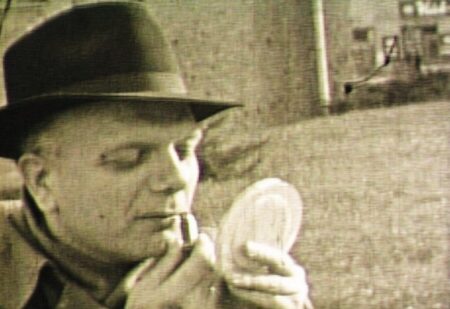
Still from Vakvagany (2002)

COMMENTS: For as long as there have been movies, there have been professionals who seek to deliver a story to a wider audience, and there have been amateurs who only wish to record personal moments for later reminiscence. When it comes to the latter, the idea that anyone beyond a very small circle might see the footage borders on absurd. To reach a mass audience, the film would have to present something of enormous significance, like the scene captured by Abraham Zapruder in Dallas in November 1963. Or perhaps it could be used to comment on current events, such as to understand the accused subjects of Capturing the Friedmans. But beyond that, a home movie seems of little public value outside of the home, and to watch one uninvited feels nosy at best and invasive at worst.

The directors of Vakvagany seem to feel they’ve backed into a Rear Window scenario. Someone has found some old home movies, they’ve watched them, and they’ve seen some surprising things: a couple sorting through a treasure trove of jewelry and other valuables. Unusually lengthy shots of a nude infant. Footage of a mother holding her toddler son’s penis as he attempts to urinate. “What’s going on here?” they must have asked themselves. “Is this immoral? Criminal, even?” Their snooping has led them to a possibly unsavory place, and now they feel compelled to know more.

In these discovered films, we meet the Locsei family, and the first facts we receive are unsettling. Mr. Locsei was evidently a functionary in the postwar Hungarian government. A neighbor suggests he may have overseen the collection of valuables from Jews who were deported to concentration camps during the war, which may explain that delighted sorting of valuables we witnessed. (On the other hand, it will be suggested later in the film that Mr. Locsei was actually saving these possessions to be returned to their owners.) We also see his wife cavorting with grapes, which matches with suggestions of alcoholism. Most importantly, we see the two Locsei children, who don’t relish being on camera, hardly surprising given some of the awkward moments to which they’ve been subjected. 

To help us out, the filmmakers have enlisted onscreen interpreters, who are shockingly confident in their impromptu reactions. Legendary experimentalist Brakhage, upon seeing a father embracing his squirming daughter, opines, “I don’t quite believe his hugs,” and later compares the son’s efforts to free his arm from his father’s grasp to a Nazi salute. (“Perhaps I’m reading too much into it,” he then admits.) Psychiatrist Menninger wryly notes the professional Continue reading IT CAME FROM THE READER-SUGGESTED QUEUE: VAKVAGANY (2002)