Category Archives: Capsules

CAPSULE: ASTRAKAN (2022)

366 Weird Movies may earn commissions from purchases made through product links.

Astrakan can be rented on-demand.

DIRECTED BY: David Depesseville

FEATURING: Mirko Giannini, Jehnny Beth, Théo Costa-Marini, Lorine Delin, Bastien Bouillon

PLOT: An orphan boy struggles to adapt to life with his foster family.

Still from Astrakan (2022)

COMMENTS: We never would have picked Astrakan, a French drama about a foster child, for coverage on a weird movie site if we hadn’t read that the ending took a sever swerve into the surreal. I hereby inform the reader that, if you stick out 90 minutes of ultra-realism, you will be rewarded at the end with an intoxicated 10 minute digestif. That ending, an aggressive montage of sometimes disturbing and reconfigured memories, presumably distorted under sketchy amateur hypnosis, provides a dreamlike nightcap to a litany of childhood sorrows. If you are strictly searching for a weird movie, you may want to abstain; but if you enjoy solemn, impressionistic art-house dramas with a tart finish of strangeness, Astrakan may be for you.

Astarkan delivers its drama matter-of-factly, as a series of slice-of-life scenes that often omit key context. Like many child actors, Samuul (Mirko Giannini) underplays most of his scenes, which in this case fortuitously serves his character. His blank face and slow, deliberate movements mask his inner thoughts, appropriate for a script that withholds information and forces us to draw our own conclusions. Samuel is psychologically, and physically, constipated. He writes down secrets and buries them in hidden places. Samuel’s abuse is clearly signaled, but not extensively detailed; we aren’t privy to its severity, although at one point we know his foster mother fears that the bruises on his thigh may get him taken away by the state. That mom, played by Jehnny Beth with a troubled sense of economic reality struggling with maternal instinct, does grow attached to Samuel—but not quite attached enough to provide him the minimal protection he would need to thrive. But his foster parents do provide him with a home, gymnastics lessons, a ski trip, a bit of dear pocket money, and occasional scraps of tenderness—and who will take care of Samuel, if not them? The foster system is an imperfect compromise, but what is the alternative?

Astrakan was shot on film in rural France; the bright blue skies and verdant fields of its pastoral setting contrast with the troubled darkness of Samuel’s existence. In keeping with the hardcore realism, the story is told with no non-diegetic music, until Bach’s “Agnus Dei” (“lamb of God”) comes in at the finale. Although it’s not explained within the movie, the movie’s title comes from the pelts of an exotic breed of black sheep, which must be killed when young, before their wool loses its dark color.

WHAT THE CRITICS SAY:

“Having established his skills and careful competence over 90-odd minutes, Depesseville then elects to showcase different facets of his talent in what amounts to an extended, dreamlike, impressionistic coda…”–Neil young, Screen Daily (festival screening)

THEY CAME FROM THE READER-SUGGESTED QUEUE: THE FOOL AND THE FLYING SHIP (1991) / MOUSE SOUP (1993)

366 Weird Movies may earn commissions from purchases made through product links.

The tradition of celebrities narrating children’s literature is as old as recorded media itself; the first thing Thomas Edison ever recorded on the phonograph was his own recitation of “Mary Had a Little Lamb.” Ever since then, plopping their children down in front of a famous person reading a book has been tried-and-true escape for parents. It’s a win for everyone: the kids get literature, the parents get distraction, and the celebrities receive a low-pressure gig with major PR upside. Not for nothing has SAG-AFTRA provided a helpful archive of famous storytellers, and if you needed another reason to hope for a speedy resolution to the ongoing strike (#sagaftrastrong #wgastrong), then it’s to save the world from recitations of kidlit by narrators with a lesser pedigree like, say, this guy.

Today, we present two such star-powered endeavors, each of which reflect the character of their narrators, but which tap into weirdness through their design as much as through the stories themselves. 

This is particularly true of “The Fool and the Flying Ship,” which features Robin Williams doing his best impression of an immigrant Jewish Eastern European grandfather unspooling an old folktale about a young schlub who sets out to win the hand of a princess by fulfilling a number of impossible conditions set forth by the King. The only thing the ridiculous young man has going for him is his innate friendliness, but that proves a decisive advantage, as he assembles a retinue of similarly odd companions who are unusually well-suited to meeting the King’s challenges. The film is a product of Rabbit Ears Entertainment, a storytelling outfit responsible for numerous memorable celebrity narrations (foremost among them Jack Nicholson’s peerless rendering of some of Rudyard Kipling’s “Just-So Stories”), but “Flying Ship” stands out as a notably odd entry. Williams’ raucous recounting of the tale frequently feels improvised, with snarky asides and deadpan diversions (perhaps best-exemplified by the casual dismissal of the Fool’s two older brothers), and the rollicking score by The Klezmer Conservatory Band mirrors his energy. The story itself is happily unweighted, with any perceived morals secondary to the silliness of the Fool’s adventures.

Still from The Fool and the Flying Ship

There’s a case to be made, though, that Williams is simply following the lead of the wild illustrations that visualize the tale. Not a true animation, the movie consists of still images of Henrik Drescher’s artwork, similar to the snapshots of book pages found on “Reading Rainbow.” Drescher’s drawings are often ugly, sometimes even deranged, but filled with such joyful anarchic spirit that director Craig Rogers doesn’t need to do much more than add a little Ken Burns-effect here and there. The illustrations, set to Williams’ energetic performance, do the lion’s Continue reading THEY CAME FROM THE READER-SUGGESTED QUEUE: THE FOOL AND THE FLYING SHIP (1991) / MOUSE SOUP (1993) →

POD 366, EPISODE 37: LANTHIMOS’ LION

366 Weird Movies may earn commissions from purchases made through product links.

Audio only link (Soundcloud download)

Quick links/Discussed in this episode:

Corner Office (2022): Discussion begins. Read Giles Edwards’ review. This mildly surreal John Hamm-led satire gets a DVD release this week (no Blu-ray). Buy Corner Office.

Venice International Film Festival: The world’s oldest film festival, Venice is still one of the most prestigious movie events of the year, although it is now in direct competition with the much larger Toronto Film Festival (currently raging). Like Cannes, Venice’s tastes tend towards the vino e formaggio crowd, but they always scoop Toronto for some adventurous high-profile debuts. Like these three, which will all be worth tracking down in the coming months:

  • AGGRO DR1FT – Discussion begins. ‘s new project is an action-packed video game on film starring rapper Travis Scott.
  • Daaaaaalí! – Discussion begins. is back again for his second film of 2023, a surrealist biopic of surrealist icon .
  • Poor Things – Discussion begins. highly anticipated adaptation of  Alasdair Gray’s novel about a woman who is revived from the dead, but with a fetus brain. It won the Golden Lion despite looking quite weird.

Venice International Film Festival official awards announcement.

Walkabout (1971): Discussion begins. Read Eric Gabbard’s review. Nicolas Roeg‘s debut film about the titular Australian aboriginal coming-of-age ritual takes its turn for a 4K UHD upgrade from the . Buy Walkabout.

WHAT’S IN THE PIPELINE:

We don’t have a guest scheduled for next week’s Pod 366, but we will talk about the TIFF slate, along with other new releases. In written reviews, Shane Wilson takes out two that Came from the Reader-Suggested Queue with a double feature of “The Fool and the Flying Ship” (1991) and “Mouse Soup” (1993); Gregory J. Smalley looks at Astrakan (2023); and, Giles Edwards preps for Daaaaaalí! (above) with a look at Mary Harron’s more conventional Dalí biopic Dalíland (2022). Onward and weirdward!

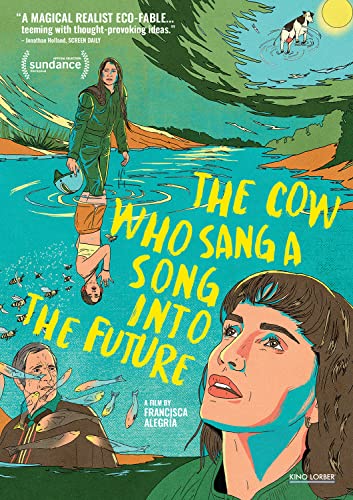
CAPSULE: THE COW WHO SANG A SONG INTO THE FUTURE (2022)

La vaca que cantó una canción hacia el futuro

366 Weird Movies may earn commissions from purchases made through product links.

DIRECTED BY: Francisca Alegria

FEATURING: Leonor Varela, Mía Maestro, , Enzo Ferrada

PLOT: When her father is hospitalized from shock after her long-dead mother appears to him, Cecilia returns to her family’s dairy farm to care for him.

Still from The Cow Who Sang a Song into the Future (2022)

COMMENTS: Fans of cows singing songs will surely be satisfied with The Cow Who Sang a Song Into the Future; the bovines croon quite well, although it is up for debate just how far into the future their tunes echo. The rest of us will at least be willing to hear the movie out: it contains much intriguing strangeness, while also held back a bit by a tangled thicket of themes and the sometimes underwhelming familial drama.

The film begins with a shot of a mouse corpse that leads to a long pan over a forest floor to a riverbank where a carpet of beached fishes sing a song about death. This is followed by the appearance of Magdalena, who arises from the water wearing a motorcycle helmet and walks silently into town. We then turn our attention to Cecilia, a single mom doctor raising two children. We meet the elder, Tomás, trying on women’s clothes and discussing a vintage newspaper article about a woman who committed suicide by riding her motorcycle into the river. Cecilia rushes to her father’s side after he collapses from shock after catching a glimpse of what he believes to be his long-dead wife, looking just as she did the day she died. Cecilia and her children settle in at the family’s dairy farm, where her brother Bernardo attempts to revive the herd’s failing fortunes while the patriarch complains about his effort. Also on site is superstitious stepmom Felicia, the first to directly interact with silent revenant Magdalena, who gradually reveals herself to the others. Meanwhile, the cows get loose at night, while back in town people stage protests, blaming a local pulp plant’s pollution for the plague of dead fish.

I’ve tagged this movie as magical realism—it’s a rule that we must do so for any moderately strange movie hailing from south of the U.S. border—but at times, Cow feints towards actual surrealism. If Magdalena’s strange and unexplained return from the dead was the only thing going on here, Cow probably could be confined to the realm of magical realism; but the magic here extends beyond the realistic. There are, of course, the choirs of singing fish and cattle. There is Magdalena’s strange relationship with technology: she’s obsessed with cellphones and her mere presence turns on microwaves. A mysterious wound appears on Cecilia’s head, quickly healed and never explained. The zombie mom briefly takes up with a lesbian motorcycle gang. So, despite a primary focus on drama, things do get weird.

But The Cow Who Sang a Song Into the Future arguably attempts to deal with too many themes at once. The family dynamics are the primary focus, with the mystery of Magdalena’s death and return illuminating and catalyzing the interplay between the others. Ecological collapse forms the background: the deaths of fish, the disappearance of bee colonies, a sickness affecting the cattle herd.  There’s a nod to issues of how conservative Latino societies deal with LGBTQ members, and even a critique of industrial dairy farming practices. But, although everything connects, to a large extent, spreading all of these concerns over the course of a 90 minute movie means that each one gets short shrift: we never uncover the source of the river’s pollution, Tomás’ transgenderism subplot feels imported from a different movie, etc. Furthermore, the big family secret is not weighty or surprising enough to justify its delayed reveal; it’s delivered in a single sentence. Still, Cow works out well in the end, generating an optimistic feeling of rejuvenation and resurrection. The postmortem resolution of Cecila and Magdalena’s relationship loosely parallels the notion that there is still time for us to atone for our sins against the environment.

WHAT THE CRITICS SAY:

“Rife with evocative symbolism, Chilean director Francisca Alegria’s feature debut is an audacious, surrealistic expression of acute ecological distress and various ideas pertaining to contemporary agita.”–Kat Sachs, Chicago Reader (contemporaneous)

The Cow Who Sang a Song Into the Future [DVD]
  • Family drama meets magic realism in this compelling environmental fable about family, nature, renewal, and resurrection

IT CAME FROM THE READER-SUGGESTED QUEUE: LITTLE MURDERS (1971)

366 Weird Movies may earn commissions from purchases made through product links.

“You get to the point where you’re, like, ‘I want someone to be sad, and I want to know that I’m responsible!’”– on living in New York City

DIRECTED BY: Alan Arkin

FEATURING: Elliott Gould, Marcia Rodd, Vincent Gardenia, Elizabeth Wilson, Jon Korkes, John Randolph, Doris Roberts, Lou Jacobi, , Alan Arkin

Still from Little Murders (1971)

PLOT: A photographer beaten down by the cruelty and indifference of modern life meets the optimistic Patsy, who has a history of “molding” her romantic partners.

COMMENTS: If the movies are to be believed, New York City in the late 60s and well into the 70s was a nightmarish hellscape, a place where morality was absent, cruelty was commonplace, and the fundamental rules of life could gain no purchase. It was a labyrinthine trap for visitors (see Neil Simon’s original The Out-Of-Towners), a hotbed of insanity amongst the residents (witness ’s crude Where’s Poppa?), and just an ungovernable mess on the whole (Death Wish, The Taking of Pelham One Two Three, Dog Day Afternoon, among others). How much the city has improved since then is in the eye of the beholder, but this period does seem to have been New York’s nadir.

So it goes in the New York of Little Murders. Muggings occur in broad daylight. Calls to the police are placed on hold. Lewd phone calls find you, wherever you may be. Electricity gives out at random times. No one on the subway bats an eye at a man covered in blood. The psychic trauma of just trying to get through the day is overwhelming; who cares about Vietnam, when a war hero can come home to be gunned down on the Upper West Side? These Manhattanites just suck it up and soldier on, but a lot of people are beginning to crack under the pressure.

Our central couple presents two very different ways to deal with this world. Patsy is the kind of person who dusts herself off after every setback. She’s not an optimist, exactly, but she is persistent. She has a history of “fixing” men who are probably homosexual, and then ditching them when they become too pliant. (She tells Alfred of her dream mate: “I want to be married to a big, strong, vital, virile, self-assured man… that I can protect and take care of.”) When her apartment is looted and ransacked, Patsy automatically begins a mental checklist of all the things she’ll need to do to restore her home. The one thing she absolutely cannot do is give up. “If you don’t fight, you don’t feel,” she insists, “and if you don’t feel, you don’t love.”

Alfred, meanwhile, has chosen to disassociate from everything. When confronted by muggers, he lets them have their way and slips into pleasant daydreams. The market for his photographs shifts from beautiful things to actual pictures of excrement, so he readily goes along. He insists upon omitting God from his wedding vows, but when his prospective father-in-law tries to buy off the officiant, he’s indifferent. Not feeling anything is his only protection, so when Patsy cajoles him into letting down his guard, it’s about the cruelest thing that can happen to him.

There’s no model for how to behave under these circumstances, as demonstrated by the three authority figures who share their wisdom. Lou Jacobi’s judge is a disgusted back-in-my-day type who insists that his immigrant ancestors’ persecution was integral to his success. (Amusingly, his harangue against the young couple continues well into a court case over which he is presiding.) Gould’s M*A*S*H cohort Donald Sutherland appears as a man of the cloth with no convictions whatsoever. The lasting marriages over which he has presided are happy accidents, while the failures are just the cost of doing business, and he shares this fact in the course of his own homily. Finally, director Alan Arkin shows up as a police lieutenant who has slipped into madness. By turns quivering with undirected rage and cackling maniacally, he sees conspiracy everywhere, and is as suspicious and demanding of victims as he is of suspects. What none of these authority figures are is helpful. It’s everyone for themselves.

There’s undoubtedly a version of this tale that plays out like a witty New York comedy of the Neil Simon/Woody Allen variety, but events keep conspiring to kill the comic buzz. The little indignities of big-city life are compounded by crime and cruelty, culminating in the most appalling tragedy of all, which ultimately tells you which of the two leads the movie thinks is right. In the face of this disaster, Little Murders ultimately proposes another way to cope: hurting others. The only thing that brings joy to Alfred and his newfound family is the opportunity to direct all of the sadness and anxiety and rage at another human being, and the laughter that ensues is emblematic of writer Jules Feiffer’s pessimism. People will ultimately make hostile choices, but they’re just trying to get through the day. Would you deny them this little pleasure?

WHAT THE CRITICS SAY:

“Funny and frightening, Little Murders strikes a tone that few films attain. It certainly doesn’t look like many movie comedies… Godard at first expressed interest in the material, but ended up turning down the project. Even though he wasn’t involved with Little Murders, the film often suggests a kindred spirit with Godard’s late-1960s work.” – Ben Sachs, Chicago Reader (2017 revival)

(This movie was nominated for review by Matthew D. Garmager. Suggest a weird movie of your own here.)