Category Archives: Alfred Eaker’s Fringe Cinema

READER POLL FOR EAKER VS. EAKER VS.THE 2017 SUMMER BLOCKBUSTERS: THE CANDIDATES

With summer just around the corner, it is time for the 366 reader base to vote on which three summer blockbusters to send the Eakers (Alfred and Aja) to review for our fourth annual installment of the series “Eaker v.s Eaker vs. the s.” The candidates below are listed in order of release. Be sure to view the entire post; you will vote at the end.

  1. Alien: Covenant, opening May 12. I ‘ll have to nix the latest Fast and Furious (April 14) and Guardians of the Galaxy, Vol 2 (April 28), simply because they’re coming too soon.  That leaves us to potentially open with Alien: Covenant, ‘s sequel to Prometheus, which is probably the  most likely to send me sleeping on the couch for a couple of nights. Why? Because I loved Prometheus and thought it the best of the entire Alien series (yes, you read that right). Aja, on the other hand, sided with the fanboy masses and hated it so thoroughly that I was not able to even watch it a second time until she left town for a week. So, this is probably the number one candidate for a knock down, drag out fight. Of course, I could be wrong. It really could suck. After all, no artist is infallible, and Scott is undeniably an uneven director.
  2. King Arthur: Legend of the Sword, May 12. Hasn’t this story been told a few times already? It’s directed by Guy Ritchie, whose resume doesn’t promise anything even remotely approaching freshness.
  3. Wonder Woman, June 2.  With their last few entries, DC comics have earned the reputation of being hacks when it comes to the big screen. This is odd, since they rule the small screen with their animated and live action series. And, let’s be honest—they have cooler, more colorful characters than Marvel. Exhibit A is the delightful series “Supergirl,” which apparently a lot of humorless fanboys hate. With Marvel, it’s usually the reverse (Exhibit B is the reportedly godawful TV series “Iron Fist”). Gail Gadot was the coolest element of the execrable Batman vs. Superman, but she was only in it briefly. Also on the potential plus side is director Patty Jenkins, whose Monster (2003) was critically acclaimed. However, her work since then has been sporadic and confined to television (although she won several Emmys). On the negative side, the trailer indicates an overblown spectacle—which shouldn’t be surprising  since a certain hack named Snyder co-wrote the script, and the only thing he seems to write well are recipes for disaster.
  4. Baywatch, June 2. Based on the cheesy TV series and starring Dwayne Johnson. Jesus God, this is gonna be really bad.
  5. The Mummy, June 9. Director Alex Kurtzman is known primarily as a writer… of bad scripts (Amazing Spiderman 2, a Transformers movie, Star Trek: Into Darkness). Lead actress Sofia Boutella is earning a reputation as a formidable screen presence. It also stars whose work is usually uneven. This is supposed to be the first entry in Universal’s planned reboot of its classic monster Continue reading READER POLL FOR EAKER VS. EAKER VS.THE 2017 SUMMER BLOCKBUSTERS: THE CANDIDATES

1974 EXPLOITATION TRIPLE FEATURE: ANDY WARHOL’S DRACULA, IT’S ALIVE, AND LEGEND OF THE 7 GOLDEN VAMPIRES

1974 brought a cult movie smorgasbord, beginning with Andy Warhol’s Dracula (AKA Blood for Dracula, directed by ), which is better known than the previous year’s Andy Warhol’s Frankenstein. It again stars (as the bloodsucker) and (as the servant Mario), along with famed Italian director Vitorrio De Sica as a patriarch with four daughters who need marrying off. Kier’s count is sick, depressed, and bored to tears. He needs virgin blood, but post-sexual revolution, that’s not easy to come by. Three of the four candidates turn out to be sloppy seconds, making the Count even sicker. When he finally does find daughter four to be a virgin, the meddlesome Mario saves her in the predictable way, with Dracula diving to the floor to lap up popped cherry sauce.

Still from Blood for Dracula (1974)Knowingly misogynistic, with a splendid score (Claudio Gizzi), an over-the-top finale that puts some of the sillier Hammer vampire dispatches to shame, and a cameo, Blood for Dracula is far from perfect, but endures as a cult oddity.

‘s Phantom of the Paradise is probably the best film based on the Gaston Leroux novel. It’s greatness lies in its refusal to put the original narrative on a pedestal, which, despite what a certain hack composer named Webber claims, is not that good anyway. It quickly secured its cult standing, but is often considered to be under the shadow of 1975’s The Rocky Horror Picture Show. Both are delightful, but if it’s an either/or situation, go with De Palma. His is the better film.

The Night Porter (directed by Liliana Cavani ) was to 1974 what Fifty Shades Of Grey was to 2015, the difference being the S&M relationship here is between a former SS officer (Dirk Bogarde) and the Jewess he tortured in the concentration camp (). It’s arthouse reputation secured a strong following for years, and it was eventually released on home video via the Criterion Collection. It wasn’t unanimously loved; Roger Ebert was among its critics, in an almost infamous review.

Rampling co-starred  in her second 1974 cult movie with ‘s Zardoz, appearing alongside in a ponytail and diaper. It’s yet another 1974 entry that made our official weird movie list.

Hyped as a soft core porn parody of “Flash Gordon,” Flesh Gordon (co-directed by Michael Benveniste and Howard Ziehm) was another immediate cult hit, although it’s largely forgotten today. More sophomoric parody than porn, it has period charm as a fan film with Continue reading 1974 EXPLOITATION TRIPLE FEATURE: ANDY WARHOL’S DRACULA, IT’S ALIVE, AND LEGEND OF THE 7 GOLDEN VAMPIRES

1973 EXPLOITATION TRIPLE FEATURE: ANDY WARHOL’S FRANKENSTEIN, SATANIC RITES OF DRACULA, AND SISTERS

Andy Warhol’s Frankenstein was the fourth film directed by under ‘s banner; although it seems that apart from co-producing, the American pop art icon had no creative input, which may be why, in Europe, it was released under the title Flesh For Frankenstein. Morrisey made this film back-to-back with Andy Warhol’s Dracula, which we will cover when 1974 rolls around. Both films star and (who also starred in the Morrissey/Warhol “hustler” trilogy Flesh, Trash, and Heat). Frankenstein is the more outrageous of the two horror films. It stars Kier as a fascistic, narcissistic, necrophiliac Baron Frankenstein who, in his most infamous scene, cuts open the ribcage of a woman (Dalila Di Lazzaro) and has sex with her gall bladder.  Naturally, this scene made Kier a cult celebrity, a position he would cement with Dracula.

Still from Andy Warhol's Frankenstein/Flesh for Frankenstein (1973)Shot in 3-D, Frankenstein aims directly to satirize the sexploitation/horror demographic with a high quota of gore and sex—the latter supplied by Monique Van Vooren as the unloved nymphomaniac Baroness, wife and sister to the Baron, and Dallesandro as the stable boy who services her. Aptly, the film opens with the Baron and Baroness as children dissecting and  beheading a doll, but “Addams Family” this isn’t: the good doctor’s supply of cadavers comes from bordellos rather than the traditional cemetery. Kier and Van Vooren are ideally cast, with her armpit sucking competing with his gallbladder screwing. Although undeniably dated, it’s every bit as outrageous as it sounds.

When writer and director unleashed The Exorcist on the world, few had any idea the impact it would make. Shining across our small 1973 TV sets, the original trailer was subdued. Although the book upon which it was based had been a best seller, only its readers knew what it was about. I don’t remember a lot of publicity beforehand, but all that changed on the weekend it was released. Newspapers were issuing warnings of something unimaginably terrifying, theaters were equipped with barf bags, and in our neck of the woods, churches were condemning it as propaganda coming from Satan himself. Indeed, the fallen angel had been rising quite high since 1968’s Rosemary’s Baby, but, at least as far as box office, even that seminal (and superior) film did not have the impact of The Exorcist. Initially, its critical standing was mixed, although now it seems to top all those “best of” horror lists.  Word of mouth made a trend of fear, and it was years before anyone from our tribe saw it. The tidal wave of Satanic themed films to follow was unprecedented, and, needless to say, preachers and Sunday Continue reading 1973 EXPLOITATION TRIPLE FEATURE: ANDY WARHOL’S FRANKENSTEIN, SATANIC RITES OF DRACULA, AND SISTERS

TALES THAT WITNESS MADNESS (1973) & FROM A WHISPER TO A SCREAM (1987)

‘ Tales That Witness Madness, made for World Film Services in 1973, is clearly patterned after the Amicus horror anthologies. Of course, what better way to emulate the competition than to acquire the man who directed nearly half of the Amicus franchise, along with several of that studio’s top draw actors?

The setup is simple and familiar enough: is the resident psychiatrist of an asylum, giving friend Jack Hawkins (in his final film) a tour of the grounds. Along the way, he tells the stories of four inmates.

In “Mr. Tiger,” Russell Lewis’ imaginary feline pet beast takes a sour view of his master’s verbally abusive parents. Just how imaginary the tiger is questioned after some clawing on the door and blood splattering on Oedipal walls.

A time traveling bicycle is at the malevolent heart of “Penny Farthing.” It stars Peter McEnery as an antique shop owner and Suzy Kendall as his wife. Soon, they discover the bike is literally antique and … we’re so sorry, Uncle Albert.

Still from "Mel" from Tales That Witness Madness (1973)“Mel” stretches credibility when Michael Jayston is more interested in an oddly shaped tree than he is in oversexed wife Joan Collins in something pink from Frederick’s of Hollywood. It’s the most remembered segment for a reason—it’s a camp hoot, with Collins channeling her inner jealous diva. The tree tries to upstage the human competition, which is not an easy task against Joan in a flimsy nightie, wielding an axe.
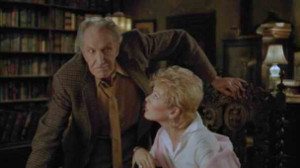
Rita Hayworth was originally cast in the final segment, “Luau,” but bowed out, citing health reasons. replaces her and gives a pallid performance as another jealous diva who happens to be a cannibalistic mother. Although not as well known or as assured as the best Amicus entries,Tales is still an enjoyable example of the genre that confirms Francis as an underrated director.

Most horror anthologies succumb to moralizing. One that avoids that route altogether and revels in its gore and perversity is the underrated From a Whisper to a Scream (1987), Jeff Burr’s first solo feature film. It’s an impressive debut that unfortunately did not lead to bigger and better projects for the director. co-stars with Martine Beswicke, , Rosalind Cash, Terry Kiser, Clu Gulager and the always underrated misfit . Price gives a solid performance in the wraparound as a Tennessee librarian whose knowledge of local history is put to use as he relays four tales to reporter Tyrell, who just came back from the execution of the librarian’s serial killer niece. The cast is uniformly good, especially Gulager who gives a hell of a performance in the first segment as an aging, pathetic grocery clerk whose relationship with his ailing sister (Gulager’s real-life wife Miriam Byrd-Nethery) is clearly incestuous. However, an unrequited love for his boss (Megan McFarland) quickly turns things uncomfortably south, with necrophilia thrown into the sororicidal brew.

White trash thug Terry Kiser is nursed back from the dead by kindly bayou voodoo practitioner Harry Caesar. When Kiser has the chutzpah to bite the hand that feeds him, a horrific fate awaits in this unfathomably grim narrative of dread.

Didi Lanier falls in love with carnival glass eater Ron Brooks, who is trepidatious about running away with her, fearing retaliation from the show’s owner/snakewoman (a delirious Rosalind Cash in her final film appearance). The intestinal finale of imploding razor blades and paper clips is gruesome enough to warrant a shower after. This is also the final film for dwarf Angelo Rossitto, who had most famously starred in Tod Browning’s Freaks (1932).

Cameron Mitchell, once a reliable character actor, emerged from a decade-long slump of in this unsettling Gothic Civil War tale that goes to the “you’re not going there” place. Knowing the war is over, Mitchell and his rogue Union squad take the attitude that it isn’t, but fatefully encounter a band of confederate children. Damien, the Children of the Corn and the killer tykes from that Village of the Damned have nothing on these southern juveniles who reinvent pin-the-tail-on-the donkey and don’t bat an eye at removing one adult limb at a time. Hoping to escape, Mitchell goes pedophile, locking lips with a pubescent and facing a visceral climax.

Still fro,m From a Whisper to a Scream (1987)Reportedly, Price had misgivings about the script and was unhappy with the final edit, feeling it too too extreme and devoid of the sense of nostalgia that drives his screen persona. His is a supporting role, no doubt due in part to his (clearly) failing health. Burr, co-writing with Mike Malone, Darin Scott, and Courtney Joyner, fires on all cylinders, without a weak link, and despite a relatively low budget. Obscure enough to rarely be listed, it’s more refreshingly original than the more familiar fare. Burr considers it as his only authentic film, having since been consigned to commission work.

1972 EXPLOITATION TRIPLE FEATURE: DRACULA A.D. 1972, VAMPIRE CIRCUS, AND THE THING WITH 2 HEADS

1972  is perhaps the most prolific year in the most prolific decade of horror and exploitation films. It’s also the year for what may be the quintessential midnight cult move: Pink Flamingos, now enshrined as one of the 366 weirdest movies of all time. Blood Freak, which is the first and only “Christian” movie to date about a turkey serial killer, is another Certified Weird 1972 exploitation picture. Competing with Freak fro sheer awfulness was Don Barton’s Zaat (AKA Blood Waters of Dr. Z), which went onto “MST3K” infamy.

In its Blu-ray presentation, ‘s maligned Baron Blood has proven better than its reputation, despite a miscast in the title role. Like most of Bava, it’s stylishly irresistible. The 1972 Amicus omnibuses Asylum and Tales from the Crypt both starred , and were critical and box office successes. Ben, Dr. Phibes Rise Again, and Beware The Blob were all inferior sequels—which is saying a lot in the case of an original monster who was just moving silly putty. tackled the two big undead kahunas (with plenty of added sex) in The Erotic Experiences of Frankenstein and Daughter of Dracula. The Count rose yet again in Count Dracula’s Great Love, starring Paul Naschy. Future King of Cartoons (William Marshall) and director William Crain fused horror with blacksploitation for the first time in Blacula. It was a enough of a box office success to warrant  (superior) sequel in 1973. Unfathomably busy, Cushing and teamed up for ‘ underrated Creeping Flesh, Gene Martin’s cult favorite Horror Express, Peter Sasdy’s misfire Nothing but the Night, and the Hammer opus Dracula AD 1972 (directed by Alan Gibson).

Widely scorned, Dracula A.D. 1972 reunited Cushing’s Van Helsing with Lee’s bloodsucker in a modern setting, even though Dracula himself is confined to a Gothic church. It’s one of ‘s favorite movies. The contemporaneous critical backlash was mostly justified. Lee, probably the best cinematic Count, is reduced to second vampire-in-waiting. But as an artifact of its time, Dracula A.D. 1972 is not entirely without virtue, enough to explain Burton’s affection.

It opens in the previous century with Dracula and Van Helsing locked in mortal combat aboard a stagecoach, which crashes, causing the vampire to be impaled on the spokes of the coach’s wheel. As Dracula attempts to free himself, a battered and bleeding Van Helsing interferes, driving the spokes in deep enough to snuff out the life of his nemesis before dying himself. Witnessing the scene is a Dracula disciple who, of course, leaves with the vampire’s relics (handy for later resurrection). Despite the preposterous   accidental impalement, it’s a red-blooded, Gothic prologue that is followed by 1972’s swinging hippies.

Still from Dracula 1972 ADInitially sounding more like old fuddy-duddy Edward Van Sloan than Peter Cushing, Lorimer Van Helsing, grandson of Abraham, lectures his granddaughter Jessica (Hammer babe Stephanie Beacham) all about the wrong crowd and premarital sex. Pooh-poohing gramps, Jessica heads straight for the wrong crowd, Continue reading 1972 EXPLOITATION TRIPLE FEATURE: DRACULA A.D. 1972, VAMPIRE CIRCUS, AND THE THING WITH 2 HEADS