All posts by Gregory J. Smalley (366weirdmovies)

Gregory J. Smalley founded 366 Weird Movies in 2008 and has served as editor-in-chief since that time. He is a member of the Online Film Critics Society, and his film writing has appeared online in Pop Matters and The Spool.

CAPSULE: THE EVIL WITHIN (2017)

DIRECTED BY: Andrew Getty

FEATURING: Frederick Koehler, , ,

PLOT: A demon who appears in a mirror tries to turn a mentally handicapped man into a serial killer by threatening him with nightmares.
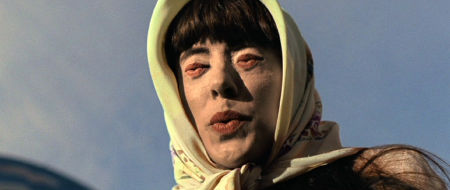
Still from The Evil Within (2017)

WHY IT WON’T MAKE THE LIST: The Evil Within is an interesting curiosity, with parts that are authentically creepy bumping up against parts that are genuinely scatterbrained. It doesn’t go quite far enough into dementia to earn a spot on the List of the Weirdest Movies Ever—maybe it would have if its director had lived to fiddle with it for another fifteen years—but fans of fruitcake horror films won’t be disappointed.

COMMENTS: “I could never know for sure what was a dream and what wasn’t,” says our protagonist at one point. The Evil Within is as disjointed as a bad dream, but there are also dreams within dreams, including a remarkable and long-extended opening sequence that lectures us on the differences between dreams and stories while showing us surreal visions of a burning key in a light switch, a woman with lips for eyeballs, and Michael Berryman unzipping a boy’s body.

It gets weirder from there, in ways that are sometimes intentional, sometimes unintentional. It turns out that in the waking world our protagonist, Dennis, is mentally handicapped, despite the fact that in the opening narration he described a haunted house ride as “the snow-capped summit in the topography of juvenile taste.” Frederick Koehler’s performance as Dennis isn’t terrible, although at times it does uncomfortably approach Donald Trump playing a disabled reporter. The plot is set into motion when Dennis’ reflection begins talking back to him, and gradually talks him into becoming a serial killer. The steps by which the alter ego accomplishes this—by convincing poor, slow Dennis that people will respect his newfound intelligence if he follows his increasingly horrifying instructions—are legitimately chilling. Meanwhile, Dennis suffers more Michael Berryman boogeyman nightmares, which are what the film does best, until a final “reveal” that explains (to some degree) his condition. The conclusion is also fairly bonkers, with animatronic monsters deployed as study aids to help decode the plot.

In many ways The Evil Within is a standard horror film, with serial killer tropes and hallucinatory monsters. But at times it seems like the work of an genuine outsider, one who doesn’t always grasp normal human motivations (why is the social worker so hell-bound on rescuing Dennis from his loving family? Why does the outrageously hot ice cream girl say “Of course it’s nice to see me, I’m outrageously hot?”) Overall, it’s an interesting and brutal, if raw, trip through the mirror: a unique blend of Nightmare on Elm Street, Henry Portrait of a Serial Killer, and Rainman. It shows a promise that suggests that, had he lived, Andrew Getty might have developed into a distinctive horror voice; if he’d been able to tame his own demons and channel his weird impulses, he might have become a genre maverick like .

The story behind The Evil Within is actually odder than the movie itself. The writer/director, who was a grandson of J. Paul Getty and heir to his oil fortune, self-financed the project, spending an estimated $5 million of his inheritance and endlessly tinkering with it in post-production for 13 years, all while battling a methamphetamine addiction. He died in 2015 at 47 years of age, before completing his work. His editor finally compiled the version we now see before us.

WHAT THE CRITICS SAY:

“…it’s already garnering a reputation as one of most singularly strange films to come along in a good while. And rightly so.”–Travis Johnson, Film Ink (contemporaneous)

(This movie was nominated for review by “Russ,” who called it “A flawed film, to be sure, but even moreso: an absolutely fascinating film, a grand example of uncomfortable, outsider art.” Suggest a weird movie of your own here.)

CAPSULE: GINGER AND FRED (1986)

Ginger e Fred

Recommended

DIRECTED BY:

FEATURING: ,

PLOT: Retired Fred Astaire/Ginger Rogers impersonators return for a guest spot on a television spectacular.

Still from Ginger and Fred (1986)

WHY IT WON’T MAKE THE LIST: One ten-teated cow does not a weird movie make. In Ginger and Fred, Fellini’s once-aggressive surrealism mellows into bemused quirkiness. Fans will find plenty to appreciate in the colorful, chaotic oddity on display, but this is a conventional comedy, by the maestro’s standards.

COMMENTS: Ginger and Fred is not a “Felliniesque” movie per se. It’s more of a roadmap for how Fellini’s vision might be channeled into something nostalgic and whimsical: Fellini for grandpas and grandmas. It’s a pleasing elegy for grand old entertainment, mixed with an unsubtle but effective satire of television. It features Fellini’s muse (Masina) and alter-ego (Mastroianni) working together for the first and only time, a pairing that in and of itself would make Ginger and Fred noteworthy. Fortunately, it’s also a good movie, with excellent performances from both stars. Masina’s Ginger is likeable and dignified, bemused by modernity without being overwhelmed or embittered. Mastroianni’s Fred hides his growing feebleness under a mask of rakishness, quick with a wolf whistle and a drink order. The scene where Fred repeatedly lifts Ginger while her eyes cross and they both start breathing heavily is as amusing a proxy for geriatric intercourse as I ever want to see on film.

Ginger and Fred‘s unseen network executives assemble a collection of human oddities for their Christmas spectacular variety show, with whom the elegant and put-upon Ginger is forced to share a hotel and a stage. There’s a transvestite with a divine calling to visit prisoners, Kafka and Proust impersonators (!), a troupe of bolero-dancing dwarfs, a mutant cow, a couple who tape-record ghost voices, and a throng of supplemental weirdos: extras wander around dressed like video game characters and decapitated geishas. There is some inherent irony in the way Ginger and Fred trots out its freakshow parade as a criticism of television, given the fact that Fellini himself was famous and celebrated for populating his films with odd-looking people and carnivalesque performers. The distinction, of course, is that Fellini isn’t criticizing television’s reliance on the grotesque, but the shallowness of its fascination, of the spectacle format in which every story is cut to fit in as short a slot as possible and not explored beyond its surface. His satirical circus is something stranger and more curious than television could ever accomplish (except, of course, when Fellini worked in the medium). He spends time exploring Ginger and Fred in-depth, making them three-dimensional characters inhabiting a two-dimensional world.

Some of the best bits are the brief parodies of television programming. There’s an absurd puppet show version of Dante’s “Inferno,” spot-on recreations of MTV music videos, a commercial with sexy French maid pouring olive oil on a huge lobster, a game show where housewives shovel pasta into their mouths from sinks, with the sauce delivered from the faucet. Televisions are everywhere in Ginger and Fred; in the hotel lobby, on the studio’s buses. Modern audiences will identify with the way the characters are always looking at screens rather than people—only back then, it was television that was the distraction. The screen has changed, but the message is the same.

In a strange footnote, Ginger Rogers unsuccessfully (and foolishly) sued Ginger and Fred‘s producers for trademark infringement and defamation.

WHAT THE CRITICS SAY:

“…a hysterical send-up of Italian television, which looks like an LSD-induced vision of ours 30 years ago – a combination of Morey Amsterdam’s ‘Broadway Open House,’ ‘The Ed Sullivan Show,’ Alistair Cooke’s ‘Omnibus’ and the Irv Kupcinet show… One longs for fewer midgets and bizarre misfits and for more of Miss Masina and Mr. Mastroianni.”–Vincent Canby, The New York Times (contemporaneous)

296. DOG STAR MAN (1964)

“One thing I knew for sure (from my own dreaming) was that what one dreams just before waking structures the following day. That dream material is gathered from the previous day, and therefore is a gathering of all previous days, ergo contains the structure of all history, of all Man… I wanted PRELUDE to be a created dream for the work that follows rather than Surrealism which takes its inspiration from dream; I stayed close to practical usage of dream material, in terms of learning and studying, for a while before editing. At this time I left strict myth considerations out of my study process as much as possible..”–Stan Brakhage speaking on Dog Star Man in “Metaphors on Vision”

DIRECTED BY:

FEATURING: Stan Brakhage, Jane Brakhage

PLOT: This silent non-narrative film is presented in four parts: a 20-minute “Prelude” introduces many of the visual motifs that will show up in later installments, followed by “Part One,” which focuses on a man  climbing a mountain with his dog. The man continues his climb in the seven-minute “Part Two,” but the picture now focuses on a baby boy, with abstract figures superimposed directly on the film. “Part Three” is a “sexual daydream” of a nude woman, with even more layered images, and “Part Four” is an even more abstract culmination of all that has come before.

Still from Dog Star Man (1964)

BACKGROUND:

  • Experimental filmmaker Stan Brakhage completed almost 400 films during his life (some of which run for less than a minute).
  • Dog Star Man is the final compilation of five short films Brakhage produced between 1961 and 1964. They are almost never screened separately, although the Prelude could stand alone.
  • While making Dog Star Man, Brakhage was unemployed and living with his wife and her parents in their Colorado cabin; to earn his keep, he chopped wood for the family.
  • Brakhage named his movie after a pulp novel he picked up as a boy, because he thought it a shame that such a great title would be forever wasted on a tawdry paperback.
  • The film is structured with increasing visual complexity. Brakhage shot one layer of film for part one, two for part 2 (and also for the prelude), three for part 3, and four for part 4. The layers of film were then superimposed on top of each other.
  • Brakhage later produced a four-and-a-half hour cut of this material called The Art of Vision, which rearranged every layer of film Brakhage shot for the project into every possible combination of superimpositions (within each part).
  • Chosen for preservation in the Library of Congress’ National Film Registry in 1992.

INDELIBLE IMAGE: Most of the amazing visual effects Brakhage achieves with his complex superimpositions fly by too quickly for us to consciously register—some can be seen for only a single frame or two. The most important repeated symbol in the film, however, may be the most mundane: the woodcutter struggling up the snowy mountain with his axe, stumbling and falling, while his dog happily bounds at his side.

THREE WEIRD THINGS: Phosphenes on film; baby with snowflakes; sex and beating hearts

WHAT MAKES IT WEIRD: Meticulous and intentionally unentertaining, Dog Star Man is a masterwork of consciously constructed dream cinema.


Excerpt from Dog Star Man (Prelude)

COMMENTS: When ordinary people think about experimental Continue reading 296. DOG STAR MAN (1964) →

CAPSULE: THE ACT OF SEEING WITH ONE’S OWN EYES (1971)

DIRECTED BY:

FEATURING: Anonymous corpses

PLOT: Footage of autopsies performed at the Pittsburgh morgue, delivered without commentary.

WHY IT WON’T MAKE THE LIST: At first I didn’t find Act at all “weird,” but the next day I found myself spontaneously describing it to another person thusly: “I saw the strangest documentary last night…” Both thoughts were true, based on different meanings of the words “weird” and “strange.” Act is strange in the sense of rare, uncommon, seldom-seen; it’s also disturbing and unsettling. But it’s deliberately rooted in reality, and not “weird” in the sense we use the term on this site: surreal, mysterious, hinting at the irrational.

COMMENTS: Society hides corpses from view—not from shame, but from unease. We seek to hide the evidence of a crime that has been committed against us. The title of Stan Brakhage’s charnel house poem (a somewhat literal translation of the Greek “autopsis”) suggests that here we will see death, and do so authentically: with our “own eyes,” not secondhand. The “act” of the title further suggests that this will not be a passive experience, but something we deliberately undertake to do.

Be prepared. Male and female, young and old, they all eventually arrive on the slab. Brakhage’s camera does not focus on any faces (a condition of his being allowed to shoot in the morgue). The anonymity of the bodies makes them more universal. He engages in little experimental camerawork (there are a few moments with strange zooms, or with abstract closeups). Bodies are clinically hacked apart and disemboweled, internal organs scooped out and placed in bins. In the most disturbing segment, the skin on the back of a man’s head is peeled upward to expose his skull, with the folds of flesh eventually bunching up around his eyes. There are closeups of meat sticking to ribs. Brakhage could have inserted footage from a butcher shop at some points, and you would not know the difference. The film runs for thirty minutes, although he could have stopped the camera after ten minutes or kept it running for another hour and a half. The end result is the same.

You might be disgusted. After a while, you might become numb, or even bored. You may be fascinated by the machinery of the body; your thoughts will likely turn to your own mortality. It’s grisly, but not exploitative. The camera does not tell you what to think or feel. The take home message of Brakhage’s audacious documentary seems to be, “look: this is what you are.”

WHAT THE CRITICS SAY:

“…perhaps the longest uncomfortable silence in the history of cinema, Stan Brakhage’s documentary short The Act of Seeing with One’s Own Eyes is a harrowing, unshakable, but fundamentally fascinating, viewing experience.”–Jeremy Heilman, Movie Martyr

(This movie was nominated for review by “Regicide.” Suggest a weird movie of your own here.)

295. NO SMOKING (2007)

“Look up the word ‘bizarre’ in the dictionary. It doesn’t mean dark. Was Eternal Sunshine Of The Spotless Mind a dark film? It was bizarre. No dictionary in the world says bizarre means dark or vice versa. This is the problem with Indians; they come with fixed notions. What is the definition of dark? Tell me!”– An exasperated No Smoking writer/director Anrag Kashyap in an interview

Recommended

DIRECTED BY: Anurag Kashyap

FEATURING: John Abraham, Ayesha Takia, Ranvir Shorey, Kiku Sharda, Paresh Rawal

PLOT: K, an arrogant businessman and highly-addicted chain smoker, agrees to enter a smoking-cessation program after his wife threatens to leave him. Going to the address his friend gave him, K is led through a labyrinth and forced to sign a contract which specifies that his loved ones will be harmed in increasingly severe ways every time he smokes a cigarette. Naturally, K relapses into smoking and is caught, eventually winding up trapped in a nightmare world.

Still from No Smoking (2007)

BACKGROUND:

  • The script (at least its early sections) bears some striking similarities to ‘s short story “Quitters, Inc.,” which was previously a segment of the 1985 anthology Cat’s Eye. The writer/director admits the story was an inspiration, although the credits do not mention King.
  • No Smoking was Anurag Kashyap’s third movie, but the first one released in India. His debut, Paanch, was never released outside of international film festivals due to state censorship (for violence and drug use); his second film, Black Friday, a true crime story, was delayed while a court case was pending and released after No Smoking. He later achieved mainstream success with 2009’s Dev D, an adaptation of a popular novel.
  • No Smoking was a colossal flop in its native India, where it baffled audiences with little exposure to psychological thrillers or surreal cinema.

INDELIBLE IMAGE: The bathtub sitting alone on a snowy plain in Siberia, just in sight of what appears to be a Soviet-era gulag, which appears in dream sequences at the beginning and end of the movie.

THREE WEIRD THINGS: Hitler’s Indian buddy; Fosse’s cigarette cabaret; banana peel suicide

WHAT MAKES IT WEIRD: No Smoking isn’t quite what would result if got a wild hair to direct a Bollywood film—but it’s a reasonable approximation. With its theme of bad men forced to forgo their vices against their will, it’s a bit like a Hindi twist on A Clockwork Orange, as well, only with more elaborate musical numbers. With the tropes of Indian popular cinema colliding against a Western-style neo-surrealist narrative, No Smoking is neither fish nor fowl; it totally confounded Indian audiences used to simple stories with happy endings, and it will probably confound you, too.


Hindi trailer for No Smoking

COMMENTS:  Anurag Kashyap’s Advice for How to Stop Smoking in Continue reading 295. NO SMOKING (2007) →