Tag Archives: Paganism

24. BEGOTTEN (1991)

“In BEGOTTEN, a time is depicted that predates spoken language; communication is made on a sensory level.”–E. Elias Merhige

RecommendedWeirdest!

DIRECTED BY: E. Elias Merhige

FEATURING: Actors from the experimental theater group Theater of Material

PLOT:  A man sitting in a chair disembowels himself with a straight razor.  A woman materializes from underneath his bloody robes, and impregnates herself with fluid taken from the dead body.  She gives birth to a convulsing, full grown man, and mother and son are then seized and tortured by four hooded figures bearing ceremonial implements.
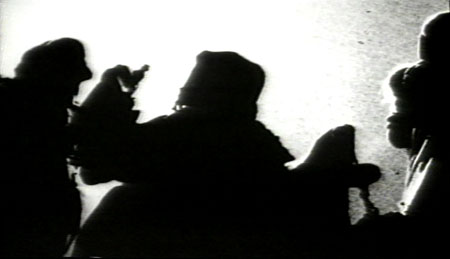
Still from Begotten (1990)
BACKGROUND:

  • Each frame of film was painstakingly manipulated to create the distressed chiaroscuro universe of the movie.  According to the technical production notes, after the raw footage was shot, “…optimum exposure and filtration were determined, the footage was then re-photographed one frame at a time… it took over ten hours to re-photograph less than one minute of selected takes.”
  • It has been reported that the film was inspired by a near death experience the Merhige had after an automobile accident.
  • Critics from Time, Film Comment, The Hollywood Reporter, The Christian Science Monitor, and New York Newsday each named Begotten one of the ten best films of 1991.  Novelist and photographer Susan Sontag called it one of the ten best films of modern times.
  • After Begotten, Merhige went on to direct the music video “Cryptorchid” for Marilyn Manson (which reused footage from Begotten) before landing a major feature, Shadow of the Vampire (2000)–a horror film about the making of Nosferatu, starring Willem Dafoe as Max Schreck and John Malkovich as Murnau.
  • Begotten is intended as part of a trilogy of films.  A second film, Din of Celestial Birds, which deals with the idea of evolution rather than creation, has been released in a 14 minute version that is intended as a prologue to the second installment.
  • After its brief run in specialty arts theaters, including stints at the Museum of Modern Art and Smithsonian, Begotten received a very limited video release, first on VHS and then on DVD.  Merhige explains that this is because he does not believe that these formats are truly capable of reproducing the look he intended for the film:

    There are so many arcane, deeply intentional uses of grain, light and dark in that film that it is closer to Rosicrucian manuscript on the origin of matter than it is to being a “movie”…. When I finished the film I never allowed it to be screened on video because of how delicately layered and important the image is in conveying the deeper mystery of what the film is “about”… this is why it is no longer available on DVD until I find a digital format that is capable of capturing the soul and intent of the film.  My experiments in BluRay have been promising.

  • Nevertheless, a (bootleg?) Begotten showed up again on DVD in 2018.

INDELIBLE IMAGE: The painfully graphic image of “God disemboweling Himself” with a straight razor–shot in the grainy, high-contrast black and white–is not easily forgotten.

WHAT MAKES IT WEIRD:  A minimalist, mythic narrative of grotesque, ritualized suffering enshrouded in astonishing abstract avant-garde visuals and a hypnotic ambient soundtrack.  Love it, hate it, or admire the technique while criticizing the intent—everyone admits there is nothing else quite like it in our cinematic universe.

Original trailer for Begotten

COMMENTSBegotten is a difficult film to rate.  It does not set out to entertain, and it does not Continue reading 24. BEGOTTEN (1991)

23. THE LAIR OF THE WHITE WORM (1988)

366 Weird Movies may earn commissions from purchases made through product links.

“This fearful worm would often feed on cows and lamb and sheep,
And swallow little babes alive when they lay down to sleep.
So John set out and got the beast and cut it into halves,
And that soon stopped it eating babes and sheep and lambs and calves.”

–Lyrics to “The D’Ampton Worm” from Lair of the White Worm
Recommended

DIRECTED BY: Ken Russell

FEATURING: Amanda Donohoe, Hugh Grant, Catherine Oxenberg, , , Stratford Johns

PLOT:  An archeology student visiting the British countryside digs up an elongated skull he assumes belongs to an dinosaur while excavating the site of a buried convent, now an English bed-and-breakfast run by two young sisters.  Lord James D’Ampton is the boyfriend of one of the sisters, and also the descendant of a legendary D’Ampton who reputedly slew a dragon (the “D’Ampton Worm”) that had terrorized the countryside.  After wintering in climes unknown, slinky and regal Lady March returns to her mansion and discovers the skull, after which strange events begin to transpire…

Still from Lair of the White Worm (1988)

BACKGROUND:

  • Russell’s script was very loosely based on Bram (“Dracula”) Stoker’s 1911 novel, although the similarity almost ends with the shared title.
  • This was Russell’s second horror film in three years after Gothic (1986).
  • Hugh Grant had roles in six films released in 1988, including portrayals of Chopin and Lord Byron.
  • This was Amanda Donohoe’s second starring role in a feature film.  She went on to greater fame when she joined the cast of the hit T.V. show “L.A. Law” in 1990.  Catherine Oxenberg, on the other hand, had made a name for herself on the hit T.V. show “Dynasty,” and this was her first feature role in a theatrical release.

INDELIBLE IMAGE: A 30 second hallucination sequence featuring Roman soldiers raping nuns before a cross on which a monstrous worm slithers over a crucified Jesus while a topless blue vampire woman looks on joyfully, waggling her tongue.  The scene is dressed up in lurid colors and performed in front of a deliberately cheesy looking blue-screen inferno.  So over-the-top and parodic that it’s not nearly as offensive as it sounds.

WHAT MAKES IT WEIRD:  Ken Russell throws a handful of his typically excessive hallucination/dream sequences into what is otherwise a subtle horror parody, creating a minor masterpiece of deliberate camp blooming with ridiculously memorable scenes.

VHS trailer for Lair of the White Worm

COMMENTS:  The one word that immediately comes to mind to describe Ken Russell’s The Continue reading 23. THE LAIR OF THE WHITE WORM (1988)

21. THE WICKER MAN (1973)

“I think it is a film fantastique in a way… a film fantastique can have almost anything in it, it’s based on facts but it can take flights of fancy which are still rooted to the truth, to the reality of the story, so the imagination can roam.”–Robin Hardy

Must See

DIRECTED BY: Robin Hardy

FEATURING:  Edward Woodward, Christopher Lee, Diane Cilento, Britt Ekland,

PLOT:  A devout Christian policeman flies to the isolated island of Summerisle off the coast of Scotland to investigate a report of a missing girl.  When he gets there, everyone denies knowledge of the girl, but he notices with increasing disgust that the entire island is practicing old pagan rituals and licentious sex.  As his investigation continues, he uncovers evidence suggesting that the missing girl was a resident of the island, and may have met a horrible fate.

the_wicker_man_1973

BACKGROUND:

  • Screenwriter Anthony Shaffer was a hot property in 1973 after adapting his own successful mystery play Sleuth into a 1972 hit movie with Laurence Olivier and Michael Caine, and penning the screenplay for Frenzy (1972) for Alfred Hitchcock.  His clout was so great that this film was released under the official title Anthony Shaffer’s The Wicker Man.  He later adapted Agatha Christie novels such as Murder on the Orient Express (1974) for the big screen.
  • Director Robin Hardy, despite doing an excellent job on this film, did not direct a feature film again until 1986’s Wicker Man variation, The Fantasist.
  • Christopher Lee, who had just come to the end of his run as Hammer’s Dracula, donated his acting services to the production.  He was quoted in 1977 as saying, “It’s the best part I’ve ever had.  Unquestionably.”
  • The “wicker man” was a historically accurate feature of Druidic religions that was first described to the world by Julius Caesar in his “Commentary on the Gallic Wars.”
  • In Britain the film was released on the bottom half of a double bill with Don’t Look Now, perhaps the most impressive psychological horror double feature in history.
  • Shaffer and Hardy published a novelization of the film in 1976.
  • “Cinefastique” devoted an entire 1977 issue to the film, calling it “the Citizen Kane of horror movies.”
  • In 2001, an additional 12 minutes of deleted scenes were added to create a “Director’s Cut” version.
  • Some of the original footage is believed to be lost forever, including part of the scene where Sgt. Howie first meets Lord Summerisle.  The original negative was accidentally thrown away when original producer British Lion Films went under and cleaned out its vaults.
  • The climax was voted #45 in Bravo’s list of the “100 Scariest Movie Moments.”
  • The 2006 Neil LaBute remake starring Nicolas Cage had as little as possible to do with the original story, was universally reviled, and was even accused of being misogynistic.  Some argue that it is so poorly conceived and made that it has significant camp value.
  • Hardy released a “spiritual sequel,” The Wicker Tree, in 2011.

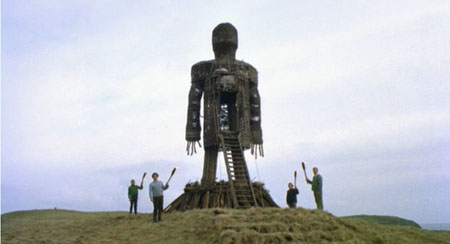
INDELIBLE IMAGE:  The wicker man itself (although, for those of a certain gender, Britt Ekland’s nude dance may be even harder to forget).

WHAT MAKES IT WEIRD:  Hardy and Shaffer create an atmosphere like no other; it’s an encounter of civilized man with strange, primeval beliefs.  Select scenes are subtly surreal—observe how the villagers break into an impossibly well-choreographed bawdy song about the innkeeper’s daughter preternaturally designed to discomfit their sexually repressed guest.  Other weird incidents are more outrageously in the viewer’s face: the vision of a woman breastfeeding a child in a graveyard while delicately holding an egg in her outstretched hand.  Almost invisible details such as the children’s lessons scribbled on the classroom blackboard (“the toadstone protects the newly born from the weird woman”) saturate the film and reveal how painstakingly its makers constructed a haunting alternate world of simultaneously fascinating and repulsive pagan beliefs.  The rituals Sergeant Howie witnesses don’t always make sense (and when they do, their significance is repulsive to him), but they tap into a deep, buried vein of myth.  The viewer himself undergoes a dread confrontation with Old Gods who are at the same time familiar and terrifyingly strange.

Original trailer for The Wicker Man

COMMENTS: CONFESSION: The version reviewed here–horrors!–is the 88 minute theatrical Continue reading 21. THE WICKER MAN (1973)