Tag Archives: Musical

CAPSULE: JESUS CHRIST SUPERSTAR (1973)

DIRECTED BY: Norman Jewison

FEATURING: Ted Neeley, Carl Anderson, Yvonne Elliman

PLOT: The last days of Jesus Christ, including the Last Supper, his betrayal by Judas, and his crucifixion, sung to a propulsive rock score composed by Andrew Lloyd Webber.

Still from Jesus Christ Superstar (1973)

WHY IT WON’T MAKE THE LIST: Though the very premise – a rock ‘n’ roll passion play – is inherently offbeat, and this particular version is laced with anachronisms and unusual characterizations, this is at heart a straightforward, earnest account of the story.

COMMENTS: When Superstar debuted on the Broadway stage in 1971, the very notion of a rock-n-roll passion play must have carried an unmistakable air of sacrilege. (Although another pop-oriented take on the story, “Godspell,” premiered off-Broadway the same year, and a film of that musical also came out in 1973.) But the show struck a chord with audiences; spawned from a concept album that had sold millions of copies, the musical ran for nearly two years on Broadway and spent eight years on the London stage, closing as the longest-running show in British history. A film version was probably inevitable; that the adaptaion would be placed in the hands of the director of In the Heat of the Night and The Thomas Crown Affair might not have been.

To Norman Jewison’s credit (the screenplay is credited to him and British broadcaster Melvyn Bragg), the movie faithfully retains the show’s determination to treat its characters as human beings, rather than the religious icons they have become. Lyricist Tim Rice sparked some controversy by suggesting that he and partner Andrew Lloyd Webber simply wanted to portray Jesus as a man, but they doggedly stuck to that vision, and the results are intriguing: Jesus is beleaguered and plagued by doubts. Judas is a buzzkill true believer, hectoring Jesus for being insufficiently pious and ultimately betraying the man he idolizes out of a sense of moral outrage. Pilate is the most reasonable man in Judea, Mary Magdalene is hopelessly confused, and the apostles are shiftless hippies. It’s probably not the version taught in Sunday school, but it lends the events a greater dramatic heft.

If Jesus Christ Superstar is controversial, it’s because it doesn’t traffic in the more mystical Continue reading CAPSULE: JESUS CHRIST SUPERSTAR (1973)

107. HEDWIG AND THE ANGRY INCH (2001)

“I fear that in the speech which I am about to make, instead of others laughing with me, which is to the manner born of our muse and would be all the better, I shall only be laughed at by them… the original human nature was not like the present, but different. The sexes were not two as they are now, but originally three in number; there was man, woman, and the union of the two, having a name corresponding to this double nature, which had once a real existence, but is now lost, and the word ‘Androgynous’ is only preserved as a term of reproach.”–Aristophanes in Plato’s “Symposium”

Must See

DIRECTED BY: John Cameron Mitchell

FEATURING: John Cameron Mitchell, Michael Pitt, Miriam Shor, Andrea Martin

PLOT: We first meet Hedwig as she and her band the Angry Inch are performing at a seafood buffet in Kansas City. In flashback, and in music videos, we learn that she was born a boy named Hans in East Berlin, and underwent a (botched) sex change operation so she could marry an American G.I. and leave for the West. Now, she and her band are shadowing the cross-country tour of Tommy Gnosis, Hedwig’s ex-boyfriend turned arena rock star, whom she accuses of having stolen her songs.

Still from Hedwig and the Angry Inch (2001)

BACKGROUND:

  • John Cameron Mitchell, then a professional stage actor, debuted the character of Hedwig in 1994 at a drag show at a punk nightclub in New York City. With the help of songwriter Stephen Trask, he built an off-Broadway play—originally staged in the ballroom of a fleabag hotel in Manhattan’s meat packing district—around the androgynous chanteuse.
  • In the early drafts of the play Tommy was the main character and Hedwig a supporting player.
  • Mitchell’s father was U.S. Army Major General John Mitchell, and the younger Mitchell spent much of his childhood in Berlin where his father was stationed during the later part of the Cold War.

INDELIBLE IMAGE: Is it Hedwig’s androgynous Aryan visage, half-hidden under a pound of glittery makeup and a sculpted blond wig big enough to double the diameter of her head? Or is it the animated retelling of Aristophanes fable in “The Origin of Love,” with a squiggly line drawing of Zeus cutting the legs off whales? Fortunately, thanks to split-screen technology, we don’t have to choose; we can get Hedwig’s glacial glam mug on the left and a severed half-moon face yearning to swallow her up on the right together in one still.

WHAT MAKES IT WEIRD:  Well, it does feature a rock star who’s the victim of a botched sex


Original trailer for Hedwig and the Angry Inch

change searching for love and vengeance and telling her life story through song while playing on a tour of discount seafood restaurants with her band of Eastern European refugee musicians, which is a plot you don’t see everyday. If that’s not enough to satisfy your weird desires, however, stick with it until the end, when it drifts into a dreamlike series of music videos that see characters swapping sexes and changing into other characters.

COMMENTS: He may not be widely acknowledged as the West’s weirdest philosopher, but Continue reading 107. HEDWIG AND THE ANGRY INCH (2001)

CAPSULE: SHOCK TREATMENT (1981)

DIRECTED BY:

FEATURING: , Cliff De Young, Barry Humphries, , Charles Gray, Ruby Wax,

PLOT: A young married couple end up in a town that’s actually a giant television network; Janet is groomed as a celebrity, while Brad becomes a mental patient in a hospital show.

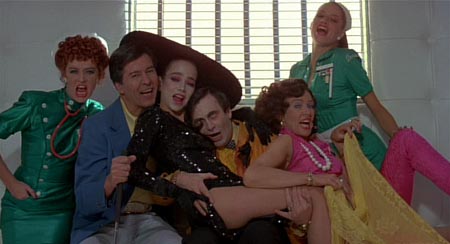
Still from Shock Treatment (1981)

WHY IT WON’T MAKE THE LIST: Shock Treatment is a cult film even among the tiny subset of cult film enthusiasts. This “sequel” was rejected as a confounding disappointment by most fans of The Rocky Horror Picture Show, but is still vehemently defended by a segment of that fan base. It’s a peculiar exercise in wacky musical satire, for sure, but it lacks the kind of résumé necessary to place it among the most significantly weird movies of all time.

COMMENTS: What would you get if you took The Rocky Horror Picture Show and stripped out Tim Curry‘s domineering performance as the mad scientist transvestite dominatrix, leaving behind only the theater-rock musical numbers and campy supporting players? (On the off-chance you don’t see where I’m going yet, the answer is Shock Treatment). Whereas Rocky Horror was a theatrical flop that organically grew into a cult movie, Shock Treatment was pitched as a deliberate cult movie, but became an instant flop. This delayed follow-up is full of amped-up ideas and energy, but it comes off as cocksure; it’s so convinced its madness is entrancing that it forgets to ground us in its quirky universe. The (confusingly executed) idea is that the entire town of Denton, U.S.A. is a TV studio, with the audience as regular citizens, the stars and staff as sorts of metro officials, and the sponsors as big-money villains manipulating studio politics behind the scenes. The movie throws so many colorful eccentrics at us that every character turns into a minor character, even the leads. Janet (not necessarily the Janet Susan Sarandon played in the previous movie) and Brad (again, a character with the same name but little connection to the original) enter the town’s audience, for unclear reasons, and wind up on a marriage counseling show run by a blind Austrian in an orange thrift-store tuxedo. He hands Brad off to a brother/sister pair of psychiatrists (writer Richard O’Brien, wearing uncomfortable- Continue reading CAPSULE: SHOCK TREATMENT (1981)

LIST CANDIDATE: TOMMY (1975)

Scott Sentinella’s writing has appeared in “The Carson News”, “The Gardena Valley News”, “Animato”, “Videomania Newspaper”, “Cashiers du Cinemart”, Dugpa.com and ALivingDog.com.

DIRECTOR: Ken Russell

FEATURING: , Ann-Margret, Oliver Reed , Eric Clapton, Elton John, Jack Nicholson, Tina Turner, Paul Nicholas, , Pete Townshend, John Entwhistle

PLOT: Captain Walker is missing and presumed dead in World War II, but when he turns up alive, his wife’s new lover kills him. Unfortunately, Walker’s son Tommy witnesses this, and the trauma leaves him deaf, dumb and blind. But Tommy can still play a mean pinball, and he becomes an odd messiah to an army of idol worshipers.

Still from Tommy (1975)

WHY IT SHOULD MAKE THE LIST: Because, with that story line, it’s a musical—literally a “rock opera”—and because Ken Russell stages every single scene like something out of a bad acid flashback.

COMMENTS: The Who’s original 1969 album, “Tommy” is wonderful to listen to, but its supposed story is impossible to figure out without, so to speak, illustrations. In this film, one of the first recorded in multi-channel sound, director Russell “illustrates”everything in the most garish hues possible—and that’s a good thing. This grotesque, excessive rock musical was clearly a predecessor to MTV, with its non-stop assault of insane imagery; Russell, not exactly the most subtle of filmmakers, is aided and abetted all the way through by an all-star cast. The Who’s lead singer, the great Roger Daltrey, inevitably plays Tommy with a vacant, blue-eyed stare, and belts every song to the back of the theater in the manner that made him famous (on the original “Tommy” album, his singing is much more low-key). Elton John, as the Pinball Wizard, parades around on stilts, while Tina Turner, as the Acid Queen, threatens to rip the screen apart with her intensity (although Paul Nicholas, as Tommy’s physically abusive Cousin Kevin, gives her a run for her money). Meanwhile, Eric Clapton as the Preacher, Keith Moon as the sexually abusive Uncle Ernie, Jack Nicholson (Ann-Margret’s old co-star from 1971’s “Carnal Knowledge”) as the Doctor, and Oliver Reed, as Tommy’s stepfather, are relatively subdued (and, yes, the last two are pretty terrible singers). Topping them all is Ann-Margret, in an unforgettable Oscar-nominated performance, as Tommy’s guilt-ridden mother. Obviously, Ann-Margret’s show tune-trained voice is really not suited to singing Pete Townshend’s music, but that only adds to the film’s strange appeal. Ann-Margret manages to be simultaneously brilliant and over-the-top (as she often is—see her Blanche Dubois in the 1984 version of Streetcar Named Desire), but when the part calls for her to roll around in baked beans and chocolate sauce, she doesn’t hold back. Then you have any number of frenzied images: Sally Simpson’s husband—a dead ringer for the Frankenstein monster, Tina Turner transformed into a giant hypodermic needle, Clapton preaching in a church filled with statues of Marilyn Monroe, Paul Nicholas burning Daltrey with a cigarette—this is a musical, all right, but it’s not exactly Meet Me in St. Louis. This version of Tommy may be bizarre to the point of self-parody, but anyone who’s ever seen the disastrous, but similar, Sgt. Pepper’s Lonely Hearts Club Band (produced, like Tommy, by Robert Stigwood), will understand the very special talents of the late Ken Russell.

Unfortunately, the Region 1 DVD (as well as the Blu-Ray) of Tommy has no extras, except for a paper insert describing the film’s “Quintaphonic” soundtrack. Luckily, the movie looks and sounds just fine.

WHAT THE CRITICS SAY:

“Russell correctly doesn’t give a damn about the material he started with… he just goes ahead and gives us one glorious excess after another… Tommy’s odyssey through life is punctuated by encounters with all sorts of weird folks, of whom the most seductive is Tina Turner as the Acid Queen.”–Roger Ebert, Chicago Sun-Times (contemporaneous)

104. WILLY WONKA AND THE CHOCOLATE FACTORY (1971)

“What is this, a freak out?”–Violet Beauregarde

Must See

DIRECTED BY: Mel Stuart

FEATURING: , Peter Ostrum, Jack Albertson, Julie Dawn Cole

PLOT:  Charlie is a poor boy supporting his mother and four bedridden grandparents with the earnings from his paper route.  When eccentric chocolatier Willy Wonka announces he will be awarding a lifetime supply of chocolate and a tour of his mysterious candy factory to the finders of five golden tickets, Charlie wants to win more than anything.  When he, along with four bratty companions, finally meets the exceedingly odd Mr. Wonka,  Charlie finds the factory, and its owner, far stranger and more magical than anything he could have imagined.

Still from Willy Wonka and the Chocolate Factory (1971)

BACKGROUND:

  • A note for those who believe product placement and corporate tie-ins are a recent phenomenon in movies: although this film was based on Roald Dahl’s bestelling children’s novel “Charlie and the Chocolate Factory,” it was retitled to incorporate the Wonka name in order to promote the release of real-life Wonka candy bars (which were still made up until 2010) by Quaker Oats, who financed the production.
  • Dahl himself wrote the original script, but it was extensively rewritten by an uncredited David (The Hellstrom Chronicles) Seltzer, reportedly to Dahl’s displeasure.  (It’s worth noting that Dahl, like most authors, pretty much hated every adaptation of his work).
  • This was the only movie Peter Ostrum (Charlie) ever acted in.
  • The movie just broke even at the box office, but became a cult sensation thanks to television screenings and home video.  In 2003, Entertainment Weekly ranked Willy Wonka and the Chocolate Factory as the 25th biggest cult movie of all time.
  • The score was nominated for a “Best Music, Scoring Adaptation and Original Song Score” Oscar but lost to Fiddler on the Roof.
  • Despite the fact that he was rejected for the role of the candy shop owner in the film, Sammy Davis, Jr.’s 1972 rendition of the film’s first musical number, “The Candy Man,” became a #1 hit and a staple of his live shows.
  • Charlie and the Chocolate Factory, Tim Burton‘s 2005 adaptation of the same material with as Wonka, is somewhat closer to Dahl’s original novel.

INDELIBLE IMAGE: Wonka’s face, bathed in flashing red and green lights, as he shrieks incoherently at the end of his terrifying trip down a psychedelic tunnel of horrors.  It’s the capping image of a horrifying scene that’s been scarring unsuspecting children for 40 years now.

WHAT MAKES IT WEIRD:  Is it Gene Wilder’s ultra-eccentric performance as the charming but vaguely demonic candyman in a purple velvet jacket and burgundy top hat who suavely arranges for wicked children to hang themselves with the licorice ropes of their own vice? Or the chorus of orange-faced, green haired, dwarf laborers who sing moralizing “Oompah Loompah” tunes after each victim ironically offs him or herself? No, we all know it’s the bad trip boat ride, where Wonka recites Edgar Allan Poe inspired verse (“By the fires of Hell a’ glowing/Is the grisly reaper mowing?”) as the craft careens down a tunnel of horrors while colored strobe lights flash and avant-garde footage plays on the walls that tips this celebration of imagination into the weird column.


Original trailer for Willy Wonka and the Chocolate Factory

COMMENTS: When I was a kid, they used to play Willy Wonka and the Chocolate Factory on Continue reading 104. WILLY WONKA AND THE CHOCOLATE FACTORY (1971)