Tag Archives: Monster

APOCRYPHA CANDIDATE: MÉCANIX (2003)

366 Weird Movies may earn commissions from purchases made through product links.

DIRECTED BY: Rémy Mathieu Larochelle

FEATURING: Julianne Côté, Stéphane Bilodeau

PLOT: One of the last surviving humans has discovered the embryo of the universe, and the hideous monsters who now control the world are desperate to keep him from using it to destroy them.

Still from Mecanix (2003)

WHY IT MIGHT JOIN THE APOCRYPHA: The parade of unholy stop-motion concoctions gets our attention. The unflinching vision of a filmmaker in his only significant cinematic credit stokes our curiosity. But it’s those things in service of apocalyptic vibes and a story that is both bleak and somewhat irrelevant that pushes this film strongly towards consideration. It’s a movie beholden to nothing but itself.

COMMENTS: One of my favorite obscure novels is Future Boston, a shared universe by a collective of Beantown science fiction writers who imagined the fate of their city if the first alien contact was made smack dab in the middle of Boston Harbor. One of the significant characters in the book is Bishop 24, a mysteriously formal interplanetary overseer, resembling a gigantic praying mantis, who shepherds humanity into the galactic community. Interaction with the Bishop is described thusly: “The Bishop has a habit of moving in a quick, jerky fashion when his attention is distracted. This is unnerving to some people and has been known to cause epileptic seizures.” To depict the movement and bearing of a creature alien to us, the writer essentially describes classic stop-motion animation.

Rémy M. Larochelle undoubtedly recognizes this alien and uncanny quality. For his sole outing as a feature filmmaker, Larochelle unveils a rogues’ gallery of fascinating and appalling creatures. Shot in a dark sepia tone that makes every scene feel like deleted footage from a snuff film, Mécanix feels like a nightmare that the filmmaker was compelled to get out of his system any way he could, and 16mm stop-motion was the only tool he had at hand. Knowing that, he leans into both the imaginative potential and technical limitations of the technique; Mécanix features a remarkable variety of animated critters, looking variously like equine bipedal skeletons, bubo-ridden Buddhas, tree mermaids, wire-brush birds, and bad-permed llamas. Their appearances are already terrifying, but the hallmarks of their animation—spasmodic jerkiness, absence of motion blur—only heighten their disturbing nature. With flailing cable appendages and misplaced heads, they need only be themselves to be the stuff of bad dreams. Daniel Lagacé’s industrial sound design— an array of distorted clangs, whirrs, and whooshes—helps to give the varmints unnatural life.

Through interviews and key art, you can tease out the hint of a plot involving a lost embryo that, if found, will defeat the alien invaders and restore the promise of life to humanity. The live-action scenes exist primarily in service of this throughline. But the story is largely beside the point, as is demonstrated whenever humans and manipulated maquettes are called upon to share the screen. When they do so, the technique is most often a rudimentary split screen, with the actors standing carefully still while the monsters react dramatically to whatever plot development is presented to them. (It’s a reminiscent of the way Björk dances in front of oversized insects in her “Human Behaviour” video, although of course with none of her screen presence.) But the choice works because the aliens, in one of the few pieces of dialogue, explain the deadly power of emotion, so foreign and deadly to them that even the whiff of a flower could destroy them.

Larochelle knows this is only going to work if things get pretty gross. Early on, we watch a doctor search for the embryo by yanking out the innards of her few remaining fellow humans. Later, a man will invert the procedure by vivisecting an avian creature in an impressively effective piece of puppeteering. (In fairness, he’ll end up doing a little grisly self-surgery as well.) And the monsters often take themselves apart and reassemble for locomotion or conversation. None of this is frightening, exactly, but Mécanix is so viscerally broken and oozy that the effect is more powerful than a jump-scare. It all just feels so unfamiliar and not-at-all right.

Larochelle began working on Mécanix right out of college and spent four years filming and animating the piece. It’s a point in favor of his native Canada that a movie like this can not only be made, but even get funding from the National Film Board of Canada. At a lean 70 minutes, it still feels like it could use a little tightening. There isn’t much in the way of conflict: the aliens demand the embryo, the man steadfastly refuses to give it, and the finish has the whiff of anticlimax. But there’s no denying that Mécanix is a singular effort, one that combines animation technique and icky atmosphere in a form that resembles little before or since. You might say that it’s “unnerving to some people.”

WHAT THE CRITICS SAY:

“Imagine then if someone had rifled through Ray Harryhausen’s bins, scavenging for his discarded works. Those ideas that he deemed too weird to finish. Imagine too that this “someone” then took that weirdness and ran with it, stripping the designs back to their most basic forms, at times down to their wire frame maquettes. Such are the denizens of Larochelle’s world… this little slice of the bizarre is a beast that stands tall and one that more than holds its own…” – Andy Stewart, Nerdly

(This movie was nominated for review by Morgan. Suggest a weird movie of your own here.)     

IT CAME FROM THE READER-SUGGESTED QUEUE: FIEND WITHOUT A FACE (1958)

DIRECTED BY: Arthur Crabtree

FEATURING: Marshall Thompson, Kim Parker, Kynaston Reeves, Terry Kilburn, Stanley Maxted

PLOT: An officer at a an American air base in rural Manitoba teams up with a comely young researcher to investigate mysterious deaths, which locals blame on a top secret nuclear project.

Still from fiend without a face (1958)

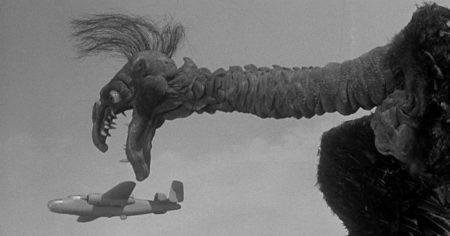
COMMENTS: This time a year ago, I was absorbing the marvels of a wondrous motion picture entitled The Giant Claw. That film built its mystery by hiding its central antagonist for a significant portion of the running time, permitting the imaginations of audiences to run wild searching for an explanation. This was followed by an enormous shift in tone due to the eventual revelation of the monster, a silly, gangly mess that drastically undercut the gravity of the story.

In some respects, history repeats itself with Fiend Without a Face, a movie in which we actually witness the murder of several townspeople by a force we cannot see, thereby building a mystery around what precisely is going on. As for what happens when we do finally lay eyes upon the title character… well, let’s just come back to that in a bit, shall we?

During the very long time that Fiend Without a Face itself waits for that big revelation, it has to fill the time with distractions. There are repercussions over the activities at the air base, which NIMBY-leaning locals blame for the mysterious deaths as well as for a decrease in dairy production. There’s the slow-burning investigation by Major Cummings, which at one point takes a lengthy side trip to a cemetery crypt. Cummings also gets the film’s romance plot, making eyes at the sister of the first victim, helped in part by an especially egregious shower scene. While none of this is boring, exactly, it’s not particularly interesting, especially since the audience is primed for a monster. It’s up to a cast of impressively obscure nobodies to sell the escalating tension through horrified stares and dramatic physical lurches. (The only cast member whose name rang any bells for me was E. Kerrigan Prescott, better known in these parts for his mad-scientist turn from Godmonster of Indian Flats.) They succeed only modestly, adding to the pressure to deliver something extraordinary at the climax.

It is a heck of a thing we ultimately get, so let’s talk about these monsters who have been sucking out their victims’ brains and spinal cords. Turns out they themselves are brains. Literally brains, with spinal cords for tails, eyestalks, and two little kickstand proboscises that deprive humans of their, well, brains and spinal cords. In the story, they’ve been wished into existence by a retired professor who Major Cummings deduces has been performing poorly vetted experiments with mental powers. In filmic terms, they’re brought to life through a combination of stop-motion animation, ill-concealed wire work, and broad acting. Oh, and they’re are goofy as all get-out. Look, I understand that special effects from yesteryear can’t be judged by the technology of today. That’s fine. But they’re still just brains, either animated to move like snakes or flown about like marionettes. The logic of brain-eating creatures that are themselves brains is impossible to parse. So you’re left with something that’s quite ridiculous, but also not quite ridiculous enough.

The climactic showdown between a group of humans trapped inside a house while a horde of flying brains tries to bust in was notable in its day for its new levels of violence and gore. (The film was called out as offensive in the British Parliament.) The setting also seems to presage settings to come, such as those seen in Night of the Living Dead or Evil Dead II. But this film’s solution is the equivalent of sending the cavalry. After all, what saves the day? How does one defeat a foe that has been created by an unholy blend of nuclear power and the untapped recesses of the human mind? Why, with guns, of course. The trio of Air Force officers starts taking out the little airborne cerebella by peppering them with bullets (and the occasional blunt instrument), resulting in a gleefully gross stew of blood and effluvia. It’s a classically 1950s mindset, using brute force to overcome the odds. This carries over to the most absurd plot element, in which Cummings saves the day by blowing up the nuclear power plant with dynamite. (Certainly no potential downside to that plan.) 

Fiend Without a Face is light fun, a solid representative of 1950s cinematic horror boasting three salient characteristics: an intriguing premise, very low-budget production, and a monster that doesn’t quite live up to the hype. File it next to similar efforts from the period like Beginning of the End, The Amazing Colossal Man, or The Crawling Eye. You know, the kind of film that works best if you just shut off your brain.

WHAT THE CRITICS SAY:

“There can be no purer surrealism in cinema than the sight of these twitching brain-things besieging a house full of people, leaping and plopping like possessed frogs. The entire climax has the bizarreness of some mad medieval allegory, like a triptych by Hieronymus Bosch” – Nigel Honeybone, Horror News

(This movie was nominated for review by Paula. Suggest a weird movie of your own here.)

CAPSULE: THE GIANT CLAW (1957)

366 Weird Movies may earn commissions from purchases made through product links.

DIRECTED BY: Fred F. Sears

FEATURING: Jeff Morrow, Mara Corday, Morris Ankrum, Edgar Barrier

PLOT: When an unidentified flying object terrorizing the globe is discovered to be an enormous, grotesque bird, the planet’s collective scientific brainpower and military might are brought to bear against the winged menace.

Still from The Giant Claw (1957)

COMMENTS: One of the great stories of cinema is the tale surrounding the production of Jaws. It seems the robotic shark that was built to terrorize the citizens of Amity was temperamental at best, unusable at worst. Accordingly, director Steven Spielberg was forced to scrap many of the intended scenes featuring the automated predator, instead resorting to obfuscatory tricks to keep the villain hidden until the last possible moment. This ended up working to the film’s benefit, as the star’s delayed entrance only served to magnify the tension. Spielberg had stumbled backwards into brilliance.

Of course, it’s questionable how much his tactics would have worked had the ultimate reveal of the shark not paid off the suspense. Once the chum-shoveling Roy Scheider comes face-to-face with Bruce the animatronic carcharodon, then we’re off to the races, because the reveal has justified the withholding. You can believe your eyes. It is the black-eyed, remorseless killing machine we were promised.

In some respects, The Giant Claw faces precisely the same dilemma. The filmmakers want to hold back the full and awesome power of their beast for as long as possible. We get hints, of course: blurry visions of an airborne foe, evocative descriptions of a flying creature “the size of a battleship,” an enormous footprint indicating the immensity of the monster, and many Spielbergian stares into the unseen maw of a force to terrible to behold. But at some point, the monster has to be revealed. And when at last it is… my goodness, how can I do this justice? Can it even be conveyed? I mean, here are just a few examples of my peers attempting to reckon with this thing:

All true, and that last one probably comes closest to illustrating just Continue reading CAPSULE: THE GIANT CLAW (1957) →

CAPSULE: THEY CRAWL BENEATH (2022)

366 Weird Movies may earn commissions from purchases made through product links.

Beware

DIRECTED BY: Dale Fabrigar

FEATURING: Joseph Almani, Karlee Eldridge, Michael Paré

PLOT: A series of earthquakes has unleashed deadly nematodes, and Danny is forced to confront his lineage while awaiting rescue from this wormy menace.

Still from They Crawl Beneath (2022)

COMMENTS: Upon finishing They Crawl Beneath, I discovered a message on my answering machine regarding a matter that required prompt attention. This effort took approximately eighty minutes to bring it—not quite—to a close. During my various intervals of being put on hold while I was shuffled around between departments, an unfortunate thought occurred: I was finding this mundane tedium far more satisfying than Dale Fabrigar’s film.

They Crawl Beneath has no respect for the audience’s attention, or intelligence. And a creature feature has no business being this slow, much less waiting until the midpoint (the first half ranking among the least pleasant 40 minutes I’ve endured in a movie) for the crawlers in question to fully mount their offensive. And speaking of offensive, I was nearly tickled with dismay at the character Doctor Wu, a definitely-Asian scientist who somehow has all the answers and, somehow, meets an off-screen death mentioned in one of the throwiest-away of throwaway lines I’ve ever heard. But I get ahead of myself: Jimmy the Cop is a good guy with a bad uncle and a dead dad, who gets trapped under a vintage car in a garage geographically situated in an earthquake-prone part of the world. He faces some worms and familial demons while his girlfriend hovers in the periphery—usually delivering lines in a monotone trance.

Sound cues do all the work for you, be they declarations of “Here there be melodrama!” or of “Here there be scary!” The heavy-handedness of the score bordered on ridiculous, but unfortunately maintained a heartfelt dalliance with boring bombast. Whatever they paid the actors, it was too much—and even more so, the screenwriter. It’d take someone with the B-movie charm of ten Bruce Campbells to compellingly deliver lines like, “Gwen, listen to me: I want to live. For you, and our baby” (oh yes, I had forgotten they threw in a truly random pregnancy to ratchet up the… something), or what I can only presume was an attempt at comedy, “I am definitely hallucinating.”

The movie did nothing well—my time could hardly be described as valuable, but even I felt insulted by this rotten attempt at storytelling. And though my game of phone-tag and being put on hold is, alas, not quite complete, I take considerable comfort in the fact that at least my experience with They Crawl Beneath is over with.

WHAT THE CRITICS SAY:

“The result is a really weird combo platter of interpersonal dysfunction within the context of a monster movie, and however many creatures are lying below, They Crawl Beneath might have resonated better had it decided on what kind of a film it really wants to be.”–Jeffrey Kauffman, Blu-ray.com (Blu-ray)

CAPSULE: GALAXY OF TERROR (1981)

aka Mindwarp: An Infinity of Terror

366 Weird Movies may earn commissions from purchases made through product links.

 DIRECTED BY: Bruce D. Clark

FEATURING: Edward Albert, Erin Moran, Ray Walston, Robert Englund, , Taaffe O’Connell, , , Bernard Behrens

PLOT: On a mission to investigate the disappearance of a lost spaceship, the crew of the Quest confronts an alien monster that hunts them by preying upon their worst fears.

Still from Galaxy of Terror (1981)

COMMENTS: No one ever accused Roger Corman of failing to capitalize upon someone else’s success. Having seen Alien reap box office gold, he and his mercenary studio New World Pictures quickly put together a film based upon a simple principle: an alien hunts a space crew one by one. Of course, what Corman and his cohorts never seemed to consider (or, more likely, could not be bothered to care) was that Alien was much more than merely a slasher film transplanted into outer space. The earlier film used foreboding and patience in a way that its imitator couldn’t even contemplate. Where Alien carefully developed the complex interpersonal relationships of the crew of the Nostromo, Galaxy of Terror just spits out one-line motivations and outsized character tics and hopes that will generate some empathy. We’ve got the blueprint here, but the only parts that carried over were the alien and the dead crew.

Galaxy of Terror is cheap. After all, it’s a Roger Corman production. But amazingly, it doesn’t look cheap, and a great deal of credit goes to the production designer, a promising young fellow by the name of James Cameron. (He also served as second-unit director and took on other behind-the-scenes roles.) The spaceship milieu is rich and convincing – the set is allegedly supplemented with spray-painted McDonald’s containers – while a walk through the chambers of an alien pyramid is vividly unfamiliar. The visual style readily evokes Cameron’s future endeavors, such as The Terminator and Aliens, and it’s entertaining to see him deploying his talents early on.

The story is considerably less accomplished. That notion of an enemy that can exploit your worst nightmares is intriguing (and would later be explored extensively by co-star Englund), but is only haphazardly pursued here, usually by a character announcing their worst fear and promptly being confronted with it in the next scene. Moran is claustrophobic, but her particularly grim fate is sealed less by confined spaces than by the vicious tentacles that attack her. Haig’s demise at the hands of his own crystal throwing stars is one of the film’s most effective pieces of visual horror, but makes little sense when you realize his weakness isn’t fear, but faith. In most cases, one has to assume that what the victims fear most is a large-clawed, bloodsucking monster, because that’s what most consistently does them in.

Which leads us to the film’s most notorious sequence, in which Continue reading CAPSULE: GALAXY OF TERROR (1981) →