Tag Archives: Independent film

READER RECOMMENDATION: MOTIVATIONAL GROWTH (2013)

Reader Recommendation by Bryan Pike

DIRECTED BY: Don Thacker

FEATURING: Adrian DiGiovanni, , Danielle Doetsch, Pete Giovagnoli, Ken Brown

PLOT: Ian Folivor, a depressed and reclusive 30-something, finds himself taking advice from a fungal growth in his bathroom after a failed suicide attempt.

Still from Motivational Growth (2014)

INDELIBLE IMAGE: The film’s lead impossibly suspended horizontally while sucking greedily from a wall-mounted fungal teat, followed closely by the animatronic mold itself.

WHY IT SHOULD MAKE THE LIST: That the protagonist communicates with a talking fungus is strange enough to warrant potential inclusion, but for a movie limited to the confines of an apartment this film takes on a truly epic and bizarre scope, with spore-induced hallucinations involving infomercials and B-grade science fiction TV shows, demonic TV repairmen, a bathroom murder and dismemberment, a sweet romantic sub-plot and by the film’s close, genuine questions as to what of the preceding 104 mins was real or imagined.

COMMENTS: “The Mold knows, Jack, The Mold knows…”

Normally when considering the first feature of an independent film director one makes allowances for certain technical shortcomings: out of focus shots, poor film stock, a bump in a dolly shot or two, things obvious to the seasoned film viewer but which are ignored in good faith and focus given to the storytelling or performances. There is no such necessity in this film, there are no such flaws to note. In terms of technical craft alone this is easily the most impressive debut I’ve seen from any feature director; the rich and developed performances and storytelling are equally impressive.

The aforementioned fungal teat sequence, the circuitous, overhead crane shots of Ian on his filthy couch, and even a quasi-bullet time shot of the lead falling in the bathroom; are all ambitious, complex shots which are executed effortlessly. The grimy, festering detritus of Ian’s depression made manifest in the scattered garbage filling his apartment is an impressive feat of art direction.

I’d classify it as an absurdist, theatrical, sitcom take on Enter the Void, at least in the sense of a post-death hallucinatory journey (or is it?). It features a shut-in who attempts suicide and is then given a new lease on life by an enormous fungus growing in his bathroom. “The Mold”, an animatronic puppet voiced by Jeffrey Combs, guides our protagonist back to a clean, regular life—if sucking from wall-mounted fungal teats, altercations with demonic TV repairmen, and dream sequences involving infomercials can be considered “regular”.

The puppet for “The Mold” is a refreshing break from the digital in our overly-CGI’ed times, reminiscent of the impressive practical effects from 80’s films like The Thing or The Howling. Jeffrey Comb’s assured, mellifluous voice is the perfect contrast to the wired, intense performance of Adrian Giovanni. The 8-bit music, while fitting the period (early 90’s) and the aesthetic of Thacker’s Imagos production company, is occasionally jarring compared to the action on screen. Although varied and amusing, the TV infomercials playing on Ian’s unit, “Kent” are perhaps the weakest aspect of the film; this satire of vapid and bombastic TV programming has been done better elsewhere, notably Fight Club, or, let’s be honest, the better moments of SNL. To Thacker’s credit it would be difficult at this stage to bring something fresh and inventive to such satire, given the sheer glut of both modern television programs and subsequent parodies.

Ian also merges with these TV programs in some kind of day dream or hallucination, with television’s Kent accusing Ian of betrayal, saying that he “looked after him” long before (the Mold?) did. In the overall context of the film it remains unclear whether Kent is a separate character and rival to the Mold for Ian’s allegiance. Is Kent—who often uses the same language as The Mold—merely an extension of it? The ambiguity employed is merely distracting, rather than serving as an engaging mystery within the film.

The only other complaint one could make of the film are that the level of technical innovation and impressive camera feats drop off towards the end (though this is more a reflection of the story taking prominence over on-screen auteur flourishes at that stage), and that the ambiguous ending leaves one feeling dissatisfied. At various points during the film it is hinted that Ian is dead (or at the very least that “someone” has died) and that our film experience is a hallucinatory afterlife trip inside Ian’s head. But this is arguably the least satisfying outcome or final premise for the film. Isn’t the buildup towards Ian’s “improvement” and the possibilities this direction takes us in (i.e. what are the Mold’s designs for Ian within the larger world outside the apartment?) more intriguing than “oh, Ian’s dead and this is him working things out in the afterlife as his corpse is consumed by mold”? I may have simply been hoping for a different film based on the initial premise than what transpired.

Ultimately, despite these minor misgivings, the film remains an impressive and vastly entertaining debut feature that rewards subsequent viewings for more details as to the nature of what we’ve witnessed.

WHAT THE CRITICS SAY:

“…you can categorize Motivational Growth under “The Weird,” and I mean that as a true compliment.”–Matt Donato, We Got This Covered (contmeporaneous)

CAPSULE: BUZZARD (2014)

DIRECTED BY: Joel Potrykus

FEATURING: Joshua Burge, Joel Potrykus

PLOT: After his latest con goes bad, a slacker and small-time scam artist goes on the run, taking along his homemade Freddy Kruger glove.

Still from Buzzard (2014)

WHY IT WON’T MAKE THE LIST: It’s not that weird, although it is an outside-the-box indie with a unique slacking-class take on American society.

COMMENTS: “You’re just trying to cheat the system?” asks an exasperated bank clerk when Marty Jackitansky takes advantage of a loophole to get a bonus for opening a new checking account. “Absolutely,” he responds. “For fifty dollars?,” the clerk continues, incredulously. “Absolutely!” replies Buzzard, with pride. (Although Marty is never explicitly referred to by that avian moniker in the film, the name is perfect for this scavenger). Marty’s completely clueless, utterly unmerited self-esteem is hilarious, and tragic; it seems the smaller the stakes of the scam, the more jazzed he gets. You might conclude Marty’s self-worth is wrapped up in his ability to get by on his wits, but isn’t really self-conscious enough for such vanities. It’s just that Buzzard has little interest in anything beyond video games, junk food, splatter flicks, metal, and the minor adrenaline rush he gets from seeing a two-figure check made out in his name. Lying simply comes as second nature to him. Gaunt and rumpled, with a slouchy swagger, Joshua Burge plays the character as a young man perfectly confident in his own indifference to his social status. Director Potrykus plays cubicle-mate Derek, the Beavis to Burge’s Butthead. He’s a corporate drone whose equally blind to his own beta-male status; he has the temerity to call his basement apartment “the Party Zone” and has such meager social prospects that he longs for approval from big brother figure Buzzard.

The style might be described as “minimalist punk,” with long takes (the already-notorious five-minute spaghetti eating scene) punctuated by bursts of senseless vandalism scored to death metal riffs. The DIY aesthetic is authentic, and the film is as unpretentious and brash as Buzzard himself. Buzzard mixes a bemused, clear-eyed disdain for its title character with a gentle touch of affection for his adolescent antics. Marty scorns the system, but he doesn’t actually oppose it; he just is disinterested in playing the game, and so tries to skate by under the authorities’ radar. Buzzard understands the psychology and sociology of pathologically shortcut-obsessed losers; it also sympathizes with his plight, without endorsing his behavior. Watching Buzzard, we feel some measure of compassion for this blatant con dude, even while he’s staring us in the face with disdain and thinking up ways to rip us off. That’s some scam to pull.

This is the third in an unofficial “animal” trilogy by Potrykus, all starring Burge. The first was the werewolf (!) short “Coyote,” followed by the 2012 feature Ape (about a pyromaniac comic). Buzzard is the best-received and distributed of the three. Both Potrykus and Burge are talents to keep an eye on.

WHAT THE CRITICS SAY:

“The dark, weird and hilarious ‘Buzzard’ is definitely a great slacker movie.”–Brad Keefe, Columbus Alive (contemporaneous)

LIST CANDIDATE: SOME CALL IT LOVING (1973)

AKA: Sleeping Beauty; Dream Castle

DIRECTOR: James B. Harris

FEATURING: , Tisa Farrow, Carol White, Richard Pryor, Veronica Anderson, Logan Ramsey, Pat Priest, Brandy Herrod

PLOT: Based on the John Collier short story “Sleeping Beauty.” A hedonistic millionaire, entranced by a carnival act involving a girl who has been asleep for years, purchases her and brings her home.

Still from Some Call It Loving (1973)WHY IT MIGHT MAKE THE LIST:  Far stranger than the synopsis would suggest, Some Call it Loving is a surreal, dreamlike take on relationship dramas. A precursor to the modern erotic thriller, it would make for an interesting double feature paired with Boxing Helena, or even Singapore Sling.

COMMENTS:  The entire genre of the “erotic thriller”—from such highlights as 9 1/2 Weeks, the steamy cable series “Red Shoe Diaries,” and Eyes Wide Shut all the way down to the low-level late night chum on Cinemax (or Skinemax, as it was nicknamed due to its reliance on such fare)—shares primary DNA with the not-as-well-known early precursor Some Call It Loving. Lead actor Zalman King would make it a cottage industry in the 80s and 90s, co-writing and producing 9 1/2 Weeks and directing Wild Orchid, Two Moon Junction and episodes of “Red Shoe Diaries” (the series he created), among others.

King’s character here, Robert, lives in a mansion with two women, Scarlett (White) and Angelica (Anderson). The three pass the time by indulging in role-playing “games” (seducing a widow, disciplining the maid, dancing nuns) that always lead to sexual situations. The only times Robert ventures into the “real world” is when he gigs as a session player with a jazz group at a bar and has conversations with his friend Jeff (Pryor), a musician who’s fallen into hardcore junkiedom.

During one of these excursions he goes to a carnival and discovers the “Sleeping Beauty,” Jennifer (Farrow), as a sideshow attraction, drugged to remain asleep. Patrons pay for one kiss to wake the Beauty—and more, it’s strongly implied. Robert decides to purchase her to take her back with him. Robert returns with Jennifer, who is accepted into the household; when she awakens, she’s also incorporated into the game-playing. But does this lead to a Happy Ending for all?

Although is provides the seed for later erotic thrillers, Loving can’t actually be classed as one. Instead, it’s a dark, fractured fairy tale in line with its source material (John Collier’s treatment of the “Sleeping Beauty” legend). In the story, the emphasis is on the man who purchases the Beauty. That holds true in Harris’ adaptation as well, but he goes further and deeper than Collier.

At the outset, Robert appears to be a “kept” man. Scarlett seems to be the wealthy benefactor, with Angelica being a recent addition to the family, and it appears that this setup has been in effect for some time. But while some may find this to be a fantasy come true, Robert is dissatisfied. His conversations with Jeff provide him with some distraction, but Jeff’s descent insures that he won’t be around for long.  Robert’s malaise is relieved by Jennifer’s arrival, but only for a short time. At first she enjoys the company and the game-playing, but it ends up in further dissatisfaction.PryorEtiquette Pictures, the uptown division sub-label of Vinegar Syndrome, made Loving their debut release in a Blu-Ray/DVD package in Summer 2015.  Done in a 2K restoration from the original negative, this is the best Loving has looked in any of its prior home video releases. Numerous extras are included, such as a commentary with writer/director Harris, a featurette on the making of the film, one on cinematographer Mario Tosi (Carrie, The Stunt Man), and outtakes featuring actress Millie Perkins, whose role was cut from the finished film.

Writer/director James B. Harris was ‘s producing partner for his early films The Killing, Paths of Glory and Lolita.

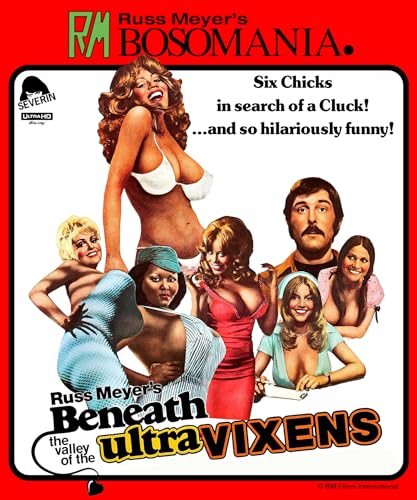
RUSS MEYER’S BENEATH THE VALLEY OF THE ULTRA VIXENS (1979)

366 Weird Movies may earn commissions from purchases made through product links.

Beneath the Valley of the Ultra Vixens (1979) is the last authentic Russ Meyer film (he returned only to produce 2001‘s rarely-seen Pandora Peaks, which is, as to be expected, an idiosyncratic interpretation of the documentary genre). Co-written by (under his “R. Hyde” pseudonym), Meyer’s swan song is film as one additional cup size enhancement. It has charmed moments of Meyerisms, including his trademark spry editing, but adds erratic eroticism. Meyer once claimed it was the favorite of his own works (although he said the same of Beyond the Valley of the Dolls). This may be an echo of Paul Gauguin’s claim that the artistic process was more satisfying than the finished work. Coloring Meyer’s sense of nostalgia for the film was his admission that he constantly engaged in sex with star between takes. According to Meyer, the actress introduced him to multifarious taboos and was even more oversexed than he was.

As in Up! (1976), the plot is emaciated Surrealism. The relationship (so to speak) between Surrealism and pornography has been complex since the movement’s inception (works by Georges Bataille, Susan Sontag, and Theodor Adorno are among essential writings on the subject). Meyer’s brand of Surrealism is strictly visceral, which renders him closer to authentic Surrealism than to soft-core porn. For the Surrealists, porn’s lack of social acceptability amounted to an endorsement. However, its totalitarian simple-mindedness prevented a complete embrace, or mimicry. Rather, elements of pornography proved influential to the aesthetics and tenets of Surrealism.

Of course, Meyer did not associate himself with any –ism, and it’s doubtful that he gave much thought to categorizing his work. He simply stayed true to his sense of craftsmanship, making films that he would want to see. He voluntarily returned to the limits of independent budgets as opposed to compromising with Twentieth Century Fox, who any other indie filmmaker would have killed to work for. That anti-bourgeoisie, stubbornly rebellious streak invites a comparison to Surrealist bad boys such as Andre Breton, , or George Antheil. However, as much as Meyer was obsessed with breasts, he was equally preoccupied with cartoonish slapstick; another surrealist plane of identification. His films, especially his last two, are akin to a visualization of a Carl Stalling collage.

Still from Beneath the Valley of the Ultra-vixens (1979)The gossamer narrative revolves around Lavonia (Natividad) who is sexually unsatisfied with hubby Lamar (Ken Kerr). As the “Small Town USA Narrator” (Stuart Lancaster in a pickup truck) informs us, “Lamar, with a 37 IQ, is strictly a rear window man ((One might speculate as well how much of this plotline was semi-autobiographical. Meyer claimed that Natividad introduced him to anal sex, which she was apparently preoccupied with)).” Lamar’s fetish gets him fired from his job (no perverts allowed here), and drives Lavonia into the sheets with her vibrator. She follows this by having affairs with Mr. Peterbuilt (Pat Wright), teen meat Rhett (Steve Tracy) and lingerie salesman Semper Fidelis (Michael Finn). Oddly, wifey’s bonding with the battery powered machine drives Lamar into a far greater frenzy than her extramarital rendezvous.
With a slinky dress and gaudy wig from Semper, Lavonia hits the strip clubs under the stage name of Lola. Borrowing a plot from countless opera librettos, the husband comes across his disguised wife and does not recognize her. Lavonia’s ruse to trick her husband into good old fashioned vaginal intercourse utterly fails, driving Lamar to seek gay counselor Asa Lavender (Robert Pearson) and female Benny Hinn type-Eufaula Roop (Anne Marie) for conversion therapy.

Meyer’s camera work and editing is at it most -like, fixating on inanimate objects, most of which are utilized as phallic and vaginal symbols (such as a record player). He also employs extreme close-ups of Natividad’s sex parts paralleled, per the norm, with vivacious sound effects.

While much of Meyer’s work intersects sex and violence, there is virtually none of the latter here and, with no real antagonist, Beneath deliriously celebrates the joy of sex. Meyer had once planned a film titled The Bra Of God, which for various reasons did not come to fruition. However, in that planned title and this film we locate the pulse of Meyer’s inseparable art and life. Existential questions are banished. Like the birds, bees, ants, and fish, the relevance of life pertains primarily to pleasure found in sexual union. We share that with the beasts and primitives. The sole difference is we do not, or should not, divorce love (and appreciation of beauty) from sex. For Meyer, pursuit of power, acquisition of dyed green paper, and the quest to find an invisible deity are pursuits for the unenlightened.

Russ Meyer's Beneath The Valley Of The Ultravixens [4K UHD]
  • An unwashed look at Small Town, U.S.A., complete with faith healers, war criminals, bosom buddies and the loin-girding quest for sexual salvation.

CAPSULE: PATCH TOWN (2014)

DIRECTED BY: Craig Goodwill

FEATURING: Rob Ramsay, , Suresh John, Zoie Palmer, Stephanie Pitsiladis, Ken Hall

PLOT: Jon works on an assembly line pulling fetal dolls from out of cabbages, but his dim memories of a loving mother lead him to venture out into the wider world searching for answers to the riddle of his past.

Still from Patch Town (2015)

WHY IT WON’T MAKE THE LIST: The promising idea is like something a young would dream up, but the execution is like something an old Tim Burton would deliver.

COMMENTS: Patch Town starts from a finely macabre premise—what if “Cabbage Patch” dolls were really alive, and after their owners outgrew and abandoned them they had their memories wiped and were retired to harvest more of their kind in an industrial hellhole run by totalitarian overseers? Unfortunately, by the end of the movie, this bent premise has been straightened out. When ex-toy Jon ventures out of his dystopia and becomes a fish-out-of-water in modern Manhattan, Patch Town becomes more Elf than Brazil. Sloppy plot points, obvious jokes, soft rock balladry, predictable beats, and sickly-sweet sentimentality undermine every novel idea the script invents. The film’s mixed-bag nature is evident from the earliest frames. Eerie shots of silhouetted storks flying in front of smokestacks show a flair for realizing storybook nightmares, but they also indicate Patch Town‘s mixed-up mythology: what is the role of storks in a world where babies are born from cabbages?

Patch Town is also a musical, which adds to its kitchen-sink credentials, but the movie would have benefited from channeling its musical energies into comedy instead. Lyrics are thrown out at almost random points, with little production behind them: characters mostly just walk and sometimes share their thoughts in song. The comedy fares little better. Cherubic Rob Ramsay is likable and physically perfect for the role, especially with his dollike mop of hair, but his antics busts minimal guts. Although his shtick is mostly limited to a funny accent, Suresh John’s Sly seems intended to be the spotlight comic relief character. Instead, it’s Ken Hall’s sadistically practical henchman who comes off the best (he declines to eat children because “you have to have boundaries”).

Patch Town is so good-spirited that it’s as hard to hate as a chubby-faced doll. The movie’s dystopian opening suggests that it’s going to subvert sentimental kids’ films, but ultimately it sides with the cute. If you read the premise and thought you were in for some bitter fun, you will be disappointed by the sugar rush. Patch Town was extended into a feature from a 26-minute short; the original was probably the perfect length, since the full-length film has about 26 minutes of good ideas.

WHAT THE CRITICS SAY:

“Patch Town’s frequently lands pretty far to the left of the dial, and anybody unable to get on its weirdo wavelength may grow fatigued by the film’s many flights of fancy.”–Charles Bramesco, The Dissolve (contemporaneous)