
Director Matty Brown decided to work on a passion project with a few friends about anxiety and depression. The spot-on depictions of the subject make it his weirdest short to date.
Tag Archives: Experimental
SATURDAY SHORT: DOG CHASED A CAT (2017)
Just some computer dog and cat stories.
SHORT: WHAT DID JACK DO? (2017)
366 Weird Movies may earn commissions from purchases made through product links.

DIRECTED BY: David Lynch
FEATURING: David Lynch
PLOT: A detective interrogates a monkey suspected of murder.

COMMENTS: David Lynch made the curious short “What Did Jack Do?” in 2017 for a French museum exhibit, and screened it once more at his own Festival of Disruption in 2018. Other than that, this bit of monkey business was an overlooked footnote in his filmography, until Netflix dropped it onto their streaming service on January 20, 2020 (on Lynch’s 74th birthday).
Shot in Eraserheadian black and white, with Lynchian signatures like coffee and a left-field musical number[efn_note]It’s also worth noting that a talking monkey had the briefest of cameos in Twin Peaks: Fire Walk with Me.[/efn_note], “Jack” is basically a two-hander (almost a one-hander, since Lynch not only plays the interrogating detective, but also provides the monkey’s voice). There is a plot, of sorts, but mostly, it’s the detective and his simian suspect trading absurdist quips that occupy a space between the ineffably sinister and the ambiguously cliched: “Don’t worry. I’ve heard the phrase ‘birds of a feather flock together.’ A perceived fundamental. There are, of course, exceptions.”
“What Did Jack Do?” is, in essence, Lynch futzing around with the Surrealist potentialities of Syncro-Vox—the technique pioneered in the 1950s in which human lips are superimposed over animals or animated characters. Lynch’s experiment is extremely sophisticated, with his usual attention to detail: visually, the lips are blended so well that they almost pass as a real feature of the Capuchin monkey, remaining just off enough to supply an uncanny undertone that harmonizes wonderfully with the overt absurdity of a talking monkey in a suit and tie. Jack’s face is, of course, blank, and his gaze flits randomly, but depending on dialogue Lynch chooses to put in his mouth he can appear lovesick, resentful, or nervous. That’s a wonderful surrealist illusion. The result, while arguably slim, is still arresting and worth your time—and it goes without saying, a must-see for Lynch completists.
I showed it to a young Lynch neophyte; her main takeaway was “Jack is cute!”
Netflix’s business practices give them a lot to answer for, but they deserve credit when they get it right. “What Did Jack Do?” is a super-niche offering that won’t be bringing the streamer new subscribers, but they’ve done a hell of a service to the cinephile community by making it available at all.
WHAT THE CRITICS SAY:
“It’s weird as hell, man, and I can’t get enough of it.”–Miles Surrey, The Ringer (Netflix release)
SATURDAY SHORT: PASTEL NOIR (2019)
Painter Beau Bardos took inspiration from a David Lynch quote about becoming a filmmaker, “I was looking at my painting and wanted it to move.” In this, his first-ever short, Beau set out to do precisely that.
Content Warning: This short contains adult situations and violence.
CAPSULE: JUBILEE (1978)
366 Weird Movies may earn commissions from purchases made through product links.
DIRECTED BY: Derek Jarman
FEATURING: Jenny Runacre, Jordan, Toyah Willcox, Nell Campbell (as Little Nell), Jack Birkett, Richard O’Brien
PLOT: Queen Elizabeth I requests her court sorcerer to summon the spirit Ariel to show her Britain’s future, and witnesses a bleak vision of apocalyptic decay.
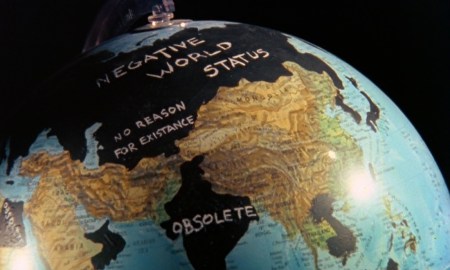
COMMENTS: An occasionally brilliant and often muddled mess of an artwork, Derek Jarman’s Jubilee lurks in a strange netherworld of identification. This is, admittedly, a typical “problem” for the movies that end up on the shores of this weird internet isle of ours, and it is a credit, in a way, to Jarman’s particular particularity that his movies tend to be both too weird to be arty while also being too arty to be weird. It’s a strange categorization, to be sure, and the call I made in not considering Jubilee Apocrypha-worthy was a tough one.
Jubilee is an Elizabethan period piece that flashes forward to then-contemporary 1970s London, which was in economic doldrums and still riddled with bombed-out, clapped-out, and otherwise derelict streets and homes. The narrative seems full of plot holes, but that fits nicely with the punk aesthetic that Jarman was, depending upon your perspective, either cynically celebrating or subtly satirizing. Clothes full of holes, ‘zine literature smashed together from ripped-up sources, and even punk’s musical style: all of it was intended to reflect decay, despair, and anger. These elements dovetail in Jubilee as we watch a loose gang of nihilistic young women spend their time breaking things and people, all while incongruously sucking up to the mysterious, flamboyant, and giggle-prone one-man superpower, “Borgia Ginz,” a music and media mogul.
The tone of Jubilee veers in as many directions as the scattershot narrative. There’s a heartwarming (if controversial) romance between two men (who are possibly brothers; the explanation is neither clear nor reliable), who eventually allow a young female artist into their relationship. But there’s also malignance. “Bod” and “Mad” (two of the girl gang members, possibly lovers) wantonly harass and then beat up a diner waitress early in the film, and then continue this cruel streak throughout. “Amyl Nitrate”, played by Punk-era icon Jordan, oscillates between petulant monologues (in the form of her world history she’s writing) and tender gestures with “Crabs” (Little Nell, whose status as the most convincing actor in the movie is saying something). And of course, what 1978 anarchic-socio-commentary-guerilla film would be complete without a young Adam Ant (then something of a nobody) as the latest protégé of Jack Birkett’s other-worldly, hyper-energized Borgia Ginz?
Derek Jarman was an artist of considerable talent: be it in the world of painting, production design, or direction. He was also someone to whom no friend or overseer (if there were any) could say “no.” While this allowed for a far more interesting oeuvre than might have existed otherwise, it was also to that oeuvre’s occasional detriment. What could have a tighter, tidier Jubilee looked like? I know, I know: I just lamented a lack of tightness and tidiness in a punk movie about the punk ethos, so perhaps I’m missing the point. But bearing that in mind, even I couldn’t help but be impressed with this glorious mess of style, pathos, music, and philosophy.
WHAT THE CRITICS SAY: