Tag Archives: Dystopian

CAPSULE: THX 1138 (1971)

“You are a true believer, blessings of the State, blessings of the masses. Work hard, increase production, prevent accidents, and be happy!” — automated life coach booth in THX 1138

Recommended

DIRECTED BY: George Lucas

FEATURING: , Donald Pleasence, Maggie McOmie,

PLOT: A citizen of a future dystopia rebels against his society and must flee the consequences, hobbled by the people he genuinely cares about.

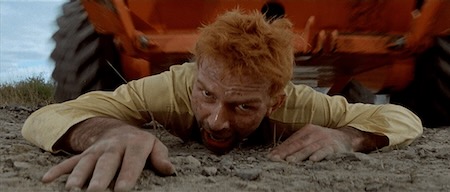
Still from THX 1138 (1971)

COMMENTS: The first thing we must do is firmly separate the subject of THX 1138‘s creator from the discussion of THX 1138. That alone makes this a challenging movie to view objectively. We’re here today to decide whether THX 1138 is a weird movie. Would the discussion be the same if its famous director wasn’t also the guy who made Star Wars?

George Lucas sows creative seeds here which will later bear fruit in Star Wars. The legions of android cops who chase the title character and company around brings to mind future Stormtroopers; their shiny metallic faces would later update into the countenance of C-3PO. The society is that of a hivemind of stoic drones, like many worlds in the Star Wars universe. Lucas, the world’s champion in the Second-Guessing-Yourself Olympics, would re-release new cuts of THX 1138; new versions opened with a brief trailer for the classic serial Buck Rogers series, which Lucas indicated was a huge influence on Star Wars (as if we couldn’t guess).

When it comes to THX 1138, Buck Rogers is far from its main influence. THX 1138 is about a futuristic dystopian society where one citizen rebels and tries to either escape the system or bring it all crashing down. Other movies in this genre using this exact same story template include (*deep breath!*): Metropolis, The 5,000 Fingers of Dr. TAlphaville, Fantastic Planet, Brazil, Akira, Zardoz, The Apple, Snowpiercer, High-Rise, The Platform, and Greatland, just to mention a few already reviewed here. Now consider the literature: “1984,” “Brave New World,” and the never-adapted, shamefully underrated Ira Levin novel This Perfect Day.” These literary works share a ton of DNA with THX 1138.

The dystopian genre produces both some of mainstream cinema’s most beloved masterpieces and some titles from the crème de la crème of the List. But it’s been done. Every kind of batty off-the-wall dystopia idea has been done ten times.

So THX 1138 fails at originality. However, it is strong in execution. Like all the great sci-fi classics from the mid-20th century, it has a distinct look and feel all its own. The movie’s entire society is housed underground, so it has a claustrophobic mentality from start to finish. Even though it’s a color film, the palette is, pathologically, a glaring white with gray and black accents. Everyone is shaved skinhead-bald, regardless of gender, which together with the pure white pajamas they wear makes them all appear like laboratory rats frantically Continue reading CAPSULE: THX 1138 (1971)

CAPSULE: THE WANTING MARE (2020)

366 Weird Movies may earn commissions from purchases made through product links.

DIRECTED BY: Nicholas Ashe Bateman

FEATURING: Jordan Monaghan, Josh Clark, Edmond Cofie, Christine Kellogg-Darrin, Nicholas Ashe Bateman

PLOT: Moira, the latest in a matrilineal line, suffers the nightly dream of a hopeful yesterday while enduring the desperate circumstances of her dystopian milieu.

COMMENTS: Imagine yourself outside, idly contemplating the setting sun. You are about to arise to go and do something—anything—when an insect lands on your forearm and begins crawling around. The next thing you know, you’ve been observing it for the better part of ninety minutes, intermittently enthralled by some detail, but mostly in a trance-like state as arm and insect come in and out of focus. Suddenly the insect flies off, heading over the horizon as you gaze placidly in the direction of its escape. So it was with this reviewer and The Wanting Mare.

Moira lives a life of wistful ennui in a rustic hipster’s paradise. Her home is well-worn but soundly constructed. It’s not in the city, but within easy walking distance. And it overlooks a beautiful stretch of coast. Her days are spent milling about, in the house or on the beach, and her nights are spent in town, in the basement of a derelict building. Deep-blue mood bulbs are strung around what was once a dance floor, and a superannuated eight-track player blasts out a live recording of a singer who we eventually learn was Moira’s mother. Moira does not like sleeping, because she always has the same dream.

Nicholas Ashe Bateman (whose full name always showed up wherever I read of him online, so I shall extend this courtesy—up to a point) tips the viewer off right from the start. The film’s opening line, spoken by a dying mother to her infant daughter, is “You’re gonna have a dream.” So will the audience. If “smash cut” refers to scattershot sequences of violence in action movies, then I shall dub whatever NAB is up to “drizzle cut.” Despite concrete scenes of action (mostly dialogue), The Wanting Mare primarily drips micro-scenes together in montages of hypnagogic (a word I looked up exclusively for this sentence) smears of images. Movement along a beach. Swaying to some music. Even the handful of scenes featuring amateur bullet extraction have a lazy, semi-shaky effect.

I’m something of an idiot when in the act of watching a movie, so it took me until the final scene to realize that this story was a parable. I had already begun to forgive the filmmaker for the shambling first half, and this new awareness effectively cleared the faults I had been stacking in my mind. The Wanting Mare‘s plot device is a promise of leaving on a ship that departs this city once a year, a voyage for which you need a white ticket. Time and again, key characters forego an opportunity to escape to a mystical land of horses and winter, in order to live their lives as best they can, and change their world for the better. It took awhile to get there, and I risked falling asleep at times, but when that insect on my arm flew off at the end, I kind of missed it.

WHAT THE CRITICS SAY:

“It’s a gorgeous effort, poetic and somber and dreamlike. But it lacks a central voice, and without that, any real connection with the audience.” -Hope Madden, UK Film Review (contemporaneous)

CAPSULE: DEAD END DRIVE-IN (1986)

366 Weird Movies may earn commissions from purchases made through product links.

DIRECTED BY: Brian Trenchard-Smith

FEATURING: Ned Manning, Natalie McCurry, Peter Whitford

PLOT: After two of his tires are jacked at a drive-in theatre, Jimmy finds himself trapped in the car lot with his girlfriend and hundreds of society’s rejects.

COMMENTS: It’s a glorious thing to randomly stumble into a movie and find out that it’s Australian. This pleasant surprise was augmented by an error on the part of the video streaming service, which claimed that Dead End Drive-In was from 2011. I was awed at how the filmmakers had captured everything about New Wave dystopian aesthetics a quarter century after the fact. When I saw the copyright date at the end of the credits I was somewhat disappointed, but also relieved. (“That makes a whole lot more sense,” my brain acknowledged.) Still and all, it Brian Trenchard-Smith’s “ozploitation” picture is a helluva lotta fun.

Trenchard-Smith was the brains behind Turkey Shoot, another “society collapses, and here’s a mess of violence” film, set in the post-apocalyptic year 1995. It hasn’t gotten as bad by the time Dead End Drive-In takes place, but it’s getting there. Jimmy (Ned Manning) is a wiry weenie of a guy who wishes his rough, tough brother would let him in on his lucrative towing business. Car parts are a hot commodity, so whenever a car gets smashed up, the first wrecker on the scene gets the bounty. Jimmy borrows his brother’s ’57 Chevy to take his sheila to the Star Drive-In for a movie and sex, during which the passenger-side wheels are swiped. Jimmy is informed by the fatherly drive-in operator that, no, he’s not going anywhere. Ever.

The misfit milieu found within this open-air prison (which doubles, nightly, as a drive-in theatre) is everything one could hope for from a mid-’80s assemblage of the best deadbeats society has on offer. Transvestites, drug users, vandals, welfare bums… I put these all in the same list not to cast any particular judgment or insinuate moral comparability, but because they all fit in the slot that button-down 80s traditionalists would consider “undesirable.” However, they’ve formed a raucous-but-welcoming society within this prison. There are occasional brawls, sure, but there’s a camaraderie, as evidenced by the freely intermingling coteries and the pick-up games of cricket.

Dead End Drive-In‘s camera work is worlds better than should be expected for a B-movie actioner. An early foreshadowing shot of a jogging Jimmy beautifully frames him behind a chainlink fence, the center demarcated by two perfectly placed tail-fin cars. The “Star Drive-In” first appears in a postcard-worthy frame. And a low shot of a police van approaching a cockerel on the lot captures the startled bird as it is flanked by the moving vehicle tires.

My one criticism of the film would be its strangely shoe-horned social commentary. When a convoy of Asian prisoners arrives at the drive-in, the locals immediately get riled up and speechify about the intruders. Obviously the director is trying to say something, but it’s both a little unclear (is all “white trash” racist?) and over-the-top (everyone but our hero immediately goes from zero to vicious in their racist mania). Regardless, Dead End Drive-In is a wonderful diversion filled with New Wave classics, gratifying camerawork, and Australians.

WHAT THE CRITICS SAY:

“…a doozy of an Ozploitation piece packaged with crazy characters, bizarre situations and solid action.”–Ian Jane, DVD Talk (Blu-ray)

(This movie was nominated for review by “dirty_score.”  Suggest a weird movie of your own here.)

APOCRYPHA CANDIDATE: GREATLAND (2020)

366 Weird Movies may earn commissions from purchases made through product links.

RecommendedWeirdest!

DIRECTED BY: Dana Ziyasheva

FEATURING: Arman Darbo, Chloe Ray Warmoth, Jackie Loeb, Nick Moran,

PLOT: On his fifteenth birthday, Ulysses must live up to his namesake when his friend Ugly Duck is exiled to Repentance island.

WHY IT MIGHT JOIN THE APOCRYPHA: This is the only film I’ve seen that could hold its own on a double bill with Alien Crystal Palace. For those (many) of you who haven’t seen ACP, read on and I will attempt to explain…

COMMENTS: Early on in GREATLAND, an elite team of enforcers known as “The Optimists”—a flash-gay, scantily clad group of glamboyant men, one of whom is armed with a weapon decorated with shimmering hearts that reduces its target to sequins—vaporize an ancillary character. This man’s crime? He “invaded and contaminated the most sacred part of a woman,” and compounding that offense, he raised that crime’s result—his daughter, Ugly Duck—in an altogether “stone age” kind of way. Yessir, we’ve reached a post-post-post-modern future in GREATLAND, one in which there is no permitted gender or racial identity, and society seems to be tipping into no identifying as species, either. The citizens of Greatland are allowed to know only love, acceptance, and positivity.

The film’s first act seems to be an anti-progressivist screed, a reducto ad absurdum commentary on the destruction of traditional norms (gender and otherwise). An all powerful “Mother” program monitors the childlike populace with the firm-but-benevolent hand found in many dystopian visions. This film doesn’t seem like it could have been authored by your stereotypical reactionary, however. The satire is too spot-on, from the gloriously flaming gayness of the forces employed to maintain order, to the hyperkinetic “political” broadcasts featuring a wheelchair-bound, pansexual emcee who oversees the current contest for the official “Sweetheart of Greatland” (the contestants are a Dobermann Pischer and a Persian Cat).

Above and beyond the madness of its setting, this is a story about Ulysses (an altogether impressive Arman Darbo) and his pursuit of the invisible man’s daughter. GREATLAND works, mostly, as a quest narrative. Mostly. Just as it works, mostly, as a satire. Mostly. Around the halfway mark, we see a bit of the “outside world,” which starts to make some sense. “Greatland” is some kind of social-experiment-by-way-of-enslavement for the financial benefit of the inventors and propagators of the city in question. However, a minor application of logic makes this element crumble to pieces, as well. Dipping her fingers into so many subversive pies, Dana Ziyasheva ultimately upends the massive dessert tray she’s put together.

Does this make GREATLAND weaker than it could have been? Possibly—but it’s much better than my strained metaphor. The lumps of damaged pie filling and cracked crust still manage to sate both the eye (dystopia is rarely this colorful) and the psyche. The final note I made while watching this movie is an entire page covered with a question mark. A logical mind cannot hope to wrap this all together. But after finishing GREATLAND, bewildered though my reason was, I couldn’t deny the unpleasant lump in my stomach. Something dark and strange is happening in this movie, and its structural chaos and contradictions are perhaps part of the overall message. Ziyasheva seems to be saying we are doomed to terrible absurdity. Or perhaps she’s just having us on.

WHAT THE CRITICS SAY:

“…(too) ambitiously weird… If GREATLAND is an allegory (and I have no doubt it is), I couldn’t tell you what it is trying to say or represent… As a simple fantasy romance, the film is perfectly engaging, but the society is way too bizarre (yes, even for me) and once the politics is introduced it becomes truly nonsensical.” -Alix Turner, ReadySteadyCut.com (contemporaneous)

CAPSULE: THE ANTENNA (2019)

Bina

366 Weird Movies may earn commissions from purchases made through product links.

DIRECTED BY: Orçun Behram

FEATURING: Ihsan Önal, Gul Arici, Levent Ünsal

PLOT: A building supervisor deals with strange occurrences after a satellite antenna is installed in his apartment building to broadcast new government-sponsored news bulletins.

Still from The Antenna [Bina} (2019)

COMMENTS: Set in a Kafkaesque cinder block, but clearly inspired by life in Erdoğan’s Turkey, The Antenna establishes its propaganda theme right away. Mehmet, an unassuming apartment building supervisor, listens to a government-sponsored radio broadcast as he dresses. Posters of a generic middle-aged strongman decorate the concrete pillars he passes as he walks to work through gray, deserted streets. The morning report declares that the government will be rolling out an elaborate communications system intended to integrate all media, one which will require the installation of a satellite dish on the roof of Mehmet’s building. This achievement will be celebrated with a special midnight broadcast—one which all citizens are strongly encouraged to watch.

Although the contemporary relevance is obvious, The Antenna is set in an indeterminately authoritarian time and place. Along with the drab utilitarian architecture, the celebration of satellite antenna television as cutting-edge technology suggest a Communist country in the 1980s. The film’s aesthetic is grimly Stalinist: residents wardrobes are almost all shades of black, white or gray (Mehmet is praised for the “seriousness” of his utilitarian, monochromatic suit). Only the younger characters, not yet fully integrated into this society, wear the occasional splash of brown, or even dull yellow or red. The cinematography favors shallow-focus shots, with background characters blurred, emphasizing each character’s isolation. Strong sound design contrasts with the grim visuals. Horror movie music plays from the pipes in the walls, and the noise of the outside world subjectively mutes when characters are in moments of crisis. At one point Mehmet’s ears are overwhelmed by a welter of staticky, overlapping propaganda broadcasts.

The Antenna builds a strong atmosphere of dehumanization and quiet despair, full of subtle threats, such as the way Mehmet’s boss playfully slaps his face to remind him of their respective ranks in the power structure. It springs some effective horror moments: black goo oozing from the wall and ceiling tiles, Mehemt seeing a column of anonymous identical silhouettes peering out of their compartmentalized windows. Angry synthesizers and VHS quality satellite broadcasts speak to the influence of Videodrome and other 1980s dystopias. For all of these virtues, however, the script lacks some urgency. It spends too long introducing us to the desperately bland lives of the tenement dwellers; even though the first kill comes 30 minutes in, it still feels slow. Nor does the two-hour journey build to a powerful climax. The ending is a series of weird visual and auditory metaphors, which happen to the characters rather than developing as a consequence of their actions. The grand finale is a confrontation with a lackey; we never burrow down to the source of the evil. Despite these reservations, debuting director Behram shows obvious skill in building fear. It’s a talent that might be better harnessed in service of a more propulsive script in the future.

WHAT THE CRITICS SAY:

“…this atmospheric nerve-jangler tips its hat to David Lynch’s gothic surrealism and David Cronenberg’s squirmy body horror, with pleasing detours into Dario Argento-style lurid giallo mania, too… [a] hauntingly weird debut.”–Stephen Dalton, The Hollywood Reporter (festival review)