Tag Archives: Animation

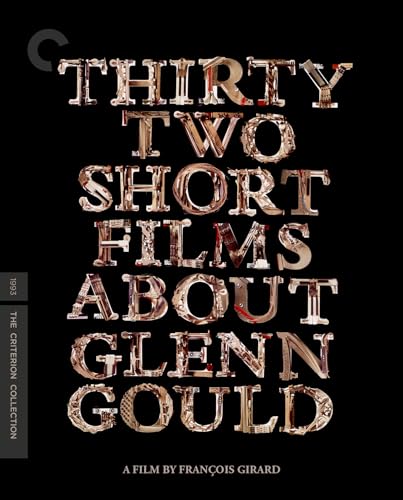
CAPSULE: THIRTY TWO SHORT FILMS ABOUT GLENN GOULD (1993)

366 Weird Movies may earn commissions from purchases made through product links.

DIRECTED BY: François Girard

FEATURING: Colm Feore

PLOT: A patchwork of short vignettes explores the allure of the eccentric piano virtuoso.

Still from thirty two short films about glenn gould (1993)

COMMENTS: I discovered my all-time favorite recording, Glenn Gould’s complete “The Well-Tempered Clavier,” and François Girard’s Thirty Two Short Films About Glenn Gould at about the same time. I can’t definitively remember which I encountered first: my guess would be Girard’s film, because it is such an effective advertisement for Gould’s genius that it seems likely to have inspired a purchase. On the other hand, it’s entirely possible that I saw there was a film out about this marvelous pianist who accompanied his nimble fingers with ecstatic spontaneous humming,  breathing humanity into Bach’s precise baroque miniatures, and knew I had to learn more about this man. I do know that Gould’s “Clavier” was reissued in on CD in 1993, likely to coincide with this film, and I love to imagine I actually picked up that set from Tower Records and rented a VHS of Thirty Two Films from my local mom and pop video store on the same weekend in 1993 or 1994.

The movie does what it says on the tin (although some might object to calling the closing credits a “short film.”) The sequences break down into four main categories: documentary-style interviews with friends and co-workers, dramatic reenactments of events in the pianist’s life, adaptations of Gould’s own works, and abstract experimental sketches. The interviews are illuminating, and give the film its hybrid documentary character. The dramatic scenes form the bulk of the movie. They follow in a roughly chronological format, but do not tell a continuing story: each is a standalone vignette. Memorable moments show Gould corralling his hotel chambermaid to listen to his hot-off-the-presses LP and the Gould mesmerized by contrapuntal conversations he hears in a diner. A performance of “String Quartet, Opus 1,” one of his few original compositions, an excerpt from the word collage “The Idea of North,” and a dramatization of a portion of his puckish essay “Glenn Gould Interviews Glenn Gould About Glenn Gould” ground us in the legend’s actual creative output. The experimental shorts constitute the most intriguing category, although there are only five or six of them (considering how you count). They include closeups of Gould’s own CD318 piano in action, hammers striking the soundboard, illustrating the physical geometry of the sonic construction; a scene of Gould playing the piano in x-ray vision; and “Gould Meets McLaren,” a 1969 animated short (originally entitled “Spheres”) that shows globes popping into existence, dancing symmetrically across the screen, and dividing like eggs undergoing musical mitosis as Gould plays a Bach fugue.

I once defined bopic as “a movie genre that’s not accurate enough to be documentary or interesting enough to be fiction.” One of the most formulaic and cliched film formats, the celebrity biography only really works when it is heavily fictionalized, as in Amadeus or Lisztomania (which, coincidentally, both involve classical musicians). Thirty Two Short Films shatters the mold of this generally insipid movie genre. There are enough talking head reminiscences to capture the spirit of the man, but not so many that it appears lazy. Girard solves the genre’s central problem—the fact that messy human lives rarely fit neatly into three act structures with unified themes—by ignoring narrative almost entirely. This collage portraiture method captures its subject more faithfully than a “realist” approach would. When we think back on people we know, we recall them as a collection of moments and characteristics; we don’t think of them as a contiguous life story. Glenn Gould was the piano prodigy and the hypochondriac and the man who went everywhere wrapped in a coat and gloves and scarf and the man who called up his friends late at night and talked their ears off and the virtuoso who developed a hatred for performing and the monster who put ketchup on his eggs and the genius and the possibly asexual hermit. He is at least thirty two separate stories, and this seemingly chaotic collection of vignettes creates a portrait of a real person far better than a tick-tock chronology or a forced storyline would. Plus, the music is, naturally, great, and what Gould himself likely would have wanted us to focus on; his passion shines through every segment, turning almost anyone into a classical music fan for at least 90 minutes. Glenn Gould is a strong contender for the greatest biopic ever made.

Thirty Two Short Films About Glenn Gould entered the Criterion Collection in June 2025 on 4K UHD and Blu-ray. Of course it is a new 4K director approved transfer. Of course it comes with a booklet (a nice fold out broadsheet with titles and scenes from the shorts on the other side) with an informative essay (from Michael Koresky.) Of course it has a director’s commentary (Girard is joined by co-writer Don McKellar). Other extras include a thirty minute conversation between Girard and fellow Canadian director Atom Egoyan, archival interviews with star Colm Feore and producer Niv Fichman, and a two part 1959 television portrait called “Glenn Gould: Off the Record” and “Glenn Gould: On the Record.”

WHAT THE CRITICS SAY:

“…because of the deadening uniformity of the genre, Girard’s film appears all the more miraculous in retrospect. From its rigorous and deliberately distancing structural gambit to its restless stylistic experimentations, Thirty Two Short Films proves that biopics needn’t color within the lines to effectively portray their subjects.”–Derek Smith, Slant (Blu-ray)

[(This movie was nominated for review, without further comment, by “Anonymous.” Suggest a weird movie of your own here.)
63*: WE ARE THE STRANGE (2007)

366 Weird Movies may earn commissions from purchases made through product links.

“We live in strange times. We also live in strange places, each in a universe of our own. The people with whom we populate our universe are the shadows of whole other universes intersecting with our own.”–Douglas Adams

Weirdest!

DIRECTED BY: M dot Strange

FEATURING: Voices of Halleh Seddighzadeh, David Choe, Stuart Mahoney, Chaylon Blancett, M dot Strange

PLOT: In the phantasmagorical metropolis of Stopmo City, two outcasts—eMMM, a boy with the head of a doll, and Blue, an ethereal, suffering young woman—search for a cherished ice cream parlor. Ongoing battles between grotesque monsters make their journey perilous. An avenging hero, Rain, defeats many of the monsters, but when the ultimate evil is revealed to be a harlequin-faced beast of a man called HIM, eMMM and Blue will have to confront the menace themselves.

Still from we are the strange (2007)

BACKGROUND:

  • M dot Strange is the nom de cinema of San Jose-based Michael Belmont, who in addition to dappling in animation is a  web designer, musician, and video game creator.
  • Demonstrating multiple animation styles, the film was created on multiple platforms of varying sophistication and complexity, ranging from Adobe After Effects to Mario Paint.
  • M dot chronicled the making of the film in a series of videos (like this one) that built a fan base of more than a million YouTube followers. Upon its release, the trailer for We Are the Strange racked up 500,000 views in its first four days.
  • The film received the Golden Prize for Most Groundbreaking Film and the Silver Prize for Best Animated Film at the 2007 Fantasia Film Festival.

INDELIBLE IMAGE: So it is foretold: “He will return and strike down evil with a fist made of aluminum foil. Then, we will celebrate with many scoops of iced cream.” And so it comes to pass, when a bubble-shaped automaton emerges to face off against the big bad, and the hellscape Power Ranger at the controls is revealed to be our diminutive dollboy with the M on his forehead. For a film that devotes itself to style over substance and a pervasive gloom, it’s an unexpected flourish of feel-good storytelling and a nifty summation of the director’s particular blend of high-tech and lo-fi animation techniques. Alas, the promised ice cream is not in evidence.

TWO WEIRD THINGS: Living, hungering arcade game; a trip on the ice cream train

WHAT MAKES IT WEIRD: Multiple forms of animation and visual styles share space in a bouillabaisse of dread and visual overstimulation. Stop-motion mingles with computer-generated anime, and both appear alongside 2D paper-folding and hand-crafted miniatures. Every scene feels crafted to be as outlandish and disturbing as possible. The randomness of it all is sometimes eclectic, often cacophonous, and frequently intriguing.

Trailer for We Are the Strange (2007)

COMMENTS: This is not the first time that a movie challenges us to Continue reading 63*: WE ARE THE STRANGE (2007) →

APOCRYPHA CANDIDATE: BOYS GO TO JUPITER (2024)

366 Weird Movies may earn commissions from purchases made through product links.

Boys Go to Jupiter is currently available for purchase or rental on video-on-demand.

DIRECTED BY:

FEATURING: Voices of Jack Corbett, Grace Kuhlenschmidt, , Tavi Gevinson, Julio Torres

PLOT: It’s winter break in Florida, and teenage dropout Billy 5000 is gigging to get five grand, but instead finds a donut-shaped alien creature.

WHY IT MIGHT JOIN THE APOCRYPHA: Mid-’90s-style computer-animation visuals in a mid-’00s-style slacker dramedy with a mid-’10s-style soundtrack make Boys Go to Jupiter something of a disorienting experience. Also: a dozen or so odd little aliens, a hyper-intelligent dolphin running a juice concern, and a Spanish-speaking mini-golf dinosaur skeleton.

COMMENTS: Too smart for school, but not mature enough to succeed as an adult, Billy 5000 also suffers from a strange last name, a misguided sense of purpose, and the weight of an impending technical correction crushing down on him. He seems all right, though, being one of those lucky teens: laid-back, sensible, and at least subconsciously accepting that life is stacked against him. Besides, he’s about to happen upon a singular opportunity for personal growth—it just won’t be the “Moolah” variety proselytized by the influencer he follows, or by rocking his Grubster™ gig.

Julian Glander has concocted (programmed? certainly directed) an unusual bildungsroman here, which could have so easily been drab and charmless had its pieces not been this selectively chosen and particularly assembled. The vibe from the simple 3-D animation isn’t uncanny so much as dreamlike, an element heightened by the prudent use of narrative pop songs. Billy flies above his delivery route, musing on life and wondering why everything feels so heavy… only to ground the scene with the realization he’s been carrying a sack of golf balls in his insulated delivery bag. (Freckles, the protagonist’s slightly younger—and far frecklier—friend starts as an aspiring hip-hop artist before deciding that the acoustic guitar is much more his thing: his grunge-style power ballad about different ways to eat eggs is a credit to the genre.)

The casual inclusion of outright surreal imagery is rattling, in a cute kind of way: simple faces may take up entire window frames, and, as hinted above, a Brontosaurus skeleton at a miniature golf course offers words of solace to its proprietor. Coupling the animation and the absurdity with an indie-drama vibe pays off handsomely, and that’s before we even get into the alien podcasters and dolphin machinations. Boys Go to Jupiter is both very strange and very laid-back, and zaps you for almost an hour and a half; a slice of life served up as exotic cocktail.

WHAT THE CRITICS SAY:

“…a movie notably unafraid to manifest the weirdest of the weird…”–Natalia Winkleman, The New York Times (contemporaneous)