Tag Archives: Alternate history

CAPSULE: JACKBOOTS ON WHITEHALL (2010)

DIRECTED BY: Edward McHenry, Rory McHenry

FEATURING: Voices of Ewan McGregor, , Rosamund Pike,

PLOT: British farmers unite with Churchill and Scotsmen to repel Nazis who invade London by

Still from Jackboots on Whitehall (2010)

tunneling under the English Channel.

WHY IT WON’T MAKE THE LIST: The idea of an absurd Nazi invasion of England acted out by children’s toys is odd and appealing, but the premise is undercooked, and never hits either the weird or (more importantly) the comic notes that it should.

COMMENTS: Hitler in a dress!  That should be funny, right?  It could be either a great punchline, or the beginning of a running series of gags that see (for example) der Führer more concerned with what’s going on with his hemlines than with developments on the front lines.  But Hitler’s transvestite cameo is emblematic of the problem with Jackboots.  The joke is never developed; the movie just trots out the dictator dressed as the Queen of England, with a pearl-handled Luger, and expects us to laugh.  Although the occasional amusing one-liner slips through the fog of war (usually delivered by in his dead-on Churchill impression), for the most part Jackboots‘ quips don’t exactly stomp on your funny bone.  They’re sparse, as well.  A lot of time is devoted to chuckle-free dramatic scenes between big-handed farmhand turned soldier Chris (McGregor), his lady-love Daisy (Pike), and her disapproving Vicar father (Grant), as well as to intricate battles between plastic Panzers and Punjabi guards that—considering they’re enacted with toy tanks fighting Ken dolls in turbans—are more thrilling than expected.  Jackboots is part WWII movie parody (with a roughneck American pilot who thinks the Nazis are Commies), part clever historical references (the defeated Brits retreat to Hadrian’s Wall, and the Germans are fearful of pursuing where even the Romans dared not go), and part pure silliness (a Braveheart spoof takes up a large part of the last act).  There is a running undercurrent of mock-prejudice against the Scottish (who are depicted as cannibals in skirts) that must be funnier to U.K. residents than to those in the U.S. and elsewhere—at least, I hope it is; otherwise, it’s just another Jackboots comic misfire.  The movie manages to be unique without ever finding its own voice, which makes it interesting without ever being engaging.  Mainstreamers hoping for a script with the sly gross-out humor of Team America or the pop-culture savvy of TV’s “Robot Chicken” (which uses the same action-figure aesthetic as Jackboots) will be disappointed, if not angry and frustrated, by the oblique comedy on display here.  But even if it’s not riotously funny, little touches like a ghoulish pig-nosed Goebbels, a cat who looks like Hitler, puppet gore, and an attack vanguard of bazooka-wielding Nazi dominatrices in black lipstick should be enough to keep weirdophiles watching to the end.

Though the end result is mediocre, Jackboots‘ crazy synopsis managed to attract top-notch cult British acting talent.  Besides McGregor, Pike, Spall and Grant, the voiceover cast includes Alan Cumming (as Hitler), Tom Wilkinson (as Goebbels), and (as Himmler).

WHAT THE CRITICS SAY:
“…for sheer oddity value… must rank as some kind of collector’s item.”–Henry Fitzherbert, Daily Express (contemporaneous)

CAPSULE: DETECTIVE DEE AND THE MYSTERY OF THE PHANTOM FLAME (2011)

DIRECTED BY: Tsui Hark

FEATURING: Andy Lau, Carina Lau, Bingbing Li, Chao Deng

PLOT: When court officials begin spontaneously bursting into flames as her coronation

Still from Detective Dee and the Mystery of the Phantom Flame (2011)

approaches, Empress Wu suspects a conspiracy and hires the one man she believes can uncover it: Detective Dee, whom she imprisoned years ago for treason.

WHY IT WON’T MAKE THE LIST:  Although there are some strange fantasy elements (an talking deer courtier called “the Chaplain”) existing alongside historical material (Empress Wu and Dee himself are real figures), when you get right down to it, Detective Dee is probably only as weird to Western eyes as Indiana Jones was to Asian eyes.

COMMENTS Detective Dee does just about everything above average, and it does one thing really well: art direction.  From the skyscraper-sized Buddha being built for the Empress’ coronation to the flooded underground city where lowlifes go to hide when the heat is on to the everyday pageantry of the Chinese imperial court, Dee is a fantastic looking film, and it’s always a pleasure to watch the film’s ass-kicking characters cavort across these carefully rendered backdrops.  The fight sequences (orchestrated by cult choreographer Sammo Hung) are typically spectacular—the scene where Dee kicks a leaping stag in the head as he flies by is amazing—but they sometimes lack spontaneity and soul, feeling over-studied and over-crafted.  (I admit to a prejudice here: I miss the balletic martial artistry of the old Shaw Brothers films that relied solely on the performers’ athleticism.  But I accept that wire fu is here to stay).  The abundant CGI effects are of acceptable quality, a few years and a few million dollars behind contemporary Hollywood standards; fortunately, they are mainly used for artistic rather than realistic effect.  The only place where Dee drops the ball a bit is in the plot.  Continuity and clarity are not qualities one expects to see highlighted in Hong Kong fantasies, but considering that this one is explicitly couched as a “mystery,” the audience might have expected a little more misdirection and revelation.  Instead, clues pop up arbitrarily, sending our detective to yet another exotic locale where enemy agents await him in ambush.  And with the introduction of various rebel factions and their separate schemes that may or may not be related to the main mystery, the plot gets confusing, without being particularly intricate.  Still, those are minor objections, easily solved by going into the movie with the expectation you’re going to be watching a detective who solves riddles with blows from his feet and his magic mace, rather than his mind.  Among its weirder features, Dee sports a talking deer with symbols scrawled on his head, robed robots, a kung-fu battle on top of two teams of thundering horses, and a character named “Donkey Wang” who disguises himself using acupuncture.  Dee isn’t a game-changing epic, but it is a two-hour mix of history, fantasy, pageantry, mystery, novelty, intrigue, spectacle and thrills—and that’s a lot for your entertainment dollar.

University of Texas-educated director Tsui Hark is one of the most important figures from the Hong Kong New Wave, basically founding the modern fantasy wuxia genre with his groundbreaking Wu: Warriors of the Magic Mountain (1983).  He has also been enormously important as a producer, financing and guiding odd fantastical projects like the unforgettable A Chinese Ghost Story (1987).  Before Detective Dee, Tsui had helmed a number of financial and artistically disappointing features since the Chinese takeover of Hong Kong in 1997.  This film has been widely hailed as a return to form by the beloved fantasy icon, and a prequel is already in the works.

WHAT THE CRITICS SAY:

“Nothing is meant to seem real in the Chinese ‘Detective Dee,’… [it] entertains us because it is so audaciously unreal.”–Chris Hewitt, St. Paul Pioneer Press (contemporaneous)

CAPSULE: NEVER LET ME GO (2010)

DIRECTED BY: Mark Romanek

FEATURING: Carey Mulligan, , Keira Knightley,

PLOT: Kathy,Tommy and Ruth grow up at the pleasant but isolated Hallisham Academy in a fictional Britain that never was; they fall in and out of love with each other and grow up to discover that the purpose of their lives has already been set for them.

Still from Never Let Me Go (2010)

WHY IT WON’T MAKE THE LIST:  It’s not weird, though the mix of genres is unprecedented.  The premise is speculative—it would be science fiction had it been set in the future instead of an alternate past—but the execution is conventional, laid down with a Merchant-Ivory-ish gravitas.

COMMENTS: I’ll respect convention and won’t give away the “spoiler” for Never Let Me Go, despite the facts that 1). the trailer reveals it to the observant viewer who has seen a couple of key B-movies from which the premise is derived, and 2). the mystery surrounding the children of Hallisham Academy is divulged about twenty minutes into the film. Point 2) is key, because this movie works not by slowly revealing twists and secrets, but by keeping us watching in horror at the ironic inevitability of the children’s unfolding fate. Locked away from the outside world in the comfortable but disquietingly totalitarian Academy, the kids make up horrible stories about what happens to disobedient children who leave the grounds (dismemberment and starvation); their myths about their own fates persist into adulthood, but the audience always understands that they are doomed even as they cling to desperate hopes.  One of the biggest problems with the film is that it lacks background detail; viewing things entirely from the perspective of the trapped children, we never get enough of a sense of the larger society and its skewed politics and ethics, and are left to raise a lot of issues for ourselves. Too many questions about this Brave Alternate World are left unanswered (primarily, why our protagonists go so gently into that good night, hardly struggling against their fate). The love story is predictable, but that doesn’t make it any the less emotionally affecting, thanks to some great performances. Carey Mulligan, a rising star, carries the film with an often heartbreaking performance: smarter and less prone to illusion than her companions, the despair starts to register in her eyes just a few moments before it reaches Garfield or Knightley’s.  She also cries on cue, including a doozy that rolls down her face and ends up hanging off her chin for a second or two.  Garfield, currently being groomed to be the next Spider-Man, is acceptable as the awkward and occasionally unbalanced male love interest, and Knightley is pro as the seethingly jealous and gently vindictive third point of the love triangle. Kudos go out to the casting director for signing a trio of child actors that are not only fine thespians, but are also almost perfect genetic models for their grown-up counterparts. The cinematography is pleasing, sometimes poetic, with lonely fields and deserted beaches lit by soft golden glows. Despite its effective mood of melancholy, however, the film never really takes off. Director Romanek seems self-conscious in adapting the famed literary property. He’s so careful to be respectful, restrained and tastefully subtle so that the film will come off as “serious” and “important” that the tale fails to live and breathe.  (Having the lead character deliver the obvious moral in a closing monologue—just in case viewers missed the script’s Oscar-caliber metaphors—was a bad decision).  The end result is a story that sends the viewer out mildly depressed, rather than existentially shattered. Despite not quite achieving its full potential, Never Let Me Go still a good choice for the arthouse patron jonesing for a flick with Brit accents, teardrops, and no car chases.

The film was adapted, with the author’s blessing and oversight, from Kazuo Ishiguro’s acclaimed novel.  Ishiguro’s main weird movie connection is that he wrote the original screenplay for The Saddest Music in the World, although director Guy Maddin and his writing partner George Toles significantly surrealized the British writer’s scenario.  Director Mark Romanek’s previous feature was One Hour Photo (2002), an offbeat psychological thriller that cast Robin Williams way against type as a creepy, delusional photo developer.  His first, hard to find feature Static (1985), about a worker in a crucifix factory who thinks he has found a way to take pictures of Heaven, is reputedly quite weird (thanks to L. Robb Hubbard for reminding us of that last point).

WHAT THE CRITICS SAY:

“…an alternate universe that exudes some of the creepy calm of Wolf Rilla’s great English science-fiction flick Village of the Damned, but also the gloomy romanticism of Keats and Shelley.”–Steven Rea, Philadelphia Inquirer (contemporaneous)

CAPSULE: WATCHMEN (2009)

Recommended

DIRECTED BY: Zach Snyder

FEATURING:, Jackie Earle Haley, Jeffery Dean Morgan

PLOT: As the film opens in an alternate past in 1985, Richard Nixon has been re-elected to a fifth presidential term as the Cold War rages on, costumed superheroes are integrated into the national security defense framework, the nuclear Doomsday Clock has ticked forward to five minutes to midnight, and ex-Watchman “the Comedian” has just been thrown through the window of his Manhattan high rise.

watchmen

WHY IT WON’T MAKE THE LIST:  Not weird enough.  Watchmen is about as weird as big-budget major studio releases will ever be allowed to get, which weirdness explains why Watchmen was released as a Spring rather than a Summer blockbuster.  All the oddness, however, resides in the scenario.  Once the rules of this alternate universe are laid out—superheroes are real, they have tawdry affairs and abuse their power in bursts of sociopathic violence—Watchmen goes about its business with strict action-movie realism.

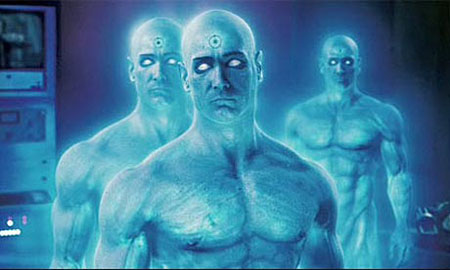
COMMENTS: The brilliant montage over the opening credits is a distillation of “all-too-human” vignettes in which we see four decades of masked avengers interact on a fictionalized American history stage, to the strains of Bob Dylan’s “The Times They Are a Changin’.” A costumed moth-man is dragged off to an insane asylum, and a glowing blue man in a three piece suit shakes hands with a grateful JFK, and Andy Warhol paints pop portraits of caped crusaders. The opening captures what is good about Watchmen: the setting is so original that the film relocates you into its own peculiar universe, which is what escapist entertainment is supposed to do.  And this one has just enough of a veneer of philosophical and political depth (“who watches the Watchmen?”) to give adults an intellectual justification to sit back and enjoy a comic book on film.  The flawed superheroes are briefly sketched, but their slightly twisted archetypes capture our interest.  The noirish Rorschach has an inflexible vigilante code of justice and ever-shifting inkblot mask; atomic superman Dr. Manhattan deploys his colossal blue CGI penis as unashamedly as he does his godlike power to create special effects, all the while suffering existential detachment as his contemplation of quantum realities alienates him from human ones. The script weights the amount of time devoted to each of the intertwining stories and backstories well, supplying a rich context without becoming confusing.  The film’s nihilism ultimately appears as little more than a tonal choice, much like a decision to film in black and white instead of Technicolor. The setting is absorbing enough to make most overlook the films more than occasional gaffes, from the excessively visceral, bone-cracking and blood-spurting violence meant to deglamorize the heroes to a laughably glamorous moonlight lovemaking scene in a hovering owlcraft.

From the standpoint of someone who hasn’t read the beloved comic book graphic novel from which the movie was adapted, it’s amusing to observe Internet kvetching over the movie’s supposedly superhuman power to drain the source work of it’s magic.  Even reviews by professional critics often devolve into column-length comparisons of the literate merits of the original to the relatively pedestrian film version.   But, coming to the film not expecting it to have the intellectual depth and characterization of a novel, I found the movie Watchmen to be an excellent advertisement for the source material.

WHAT THE CRITICS SAY:

“‘Watchmen’ is… going to be the ultimate tough sell: there will be those who view the film as a bewildering mishmash of underexplored themes, thinly sketched characters and noisy, excessive violence… And yet, there’s something admirable about the entire enterprise: its ungainly size, its unrelenting weirdness, its willful, challenging intensity.”–Tom Huddleston, Time Out London (contemporaneous)