
When interviewed about her show, “Food Party” (which plays on the Independent Film Channel), Thu Tran explained that she wanted to approach food as a material to make art with. Trust me, after watching her series, you won’t see food the same way again.
WEIRD HORIZON FOR THE WEEK OF 7/30/2010
A look at what’s weird in theaters, on hot-off-the-presses DVDs, and on more distant horizons…
Trailers of new release movies are generally available on the official site links.
SCREENINGS (NEW YORK CITY, JULY 30 – AUG 5):
“Russellmania!”: The Film Society of Lincoln Center will be screening early Ken Russell films all next week, with the director himself in attendance. The lineup consists of Women in Love (1969), The Boy Friend (1971), The Devils (1971), The Music Lovers (1971), Savage Messiah (1972), Mahler (1974), Lisztomania (1975), Tommy (1975), and Valentino (1977). At least one of these movies will make the List in the future (let the speculation begin)! Lincoln Center information page for Russellmania!
IN DEVELOPMENT:
The Beast Pageant (post-production): Surreal underground film about a man who is rescued from mundane modern life by a singing cowboy who bursts from his body one day and takes him on a magical adventure. The stills and trailer look impressively weird. The Beast Pageant official site.
Untitled Kin Dza-Dza sequel: Before we’ve even had a chance to check out the original 1986 cult Russian sci-fi movie Kin Dza-Dza (described by one of our correspondents as “crazy”), we find that there’s already an animated sequel by the same director in the works. See The Quiet Earth for more details and concept art. We’ll keep an eye out, but this is years away from being available, if it ever comes to pass.
NEW ON DVD:
Home (2008): When a busy highway opens next to a rural Swiss homestead, the insular family takes increasingly desperate and bizarre measures to block out the intrusion of the outside world. Starring Isabelle Huppert, this Swiss entry for the 2009 foreign language Academy Award received fantastic reviews; the London Telegraph called it a “bewitching dream.” Buy Home
Night of the Living Dead: Reanimated (2009): An intriguing idea. Shades of Waking Life, a team of animators created scenes from the public domain classic Night of the Living Dead in varying styles encompassing “everything from puppet theater to CGI, hand drawn animation to flash, and oil paintings to tattoos.” Buy Night of the Living Dead: Reanimated
Repo Men (2010): A more serious, action-oriented, Paris Hilton-free, non-musical—in other words, a less weird—treatment of the same idea covered in Repo: The Genetic Opera: a future in which human organs can be bought and are repossessed if their owner fails to meet their payments. With Jude Law and Forrest Whittaker. Sank like a stone in theaters, but it has its fans. Buy Repo Men
NEW ON BLU-RAY:
Crouching Tiger, Hidden Dragon (2000): Asian-American director Ang Lee first brought the wuxia film to the cineplexes with this Tawianese co-production starring Chow Yun-fat and Michelle Yeough as warriors fighting over a stolen sword. Beautifully filmed and there’s a gorgeous magical realist scene where combatants tiptoe over treetops, but it’s greatest value was in opening American eyes to the grace and pageantry of the modern far East martial arts film. This Blu-ray edition has been highly anticipated for years. Buy Crouching Tiger, Hidden Dragon [Blu-ray]
Home (2008): See description in DVD above. Buy Home [Blu-ray]
What are you looking forward to? If you have any weird movie leads that I have overlooked, feel free to leave them in the COMMENTS section.
BORDERLINE WEIRD: SPIDER (2002)
366 Weird Movies may earn commissions from purchases made through product links.
DIRECTED BY: David Cronenberg
FEATURING: Ralph Fiennes, Miranda Richardson, Gabriel Byrne
PLOT: A disturbed man is released from a mental institution and sent to live in a halfway house. While there, he traces back to his childhood to remember a troubled past and the tragic events that shaped his current mental instability.
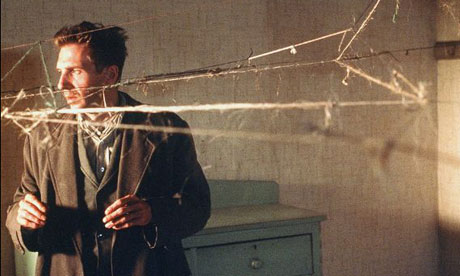
WHY IT’S ON THE BORDERLINE: To compile a list of the weirdest movies ever made, one would be hard-pressed not to include Cronenberg’s entire oeuvre. Here, the director eschews the “body horror” that encompassed much of his earlier films and focuses solely on the deterioration of the mind. While this can be just as grotesque as horrors of the flesh, the journey can get so convoluted at times that the weirdness teeters on a fulcrum. Eventually, the confusion weighs too heavy and topples the weirdness into mere befuddlement.
COMMENTS: A cinematic pet peeve of mine was surely tested with this movie. Being American, I shouldn’t have to struggle listening to an English film (i.e., UK-Great Britain). We speak the same tongue, albeit with some slight variances in words and phrases. The cockney accents in this film can get so thick at times I considered reaching for the subtitle button on the remote. To make matters worse, the film focuses on the character of Spider (Fiennes) who mumbles and spews gibberish as a means of communication. Actually, most of his conversations are only with himself. I loathe having to toggle the volume levels up and down. I had to do this for the duration of the film. Aside from this aggravation, Spider is not a bad film; nor is it a great one.
I loved the approach taken in the opening credits. Various textiles and walls are displayed artistically with corrosion and chipped paint, each frame containing a pattern or form that is open to interpretation. It is set up to resemble Rorschach inkblot tests used in the psychiatric field (I must be going mad myself because all I see in them are cool looking demons). These opening credits are effective because they prepare the viewer for a movie that deals with an imbalanced mind. What we perceive to be truth is certainly going to be skewed from the perspective of a protagonist with warped sensibilities.
Spider enters the picture slowly, exiting a train and returning onto the streets of London. Continue reading BORDERLINE WEIRD: SPIDER (2002)
FEMALE TROUBLE (1974)
Several years ago I came across a review of John Waters Pink Flamingos (1972) in which the reviewer made the tiresome claim that it wasn’t even a “real” movie (while reviewing it in a ‘movie’ review column). Such is the power of John Waters to provoke.
Waters admirers seem to be divided into two camps; pre-and post Hairspray (1988 ), although it really was Polyester (1981) that ushered in the new “Waters with a budget.” Waters certainly lost two inimitable “stars” in Divine and Edith Massey. While he has never lost his edge, and A Dirty Shame (2005) is a good example of that, Waters post-Polyester films are not mired as steeply in that idiosyncratic Waters’ universe.
John Waters is as innovative a director as Luis Buñuel. John Waters is as important a director as Orson Welles. John Waters is as true blooded Americana as John Ford. John Waters defines the word auteur like few others, creating a highly personal look at the world. It was that personal vision which brought his following to him, and not the other way around. When John Waters started making films, he did not develop a distribution strategy nor did he factor in who his target audience might be. He simply made visionary art. Of course, many argue the value of his vision, but it’s the lack of pretense in Waters that is unsettling. Throughout his body of work, he has been consistently stubborn in his refusal to cater to populist notions regarding pedestrian definitions of art and entertainment. That said, one finds Waters to be a remarkably narrative director and the 1975 Female Trouble may be his most assured narrative masterpiece.
 Female Trouble chronicles the rise and fall of an American legend, straight from the studio of Jerry Springer (long before Springer existed). Transvestite Divine plays quintessential white trash Baltimore rebel Dawn Davenport. Dawn hates school, her parents, and Christmas, so she can’t be all bad, right? She’s bad ass enough to run away from home and the parents who simply cannot recognize Continue reading FEMALE TROUBLE (1974)
BORDERLINE WEIRD: STINGRAY SAM (2009)
DIRECTED BY: Cory McAbee
FEATURING: Cory McAbee, Crugie, David Hyde Pierce
PLOT: Ex-con/lounge singer Stingray Sam grudgingly joins his former partner the Quasar Kid
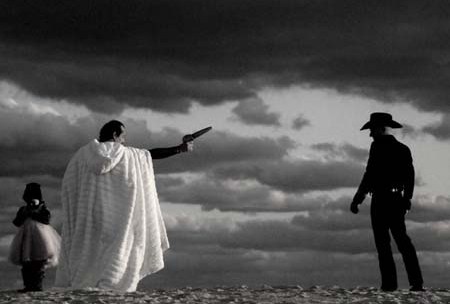
in a quest to save a little girl, with frequent musical breaks featuring songs by The Billy Nayer Show. David Hyde Pierce narrates intermittent segments of animated collage that explain their futuristic society.
WHY IT’S ON THE BORDERLINE: It’s a wacky, memorable space musical with western flair, crisp black and white visuals, and imaginative, nonsensical notions of the future, but all that can be found in slightly more intriguing form in McAbee’s earlier work The American Astronaut, which better serves The List by being a feature-length movie (Stingray Sam is an hour-long serial). But it certainly contains enough of its own charm and inventiveness to stand alongside its predecessor, and it shouldn’t be wholly dismissed just yet.
COMMENTS: Conspicuously sponsored by the fictional “Liberty Chew Chewing Tobacco” and excitedly asking what our heroes will be up to next at the end of every episode, Stingray Sam is a fitting tribute to old-fashioned serials, keeping many of the western and sci-fi elements of such shows while incorporating a wealth of inspired new ideas. There are several weird inventions and convenient technologies to place it in the futuristic space setting, but the sets are wonderfully low-key and familiar. McAbee’s incredible charm seeps through the screen in everything from his performance to the silly dialogue, aided along by the excellent musical numbers and gorgeous animated collage sequences.
By the time the second episode’s explanatory animated piece details the upper class invention of gender-determining drugs, male-on-male baby-making, and a delightful portmanteau naming system, what started out as a fairly straightforward quest to rescue a maiden quickly evolves into a madcap journey through McAbee’s unpredictable imagination. The layers of references, backstory, character, and pseudo-science wrapped up in a musical comedy-adventure are impressively nuanced. David Hyde Pierce’s articulate and tongue-in-cheek narration (which delights particularly in the word “Durango”) offers a range of ideas, inventions, and happenings that don’t always make sense but never fail to spark interest. The first time around some of this information goes by too quickly, as viewers are hit with so many novelties and humorous animation at once, but subsequent watches prove McAbee’s involved story and unique futuristic vision to be unavoidably successful, if preposterous.
With catchy tunes that probably sit somewhere in the rock and roll spectrum yet manage to remain without a definable genre classification, The Billy Nayer Show (who also comprise several main cast members) craft a fun soundtrack that usually leads to manic dancing and wide smiles. Each episode contains one song, which never encroaches on the action or comedy (and often increases the latter), along with a curt opening theme that reminds us “Stingray Sam is not a hero, but he does do the things that folks don’t do that need to be done.” They serve to make the strange story even more memorable, describing stingray babies, entertainment on Mars, and peg-legged fathers, and add an extra element of goofy joy to the work.
Looking past the wonky sci-fi premise and western trappings (complete with cowboy hats and “yes ma’ams”), the heart of Stingray Sam lies in the unbridled glee the entire project exudes. As Sam, McAbee swings his way into everyone’s hearts with his jerky dance moves, easy smile, and affable demeanor, while Crugie keeps his cool as the Quasar Kid, offers some gruffer tunes, and frequently betrays a weakness for olives. Their intricate secret handshake is just icing on this lovable, quirky cake of a partnership. The beleaguered faces of many supporting cast members seem somehow twisted and plasticine, suiting the off-kilter atmosphere perfectly as they help or hinder our heroes’ proceedings. There’s not much else like Stingray Sam.
Stingray Sam is currently only available directly from director Cory McAbee at his personal site (click here to purchase). If the film follows the marketing plan of The American Astronaut, it will eventually be released via normal distribution channels as well.
WHAT THE CRITICS SAY: