Coming up next week: reviews of the Roger Corman quickie The Little Shop of Horrors (1960), the best black comedy about a man-eating plant ever filmed in 48 hours; the seminal surreal cyperpunk pic Tetsuo: The Iron Man (1989); Lon Chaney‘s 1925 The Monster; a 366 Underground report on the experimental Wrists (2011); and possibly even a bonus review hidden in there somewhere.
It was a sick and disturbing week for weird search terms used to locate the site. People flocked to search engines desperately looking for movies matching the following twisted descriptions: the awful “3 weird robots rape a girl,” the Father’s Day-themed “movie of pubic hair of old man dad,” and, of course, this week’s weirdest search term of the week, “silent film with a dwarf climbing into a vagina black and white.” As you read this, we’re on the lookout for any movies matching the above descriptions for possible future review and certification.
Here’s the ever-growing reader-suggested review queue (more titles after break): Tetsuo (next week!); Perfume: The Story of a Murderer;Lunacy [Sílení]; Inmortel (2004); Dead Ringers; Kairo [AKA Pulse]; The Guatemalan Handshake; Dead Leaves; The Seventh Seal; Primer; A Continue reading WHAT’S IN THE PIPELINE→
Speed Levitch, who appeared in the certified weird film, Waking Life, has gained a cult following since the mid 90’s for his unconventional philosophical ideas, and his ability to articulate them.
In “Epidermis” Speed refers to the city (as he often does) as a living and self-aware object that often goes unnoticed, and unappreciated. Whether he is insightful or completely mad will have to depend on the viewer’s verdict. Either way he is, at the very least, intriguing.
A look at what’s weird in theaters, on hot-off-the-presses DVDs, and on more distant horizons…
Trailers of new release movies are generally available on the official site links.
IN THEATERS (LIMITED RELEASE):
General Orders No. 9 (2009): A documentary about—well, after watching the trailer, we’re still not quite sure what it’s about. It’s an experimental documentary the synopsis describes as “one last trip down the rabbit hole before it gets paved over.” It appears intended in the spirit of Koyaanisqatsi; the cinematography looks fantastic and the movie poster features a rabbit smoking a corncob pipe. Premiering (two years after its festival run) at ReRun in Brooklyn, future screening dates unknown. General Orders No. 9 official site.
SCREENINGS (Kino Club, Brighton, UK, June 26 7:00 PM)
Lint the Movie (2011?): Documentary about the famous unknown sci-fi writer and cartoonist Jeff Lint, British rival of Phillip K. Dick (as well as Cameo Herzog) and author of such cult opuses as “Clowns & Insects,” “The Stupid Conversation,” and “Catty and the Major,” the last known as “the scariest kid’s cartoon ever aired.” Directed by Steve Aylett, a sci-fi author who is a bit Dick-ish himself. I remember when I first discovered Lint; I was gazing at my navel at the time. More info on Lint the Movie here.
ON THE WEB:
Frank DanCoolo: Paranormal Drug Dealer (2010): The synopsis is accurate in describing this as a “screwball cyberpunk comedy” set in Neo-Mega-Ultra-Tokyo and starring a fast-talking gal reporter. It’s professionally acted, has played a number of big film festivals including Toronto After Dark, and is only seven minutes long. Check it out. Watch Frank DanCoolo: Paranormal Drug Dealer.
NEW ON DVD:
Bedways (2010): The plot is that a director wants to shoot an experimental sex film but doesn’t have an idea for a plot. Unsimulated sex and experimental filmmaking merge in this new wave art porno with the tagline “Berlin is the shelter/Love is impossible/Flesh is the law.” Buy Bedways.
Mega Python vs. Gatoroid (2011): Forget the title conflict: the real monster battle here is between ex-80s pop stars Tiffany (late of Mega Piranha) and Debbie Gibson (of Mega Shark vs Giant Octopus), who tangle in a heavily-promoted catfight in the mud. Mega Piranha probably gave us our mega-fix for at least another year, but if you can’t get enough of this brand of cheese, by all means go for it. Buy Mega Python vs. Gatoroid.
FREE (LEGITIMATE RELEASE) MOVIES ON YOUTUBE:
Sadko (1953): This week we dig into the Mosfilm archives (see the rest of our archeological discoveries here) for this Aleksandr Ptushko fairy tale feature in which a Russian “Sinbad” seeks the Bluebird of Happiness. You may have seen the dubbed version of this film (The Magic Voyage of Sinbad) spoofed on Mystery Science Theater 3000; here’s a chance to see at as originally intended, with the Rimsky-Korsakov classical score intact. Watch Sadko free on YouTube.
What are you looking forward to? If you have any weird movie leads that I have overlooked, feel free to leave them in the COMMENTS section.
Tod Browning‘s final film, Miracles For Sale (1939) has been made available on home video for the first time in 2011. It is part of the Warner Archive Collection, but rather oddly, it’s hidden inside a Robert Young double-feature package. Nothing against Young, but one is tempted to ask the Warner Marketing team an incredulous “what were you thinking?” The list of devotees of actor Robert Young would seem quite short today. Comparatively, the marketing team would probably generate far more interest in collections by directors such as Browning or James Whale, both of who still have considerable followings among classic film fans, genre fans, film students, and film historians.
Although Browning was on his brand of “best behavior” following the debacle of Freaks (1932) and was forced to be cautious within the Will Hays Code Universe, he stubbornly only made compromises which still allowed him to be Tod Browning, retaining thematic continuity up to this, his last work. Miracles For Sale begins with a typical Browning scenario: mutilation. A young woman has been captured and awaits military execution for political crimes. She is placed in a large box and shot in half. This stark opening is followed by another Browning theme: the illusion. It turns out this below the waist mutilation is merely a staged demonstration trick for the magician’s business “Miracle for Sale.” According to the magician and seller of magic tricks, Mike Morgan (Robert Young), “the hand is faster than the eye” (with a sleight of hand now, watch that sugar bowl). The structure of Miracles For Sale takes Morgan’s credo to heart. It is kinetically paced like a screwball comedy, reminding us that Browning’s earliest ventures into film were slapstick.
In this very loose adaptation of Clayton Rawson’s hit novel, “Death from a Top Hat,” Browning revisits familiar, obsessive themes of fake spiritualism, magic acts, the whodunnit locked door murder mystery, and transformation through disguises (the last provided by the Houdini-like character of Dave Duvallo, played by Henry Hull of 1935’s Werewolf of London). Morgan has a reputation for assisting the police department in helping to expose phony mediums, occultists and immoral tricksters who prey on gullible widows and the like. Morgan’s rep gets Continue reading TOD BROWNING’S MIRACLES FOR SALE (1939)→
PLOT: Nina, a goody two-shoes ballerina, wants to dance the lead role in a production of “Swan Lake,” but although she’s perfect for the role of the White Swan, she lacks the seductiveness to portray the Black Swan. Lily, a sexy, irresponsible dancer newly arrived from a San Francisco troupe, becomes her primary competition for the part, but also helps her loosen up by talking her out on the town for a night of drinking and meeting guys. Nina starts physically break down and hallucinate as the stress of preparing for the role takes its toll; by opening night, she can’t distinguish reality from the story she dances of the princess trapped in the body of a swan who takes her own life.
BACKGROUND:
Natalie Portman danced many of her own parts, and actually dislocated a rib while dancing during the shoot. More difficult moves were performed by professional ballerinas, and for two sequences Portman’s face was digitally superimposed on dancer Sarah Lane’s body. There was a minor controversy over how much of the dancing Portman actually did herself and how much was performed by doubles; Aronofsky estimated that the actress executed more than 80% of the dance moves that appear onscreen.
Portman won the 2010 Best Actress Oscar for her role as Nina. The film was also nominated for Best Picture, Director, Cinematography and Editing.
Aronofsky received “The Understudy,” the original script that became Black Swan, while he was making Requiem for a Dream (2000). He described the script as Dostoevsky’s “The Double” meets All About Eve. Aronofsky combined that script, which was set in an off-Broadway production, with an idea he had to shoot a movie in the New York ballet world to create Black Swan.
Aronofsky and Portman had discussed doing a ballet movie together 8 years prior to shooting.
Made on a relatively small budget of about $12 million, Black Swan has grossed more than $300 million worldwide as of this writing.
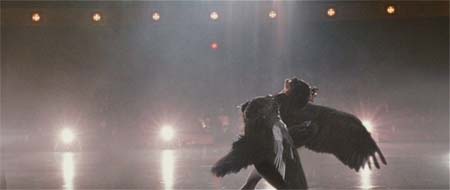
INDELIBLE IMAGE: Nina’s “triumphant” onstage transformation into the Black Swan: as she pirouettes, feathers sprout from her arms, thickening with every swirl, until her limbs have been replaced by wings.
WHAT MAKES IT WEIRD: Up until opening night, Black Swan is a backstage melodrama about backstabbing ballerinas, with an exaggerated, lurid psychopathology that’s thrust even further over-the-top by lesbian love scenes, hints of horror, and mirrors, mirrors, mirrors. When the curtain rises on the big night, we experience the performance through the subjective perspective of an overworked, paranoid, demented dancer, whose psychology has been shattered by the film’s sledgehammer symbolism. No avant-grade choreographer could stage as disorienting a “Swan Lake” as the one she hallucinates for us through her obsessed eyes.

 .
 .
 In this very loose adaptation of Clayton Rawson’s hit novel, “Death from a Top Hat,” Browning revisits familiar, obsessive themes of fake spiritualism, magic acts, the whodunnit locked door murder mystery, and transformation through disguises (the last provided by the Houdini-like character of Dave Duvallo, played by Henry Hull of 1935’s Werewolf of London). Morgan has a reputation for assisting the police department in helping to expose phony mediums, occultists and immoral tricksters who prey on gullible widows and the like. Morgan’s rep gets