Category Archives: Capsules

CAPSULE: 11:14 (2003)

DIRECTED BY: Greg Marcks

FEATURING: , Hilary Swank, , Ben Foster, Colin Hanks, Henry Thomas

PLOT: A ragtag assortment of small-town misfits shuffle through an eventful night: we follow the small cast through their stories, which all intertwine at the fateful minute of 11:14PM. Someone will die, someone will get arrested, someone will get in a fight, several people will have vehicular damage, and absolutely everybody will panic.

Promotional image from 11:14 (2003)

WHY IT WON’T MAKE THE LIST: It’s a great, dark comedy thriller that quaffs a heroic shot of with a chaser of ’ comedy. But it’s not even remotely weird. As a Public Service Announcement, PLEASE stop cramming the reader suggestion box with every random movie you can name just because you like it. This is the WEIRD (Adj.: “very strange, bizarre”) movie site.

COMMENTS: The movie opens with bouncy alternative rock and an animation of the credits driving around on a grid of streets. Yes, you guessed correctly, this is an Indie Flick. Eighty-six minutes later, it proves to be one of those gems that are the whole reason you hang out at film festivals. 11:14 is so clever, it’s almost a fault, like the one kid too smart for his own good that can’t resist showing off, so much that the rest of the class strains for a chance to knock him down a notch. The story intertwines five mini-stories in a small town in Anywhere, America, all of which intersect at 11:14 P.M. on what would have been an uneventful night if everybody had stayed home. It also does that Tarantino thing where it shows the events out of order so we can see how all the parts of the evening fit together. Ready? No you’re not.

In this busy town full of busy people, we meet #1: Jack (Henry Thomas) is a drunk driver who sails under an overpass and gets into an accident; #2: Tim (Stark Sands), Mark (Colin Hanks) and Eddie (Ben Foster), teenage waste-aways who are driving around bored when Eddie injures himself during a completely different accident; #3: Frank (Patrick Swayze), walking his dog and finding car keys belonging to his daughter, Cheri (Rachael Leigh Cook), implicating her in a crime he wants to clear her for; #4: Duffy (Shawn Hatosy) who thinks he has gotten Sheri pregnant and needs money for an abortion, so he goes to his friend Buzzy (Hilary Swank), who works at a convenience store, for help; and #5: Cheri, who is in the cemetery having sex with her boyfriend Aaron when yet another freak accident happens. “Middleton: A happy place to live!” Most of all, this is a movie about people under pressure making hasty decisions.

As you can see, this movie is set up to make life hell for movie re-cappers. How does all this come off? Everybody has a Wile E. Coyote scheme that backfires, and furthermore random events by coincidence steer all of their fates no matter how they try to wriggle out of them. Nobody in this movie is particularly stupid, it’s just that they’re C-average ordinary people who find themselves at crisis points. The dialog is funny, the characters are well-cast, the soundtrack rocks, the plot construction is dizzying, and of course the movie has to keep starting over again to show time from different characters’ points of view as all their drama intersects in an untidy heap at the fateful minute. It’s dark, funny, thrilling, and tickling. It demands multiple viewings so you can retrace the plot intersections and try to spot the exact minute writer-director Greg Marcks is stuffing all the rabbits and doves into his hat. The show-off.

WHAT THE CRITICS SAY:

“…Marcks does a number of things quite well. He establishes a difficult tone — part dramatic, part comic, part absurdist — and he maintains it throughout.”–Mick La Salle, San Francisco Chronicle (contemporaneous)

(This  movie was nominated for review by “Nick,” who described it as “definitely untypical.” Suggest a weird movie of your own here).
CAPSULE: THE EVIL WITHIN (2017)

DIRECTED BY: Andrew Getty

FEATURING: Frederick Koehler, , ,

PLOT: A demon who appears in a mirror tries to turn a mentally handicapped man into a serial killer by threatening him with nightmares.

Still from The Evil Within (2017)

WHY IT WON’T MAKE THE LIST: The Evil Within is an interesting curiosity, with parts that are authentically creepy bumping up against parts that are genuinely scatterbrained. It doesn’t go quite far enough into dementia to earn a spot on the List of the Weirdest Movies Ever—maybe it would have if its director had lived to fiddle with it for another fifteen years—but fans of fruitcake horror films won’t be disappointed.

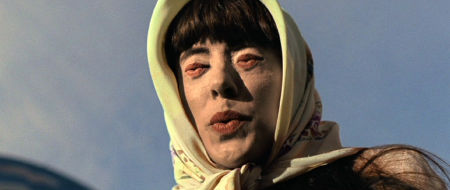
COMMENTS: “I could never know for sure what was a dream and what wasn’t,” says our protagonist at one point. The Evil Within is as disjointed as a bad dream, but there are also dreams within dreams, including a remarkable and long-extended opening sequence that lectures us on the differences between dreams and stories while showing us surreal visions of a burning key in a light switch, a woman with lips for eyeballs, and Michael Berryman unzipping a boy’s body.

It gets weirder from there, in ways that are sometimes intentional, sometimes unintentional. It turns out that in the waking world our protagonist, Dennis, is mentally handicapped, despite the fact that in the opening narration he described a haunted house ride as “the snow-capped summit in the topography of juvenile taste.” Frederick Koehler’s performance as Dennis isn’t terrible, although at times it does uncomfortably approach Donald Trump playing a disabled reporter. The plot is set into motion when Dennis’ reflection begins talking back to him, and gradually talks him into becoming a serial killer. The steps by which the alter ego accomplishes this—by convincing poor, slow Dennis that people will respect his newfound intelligence if he follows his increasingly horrifying instructions—are legitimately chilling. Meanwhile, Dennis suffers more Michael Berryman boogeyman nightmares, which are what the film does best, until a final “reveal” that explains (to some degree) his condition. The conclusion is also fairly bonkers, with animatronic monsters deployed as study aids to help decode the plot.

In many ways The Evil Within is a standard horror film, with serial killer tropes and hallucinatory monsters. But at times it seems like the work of an genuine outsider, one who doesn’t always grasp normal human motivations (why is the social worker so hell-bound on rescuing Dennis from his loving family? Why does the outrageously hot ice cream girl say “Of course it’s nice to see me, I’m outrageously hot?”) Overall, it’s an interesting and brutal, if raw, trip through the mirror: a unique blend of Nightmare on Elm Street, Henry Portrait of a Serial Killer, and Rainman. It shows a promise that suggests that, had he lived, Andrew Getty might have developed into a distinctive horror voice; if he’d been able to tame his own demons and channel his weird impulses, he might have become a genre maverick like .

The story behind The Evil Within is actually odder than the movie itself. The writer/director, who was a grandson of J. Paul Getty and heir to his oil fortune, self-financed the project, spending an estimated $5 million of his inheritance and endlessly tinkering with it in post-production for 13 years, all while battling a methamphetamine addiction. He died in 2015 at 47 years of age, before completing his work. His editor finally compiled the version we now see before us.

WHAT THE CRITICS SAY:

“…it’s already garnering a reputation as one of most singularly strange films to come along in a good while. And rightly so.”–Travis Johnson, Film Ink (contemporaneous)

(This movie was nominated for review by “Russ,” who called it “A flawed film, to be sure, but even moreso: an absolutely fascinating film, a grand example of uncomfortable, outsider art.” Suggest a weird movie of your own here.)

CAPSULE: GINGER AND FRED (1986)

Ginger e Fred

Recommended

DIRECTED BY:

FEATURING: ,

PLOT: Retired Fred Astaire/Ginger Rogers impersonators return for a guest spot on a television spectacular.

Still from Ginger and Fred (1986)

WHY IT WON’T MAKE THE LIST: One ten-teated cow does not a weird movie make. In Ginger and Fred, Fellini’s once-aggressive surrealism mellows into bemused quirkiness. Fans will find plenty to appreciate in the colorful, chaotic oddity on display, but this is a conventional comedy, by the maestro’s standards.

COMMENTS: Ginger and Fred is not a “Felliniesque” movie per se. It’s more of a roadmap for how Fellini’s vision might be channeled into something nostalgic and whimsical: Fellini for grandpas and grandmas. It’s a pleasing elegy for grand old entertainment, mixed with an unsubtle but effective satire of television. It features Fellini’s muse (Masina) and alter-ego (Mastroianni) working together for the first and only time, a pairing that in and of itself would make Ginger and Fred noteworthy. Fortunately, it’s also a good movie, with excellent performances from both stars. Masina’s Ginger is likeable and dignified, bemused by modernity without being overwhelmed or embittered. Mastroianni’s Fred hides his growing feebleness under a mask of rakishness, quick with a wolf whistle and a drink order. The scene where Fred repeatedly lifts Ginger while her eyes cross and they both start breathing heavily is as amusing a proxy for geriatric intercourse as I ever want to see on film.

Ginger and Fred‘s unseen network executives assemble a collection of human oddities for their Christmas spectacular variety show, with whom the elegant and put-upon Ginger is forced to share a hotel and a stage. There’s a transvestite with a divine calling to visit prisoners, Kafka and Proust impersonators (!), a troupe of bolero-dancing dwarfs, a mutant cow, a couple who tape-record ghost voices, and a throng of supplemental weirdos: extras wander around dressed like video game characters and decapitated geishas. There is some inherent irony in the way Ginger and Fred trots out its freakshow parade as a criticism of television, given the fact that Fellini himself was famous and celebrated for populating his films with odd-looking people and carnivalesque performers. The distinction, of course, is that Fellini isn’t criticizing television’s reliance on the grotesque, but the shallowness of its fascination, of the spectacle format in which every story is cut to fit in as short a slot as possible and not explored beyond its surface. His satirical circus is something stranger and more curious than television could ever accomplish (except, of course, when Fellini worked in the medium). He spends time exploring Ginger and Fred in-depth, making them three-dimensional characters inhabiting a two-dimensional world.

Some of the best bits are the brief parodies of television programming. There’s an absurd puppet show version of Dante’s “Inferno,” spot-on recreations of MTV music videos, a commercial with sexy French maid pouring olive oil on a huge lobster, a game show where housewives shovel pasta into their mouths from sinks, with the sauce delivered from the faucet. Televisions are everywhere in Ginger and Fred; in the hotel lobby, on the studio’s buses. Modern audiences will identify with the way the characters are always looking at screens rather than people—only back then, it was television that was the distraction. The screen has changed, but the message is the same.

In a strange footnote, Ginger Rogers unsuccessfully (and foolishly) sued Ginger and Fred‘s producers for trademark infringement and defamation.

WHAT THE CRITICS SAY:

“…a hysterical send-up of Italian television, which looks like an LSD-induced vision of ours 30 years ago – a combination of Morey Amsterdam’s ‘Broadway Open House,’ ‘The Ed Sullivan Show,’ Alistair Cooke’s ‘Omnibus’ and the Irv Kupcinet show… One longs for fewer midgets and bizarre misfits and for more of Miss Masina and Mr. Mastroianni.”–Vincent Canby, The New York Times (contemporaneous)

CAPSULE: MALADY (2015)

DIRECTED BY: Jack James

FEATURING: Roxy Bugler, Kemal Yildirim, Jill Connick

PLOT: A grieving daughter buries her sorrow in a new relationship, but when her boyfriend’s mother summons him home, she confronts a malevolent force.

Still from Malady (2015)

WHY IT WON’T MAKE THE LIST: Malady is a brutal, unforgiving look at both the rawness of grief and the depth of cruelty. The film explores these topics with shocking bluntness. However, the weirdness lies mostly in the telling, which deliberately challenges the audience in order to evoke the characters’ feelings.

COMMENTS: If Malady were a typical horror film, the moment when Holly (Bulger) takes her first step toward calamity would be a scene of heightened drama, possibly with foreboding music or a shock jump. But here, it’s the grating buzz of a vibrating cell phone. Banal as it seems, her new boyfriend greets the signal with dread. However, like the warning of a crotchety old man about the old cabin up the trail, Holly pushes the red flag aside, and there the trouble truly begins.

In that respect, Malady is a typical horror film, hitting all the beats of the tale of a girl who wanders into the woods only to find a monster lurking within. But writer-director James grafts these tropes onto an atypical examination of the debilitating impact of grief, so what would normally be attributable to inexplicable bubbleheadedness can here be ascribed to the devastating power of loss.

Malady is an uncompromisingly grim motion picture; it starts with the death of Holly’s mother, ensuring that our protagonist begins the tale wounded and psychically frayed. “Find love” is her mum’s final missive, but too devastated to engage with the world, she jumps into a relationship with Matthew (Yildirim), an emotional compatriot. Together, they hide away from the world, having joyless, desperate sex, managing the barest of conversation, and dreading the moment when they will have to re-connect to society. But the more time they spend together, the more Holly begins to feel like this could be the love she seeks. She starts  fumbling about looking for a trace of normal, which leads inexorably to that fateful phone call.

So sparse is the dialogue in Malady that it could barely fill out a long poem. (It’s roughly ten minutes before our heroine utters a word). In the film’s second half, the bulk of that dialogue is delivered by Matthew’s dying mother (Connick), a monstrous figure who speaks only if she can hurt someone in the process and who is self-evidently the cause of her son’s wrecked ego. Her unerring knack for targeting her hate, combined with purposely claustrophobic camerawork, off-kilter editing, and a buzzing soundtrack, leaves the viewer feeling much like Holly: uncomfortable and unmoored.

James has absolute control over the vision presented here, and he has created something impressionistic, channeling raw feeling through cinematic technique. (In addition to writing and directing, he also serves as cinematographer, editor, sound designer and editor, colorist, and producer). The film is a rush of images, sometimes unfocused, frequently confusing in their order and context. Malady is about deeply damaged people, and James has crafted a piece that reflects their troubled, fraught mindset, even if it doesn’t offer them much hope.

Malady is expertly made, superbly acted (especially by Bulger, who deserves a film where she can smile), and so emotionally raw that it’s nigh impossible to contemplate a repeat viewing. There’s cleverness in the application of horror-film logic to the overpowering effects of grief, depression, and abuse, and it extends to the movie’s climax: having endured a hell that would be absurd by conventional standards, Holly is moved to act in a manner that would earn her cheers if she was vanquishing a supernatural monster or a relentless serial killer. However, in this setting, the victory is hollow, and the movie’s final message seems to be that the real Big Bad here—painful and devastating loss—can never be defeated. Malady is a horror movie where nothing is metaphor, and the Final Girl is destined to lose.

WHAT THE CRITICS SAY:

“This aesthetic package’s psychological dimensions are at once vivid and mysterious — an impact that may not fully compensate for those viewers ultimately frustrated by the pic’s stubborn resistance to greater character development/backgrounding, let alone the odd moments when seemingly key dialogue is almost unintelligible. For others, though, the unique clammy force of Malady’s claustrophobic bad vibes will outweigh the nagging questions its narrative leaves behind.” – Dennis Harvey, Variety

CAPSULE: THE ACT OF SEEING WITH ONE’S OWN EYES (1971)

DIRECTED BY:

FEATURING: Anonymous corpses

PLOT: Footage of autopsies performed at the Pittsburgh morgue, delivered without commentary.

WHY IT WON’T MAKE THE LIST: At first I didn’t find Act at all “weird,” but the next day I found myself spontaneously describing it to another person thusly: “I saw the strangest documentary last night…” Both thoughts were true, based on different meanings of the words “weird” and “strange.” Act is strange in the sense of rare, uncommon, seldom-seen; it’s also disturbing and unsettling. But it’s deliberately rooted in reality, and not “weird” in the sense we use the term on this site: surreal, mysterious, hinting at the irrational.

COMMENTS: Society hides corpses from view—not from shame, but from unease. We seek to hide the evidence of a crime that has been committed against us. The title of Stan Brakhage’s charnel house poem (a somewhat literal translation of the Greek “autopsis”) suggests that here we will see death, and do so authentically: with our “own eyes,” not secondhand. The “act” of the title further suggests that this will not be a passive experience, but something we deliberately undertake to do.

Be prepared. Male and female, young and old, they all eventually arrive on the slab. Brakhage’s camera does not focus on any faces (a condition of his being allowed to shoot in the morgue). The anonymity of the bodies makes them more universal. He engages in little experimental camerawork (there are a few moments with strange zooms, or with abstract closeups). Bodies are clinically hacked apart and disemboweled, internal organs scooped out and placed in bins. In the most disturbing segment, the skin on the back of a man’s head is peeled upward to expose his skull, with the folds of flesh eventually bunching up around his eyes. There are closeups of meat sticking to ribs. Brakhage could have inserted footage from a butcher shop at some points, and you would not know the difference. The film runs for thirty minutes, although he could have stopped the camera after ten minutes or kept it running for another hour and a half. The end result is the same.

You might be disgusted. After a while, you might become numb, or even bored. You may be fascinated by the machinery of the body; your thoughts will likely turn to your own mortality. It’s grisly, but not exploitative. The camera does not tell you what to think or feel. The take home message of Brakhage’s audacious documentary seems to be, “look: this is what you are.”

WHAT THE CRITICS SAY:

“…perhaps the longest uncomfortable silence in the history of cinema, Stan Brakhage’s documentary short The Act of Seeing with One’s Own Eyes is a harrowing, unshakable, but fundamentally fascinating, viewing experience.”–Jeremy Heilman, Movie Martyr

(This movie was nominated for review by “Regicide.” Suggest a weird movie of your own here.)