Category Archives: Capsules

CAPSULE: OFFSEASON (2021)

366 Weird Movies may earn commissions from purchases made through product links.

DIRECTED BY:

FEATURING: Jocelin Donahue, , Richard Brake, Jeremy Gardner

PLOT: After receiving a letter from the local cemetery caretaker, Marie returns to the island where her mother grew up.

COMMENTS: “Rhymes with ‘Smagon’.”

That’s all I’ve got. Because frankly, I have no idea what to tell you about this film apart from the following: it moves by quickly enough (which is a considerable relief) and it tells a mere shaving of the story it could have told. Offseason has all the elements: antiquated motifs (is this set in the ’80s?), madness, tales of a sea demon, and mysteriousness without much by way of reason. This final point is worth exploring, if only because, as in the far-better crafted tales from the Mythos Man himself, one can find something enjoyably unsettling in phenomena with no ready explanation. But Lovecraft’s unspeakable horrors all gelled into a gut-level understanding despite—or rather, owing to—the inexplicability of their horrifying events. Writer/director Mickey Keating’s movie feels more like a cobbling together of random eldritch parts into an ungainly stack of “Meh”.

When Marie Aldrich (wide-eyed and single-noted Jocelin Donahue) receives a letter informing her that her mother’s grave has been vandalized, she immediately heads to Lone Palm Island with her Gentleman (Husband? Ex-husband? Friend? Regardless, he’s played by Joe Swanberg, a poor man’s Philip Seymour Hoffman) and misses her first cue to head home. It’s a dark and stormy night when they arrive, and the bridge keeper (Richard Brake, a poor man’s Stephen McHattie) advises the out-of-towners that the island is “closed for the season.” This revelation is odd, but not so odd that Marie pays it any mind, and she insists on gaining entry. In the cemetery is a friendly Little Old Lady; surrounding the cemetery is a forest filled with blank-eyed townspeople. In town is the local drinking hole, “the Sand Trap” (its name yet another hint), in which a honky-tonk piano tune is being played, and whose patrons literally all stop and stare at Marie and Gentleman upon their entrance. Shifty-but-earnest Man With Boat (Jeremy Gardner, a poor man’s Michael Shannon) is there, and as his designation suggests, he has a boat—and is strangely insistent that Marie visit him later.

You get the gist. Keating somehow manages to overplay the surface goings on while ignoring virtually all of the interesting possibilities beneath. I am not giving too much away when I tell you I am very interested in the deal-with-sea-demon background for this island town. (This particular tidbit is dropped at the slightest prompt by any citizen one might encounter in the… off season.) But the story here spins out over an excessively prodding film score (the strings in particular seem to be shrieking, “Something Unsettling Is Going On!”) and features far too many of Marie’s wanderings through empty streets and semi-creepy back rooms. (I will admit, though, that I quite liked the amble through the historical society.) So yes, please: tell me more about the founding of Lone Palm Island. And spin me some yarns about the arduous existence faced by those who are blessed-cursed by the demon. Come to think of it, this premise was explored with actual tension, and humor, in The Endless. Go watch that again instead.

WHAT THE CRITICS SAY:

“If you enjoy surreal, nightmarish horror, then you’re likely to enjoy Offseason.”–Staci Layne Wilson, Women in Horror (contemporaneous)


CAPSULE: BIG GOLD BRICK (2022)

366 Weird Movies may earn commissions from purchases made through product links.

Big Gold Brick is currently available for VOD rental.

DIRECTED BY: Brian Petsos

FEATURING: , , , Lucy Hale,

PLOT: After smashing his car into a suicidal scribe, the driver hires the writer as his biographer.

COMMENTS: This film left me with a weight in my heart. A weight of approximately 313 pounds per cubic foot, when it had aspirations of four times that. To the science-y types amongst you, this clumsy metaphor will come across as modestly clever, albeit markedly pertinent. Big Gold Brick, a recent addition to the Hipster-Com-Core genre (“too”-clever, “too”-stylized mysterious-esque films), has the veneer of a shiny new bauble to be melted down and enjoyed: a cryptical client, ironic soundtrack, eccentrics over every shoulder, and a splintered protagonist. It is only around the half-way juncture that Brian Petsos’ feature debut lets slip that it’s faking it—because its key element is missing.

Samuel is, for reasons of various legitimacy, on the cusp of suicide. His first instincts, kicking into furious gear in an opening montage of heavy drinking and light mess-making, spur him to abandon his apartment (owing five months back rent, no less; that West Coast Sam ain’t got nothin’ on this guy), and travel by bus to “Rockchester,” carrying nothing but his typewriter and his crumpled suicide note. From the station, Samuel walks into on-coming traffic in time for Floyd (Andy Garcia) to aspirate some tasty frozen custard while driving his Cadillac. For surly Sam, a crash, a hospital stay, some possible brain damage, and an offer of a writing gig; for Floyd, the shaggy-dog-story-teller in this shaggy-dog movie, a chance for some validation after a life of near-misses.

“Near miss.” Now that would have been an efficient way to describe Big Gold Brick. But seeing as Petsos takes the long way around, I return the favor. The fact of the matter is, it almost works, largely because of the secondary lead. Andy Garcia’s turn as an ex-military “plastics, lenses, and lasers” scientist is both quirky and endearing. Floyd is a delight, as are the bizarre sequences sloshed around with tasteful abandon. Some are mundanely surreal, as when Floyd is talking with the brain specialist at the hospital. The good doctor lights a cigarette, prompting Floyd to inquire, “Can you smoke here?,” to which the doctor takes a puff and nonchalantly replies, “No, you can’t.” Others are sudden, literal, bursts: Floyd (and an unlucky co-worker) discover that the gun actually does function, despite suspicions otherwise.

Megan Fox makes the most of it in her turn as sex-vixen lawyer wife. Lucy Hale is believably spiky and fragile as the cocaine-pixie-dream-girl. And Oscar Isaac lovingly chomps through every Austrian-accented, hyper-limping, bearded corporate crime lord moment as Anselm Vogelweide. The improbable wash nearly carries the film, except, unfortunately, for another casting choice. The lead. I know from Lords of Chaos that Emory Cohen can be very convincing. But surrounded by this cast of weirdos, his bumbling mannerisms and unconvincing narration fall flatter than a pancake on a sheet of drywall.

Big Gold Brick‘s current abysmal rating of 3.4 on IMDb is undeserved. Except, of course, if one bears in mind what this might have been.

WHAT THE CRITICS SAY:

“…begins as a tragedy before veering into a wild, outrageously funny and unashamedly bizarre ride… a bold, wildly entertaining and provocative trip down the rabbit hole. It deserves to become a cult classic in the vein of Donnie Darko.”–Avi Offer, NYC Movie Guru (contemporaneous)


CAPSULE: L’INFERNO (1911)

DIRECTED BY: Francesco Bertolini, Adolfo Padovan, Giuseppe De Liguoro

FEATURING: Salvatore Papa, Arturo Pirovano, Emilise Beretta, Augusto Milla

PLOT: In the company of the poet Virgil, Dante Alighieri descends into Hell, where he discovers the variety of malefactors consigned to the netherworld by their misdeeds on Earth and the array of torments visited upon them.

Still from L'Inferno (1911)

COMMENTS: When the pioneers of the Italian film industry set about creating the country’s first feature-length motion picture (a format still in its infancy in 1911), they most decidedly did not screw around. No, they went straight for an adaptation of a foundational piece of literature, the one that did as much as anything to establish the language and the national identity. Without hesitation, they turned to Dante.

It’s an ambitious undertaking. “The Inferno,” the first part of Dante’s epic Divine Comedy, is a true horror story, a warning about the torture that awaits sinners in the afterlife. Part of what made Dante’s work so noteworthy was his willingness to name names. Various popes, Holy Roman Emperors, and other notable figures are depicted, along with their crimes and punishments. And his God is a harsh one: Julius Caesar’s assassins undergo perpetual torment, but Caesar himself was relegated to Limbo, an inferior paradise for those who made the terrible mistake of existing on Earth before Christ. It took a very pure life to stay out of Dante’s Hell, and he was only too happy to reveal the consequences of failure.

If all it took to get on our list was the “Indelible Image” category, L’Inferno would make the cut in a cakewalk. The limited practical and special effects of early cinema yield terrific results, conveying Hell as a real and horrible place in spectacular fashion. The harsh landscapes are difficult to navigate, and usually strewn with writhing bodies in some unholy mix of Hieronymous Bosch paintings and Spencer Tunick photographs. Multiple exposures conjure up rivers in the sky composed of thousands of the damned. Forced perspective brings the travelers into the realm of the mighty and rageful Pluto, and blackout techniques permit one doomed soul to carry his own head. The film’s climactic tableau combines these methods and more to present a three-mouthed Lucifer devouring some of history’s most notorious traitors; it resembles nothing so much as Goya’s grotesque classic “Saturn”. This appears simplistic to modern eyes but remains quite powerful in its effect. It’s as though the filmmakers carefully studied the magical techniques of Georges Méliès for the sole purpose of applying them to horror.

But alas, imagery alone is not enough to make a weird movie. The film of “The Inferno” suffers from the format that inspired it: it’s a travelogue. A travelogue through Hell, but a winding, episodic tour nonetheless. Dante visits a new circle of Hell, Virgil explains what the condemned did on Earth and what fate awaits them now, and we see that fate enacted. There’s not much more to it, so that this work of tremendous faith and contrition is reduced to a haunted house. Hell? It’s pretty bad, say the filmmakers. Rinse and repeat.

L’Inferno is a landmark film, and it creates dramatic and powerful screen pictures that most modern CGI-powered spectacles would be hard-pressed to match. Those pictures are often ugly and monstrous, and the rhythms are repetitive, which is probably why it hasn’t endured like more fantastical or pastoral works of the period. But it certainly deserves to be remembered. To abandon it to history would be a sin.

WHAT THE CRITICS SAY:

“Anyone with an interest in the history of cinema should make an effort to seek this film out. Rightly famous, it is quite bizarre, unique and — in a way — haunting.” – Richard Cross, 20/20 Movie Reviews

(This movie was nominated for review by “Pete.” Suggest a weird movie of your own here.)

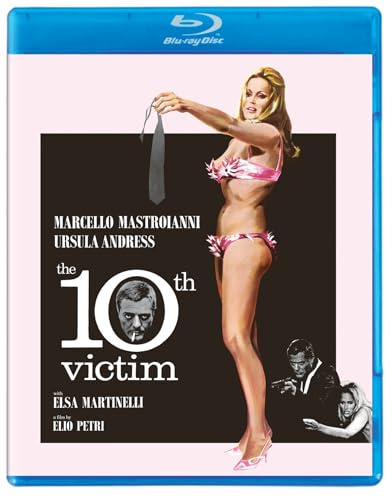
CAPSULE: THE 10TH VICTIM (1965)

La decima vittima

366 Weird Movies may earn commissions from purchases made through product links.

DIRECTED BY: Elio Petri

FEATURING: Marcello Mastroianni, Ursula Andress,

PLOT: To control violence and population, people are invited to participate in The Big Hunt, a sanctioned game of cat-and-mouse that ends in murder; complications ensue when two of the top assassins, Caroline and Marcello, fall in love, even as they are pitted against each other.

Still from The 10th Victim (1965)

COMMENTS: The term “bread and circuses” goes back to the end of the 1st century, a reference by the poet Juvenal (“panem et circenses”) to the willingness of the citizenry of the Roman Empire to be appeased by trifles and cheap entertainment. Because of the violent nature of the contests held at the Colosseum to pacify the populace, the term eventually became a catch-all for spectacles where human life takes a backseat to fun and amusement. In the modern world, the concept has become downright ubiquitous. Kicking off with Richard Connell’s short story “The Most Dangerous Game” nearly one hundred years ago, writers and filmmakers have had a field day with the premise of a society that turns murder into a spectator sport. From the anti-intellectualism of Fahrenheit 451 to the crass commercialism of The Running Man, from the fear of age in Battle Royale to the fear of class in The Purge, mollifying the masses remains a pertinent subject over two millennia later. (And that’s not factoring in displays of masochism made for public consumption like “Fear Factor” or the National Football League.) Not for nothing is the bloodthirsty land of The Hunger Games called Panem.

All of which is to say that The 10th Victim wasn’t exactly breaking new ground when it adapted Robert Sheckley’s 1953 short story for the big screen. (A previous adaptation for radio was more faithful to the original.) But if you’re looking for the singular factor that sets this movie apart from the rest, it’s this: it’s swingin’, baby, yeah! This speculative future turns out to be only a couple years ahead of its time, from a visual standpoint. We’re treated to sleek, brutalist architecture, pop art on the walls, and costumes (courtesy of designer Giulio Coltellacci) that are giddily mod and gloriously over-the-top, with every female outfit sporting a backless cut. Before Carnaby Street or the Haight, the styles that would come to define the 60’s were clearly to be found along the Via dei Fori Imperiali.

All the proof you need that this film crucially contributed to the DNA of the Swinging Sixties can be found in the movie that proudly carries the banner for the era: Austin Powers: International Man of Mystery. The eagle-eyed will notice Ming Tea, Andress’ overeager sponsor, supplies the name of the groovy super-spy’s psychedelic rock band, while even the naked-mole-rat-eyed will recognize the brassiere-machine gun Andress uses to dispatch a pursuer.

All this groovy atmosphere is the foundation for a healthy dose of satire, which is ladled on like hearty Bolognese. Announcements blare out the glory of the Big Hunt like drop-off instructions at the airport. A flack for the contest proclaims that Hitler would have signed up for the Hunt and thereby obviated World War II. The uniformly ignorant public goes about their business as gunplay breaks out all around them. Mastroianni’s mistress shrieks in horror when a team of repo men reclaim her collection of comic books: “No, not the classics!”

But the jaunty vibe, accompanied by Piero Piccioni’s frothy, vocal-tinged score, means the film’s attitude is more droll bemusement than anger. The screenplay only occasionally hints at the bile that must have inspired it, such as when a hunter bitterly laments the rules that have limited his fun. “We can’t shoot anywhere anymore,” he complains, noting that even churches and nursery schools are now off-limits. Oh, to be in America: “Anyone can shoot where and when they want.”

The leads do a lot to sell it. Amidst all of the mayhem, Andress tries to go full mercenary, eagerly hoping to maximize her marketability as a global icon of murder. Meanwhile, Mastroianni is stricken with overwhelming ennui. He openly broadcasts his victim status, he laments the pointlessness of life and relationships, and cynically fakes tears for the cult of sunset-worshipers he leads. Even murdering a Nazi brings him no pleasure. So it’s genuinely charming to watch him discover pure joy in the effort Andress exerts to make his murder something special.

Despite the body count, The 10th Victim turns out to be a rather gentle dystopia. The violence is plentiful but cartoonish. The satirical targets are numerous: disregard for human life shares space with the absurdity of marriage, contempt for the elderly, and capitalism run amok. (The fact that Andress must delay her kill to appease her advertisers is one of the better solutions to the “why don’t they just kill them” dilemma.) The 10th Victim is not so irresponsible as to make you think for a moment that this is a better world than the one we live in. But it does seem a great deal more fun.

WHAT THE CRITICS SAY:

“As a licensed hunter-killer in a weirdly futuristic social state and with the statuesque Ursula Andress as his deadly adversary, [Mastroianni] is dishing up yet another brazen hero on the order of Bond… What is actually delivered in this peculiarly supergraphic film is a clever but patently self-conscious intellectual exercise, much on the order of that which Jean-Luc Godard gave us recently in ‘Alphaville.’ The cleverness is so insistent that it soon becomes excessive and absurd, and the gamesmanship of the satire becomes too cute, too much a bore.” – Bosley Crowther, The New York Times (contemporaneous)

(This movie was nominated for review by the late Irene Gonchorova. Suggest a weird movie of your own here.)