All posts by Shane Wilson

CAPSULE: L’INFERNO (1911)

DIRECTED BY: Francesco Bertolini, Adolfo Padovan, Giuseppe De Liguoro

FEATURING: Salvatore Papa, Arturo Pirovano, Emilise Beretta, Augusto Milla

PLOT: In the company of the poet Virgil, Dante Alighieri descends into Hell, where he discovers the variety of malefactors consigned to the netherworld by their misdeeds on Earth and the array of torments visited upon them.

Still from L'Inferno (1911)

COMMENTS: When the pioneers of the Italian film industry set about creating the country’s first feature-length motion picture (a format still in its infancy in 1911), they most decidedly did not screw around. No, they went straight for an adaptation of a foundational piece of literature, the one that did as much as anything to establish the language and the national identity. Without hesitation, they turned to Dante.

It’s an ambitious undertaking. “The Inferno,” the first part of Dante’s epic Divine Comedy, is a true horror story, a warning about the torture that awaits sinners in the afterlife. Part of what made Dante’s work so noteworthy was his willingness to name names. Various popes, Holy Roman Emperors, and other notable figures are depicted, along with their crimes and punishments. And his God is a harsh one: Julius Caesar’s assassins undergo perpetual torment, but Caesar himself was relegated to Limbo, an inferior paradise for those who made the terrible mistake of existing on Earth before Christ. It took a very pure life to stay out of Dante’s Hell, and he was only too happy to reveal the consequences of failure.

If all it took to get on our list was the “Indelible Image” category, L’Inferno would make the cut in a cakewalk. The limited practical and special effects of early cinema yield terrific results, conveying Hell as a real and horrible place in spectacular fashion. The harsh landscapes are difficult to navigate, and usually strewn with writhing bodies in some unholy mix of Hieronymous Bosch paintings and Spencer Tunick photographs. Multiple exposures conjure up rivers in the sky composed of thousands of the damned. Forced perspective brings the travelers into the realm of the mighty and rageful Pluto, and blackout techniques permit one doomed soul to carry his own head. The film’s climactic tableau combines these methods and more to present a three-mouthed Lucifer devouring some of history’s most notorious traitors; it resembles nothing so much as Goya’s grotesque classic “Saturn”. This appears simplistic to modern eyes but remains quite powerful in its effect. It’s as though the filmmakers carefully studied the magical techniques of Georges Méliès for the sole purpose of applying them to horror.

But alas, imagery alone is not enough to make a weird movie. The film of “The Inferno” suffers from the format that inspired it: it’s a travelogue. A travelogue through Hell, but a winding, episodic tour nonetheless. Dante visits a new circle of Hell, Virgil explains what the condemned did on Earth and what fate awaits them now, and we see that fate enacted. There’s not much more to it, so that this work of tremendous faith and contrition is reduced to a haunted house. Hell? It’s pretty bad, say the filmmakers. Rinse and repeat.

L’Inferno is a landmark film, and it creates dramatic and powerful screen pictures that most modern CGI-powered spectacles would be hard-pressed to match. Those pictures are often ugly and monstrous, and the rhythms are repetitive, which is probably why it hasn’t endured like more fantastical or pastoral works of the period. But it certainly deserves to be remembered. To abandon it to history would be a sin.

WHAT THE CRITICS SAY:

“Anyone with an interest in the history of cinema should make an effort to seek this film out. Rightly famous, it is quite bizarre, unique and — in a way — haunting.” – Richard Cross, 20/20 Movie Reviews

(This movie was nominated for review by “Pete.” Suggest a weird movie of your own here.)

CAPSULE: THE 10TH VICTIM (1965)

La decima vittima

366 Weird Movies may earn commissions from purchases made through product links.

DIRECTED BY: Elio Petri

FEATURING: Marcello Mastroianni, Ursula Andress,

PLOT: To control violence and population, people are invited to participate in The Big Hunt, a sanctioned game of cat-and-mouse that ends in murder; complications ensue when two of the top assassins, Caroline and Marcello, fall in love, even as they are pitted against each other.

Still from The 10th Victim (1965)

COMMENTS: The term “bread and circuses” goes back to the end of the 1st century, a reference by the poet Juvenal (“panem et circenses”) to the willingness of the citizenry of the Roman Empire to be appeased by trifles and cheap entertainment. Because of the violent nature of the contests held at the Colosseum to pacify the populace, the term eventually became a catch-all for spectacles where human life takes a backseat to fun and amusement. In the modern world, the concept has become downright ubiquitous. Kicking off with Richard Connell’s short story “The Most Dangerous Game” nearly one hundred years ago, writers and filmmakers have had a field day with the premise of a society that turns murder into a spectator sport. From the anti-intellectualism of Fahrenheit 451 to the crass commercialism of The Running Man, from the fear of age in Battle Royale to the fear of class in The Purge, mollifying the masses remains a pertinent subject over two millennia later. (And that’s not factoring in displays of masochism made for public consumption like “Fear Factor” or the National Football League.) Not for nothing is the bloodthirsty land of The Hunger Games called Panem.

All of which is to say that The 10th Victim wasn’t exactly breaking new ground when it adapted Robert Sheckley’s 1953 short story for the big screen. (A previous adaptation for radio was more faithful to the original.) But if you’re looking for the singular factor that sets this movie apart from the rest, it’s this: it’s swingin’, baby, yeah! This speculative future turns out to be only a couple years ahead of its time, from a visual standpoint. We’re treated to sleek, brutalist architecture, pop art on the walls, and costumes (courtesy of designer Giulio Coltellacci) that are giddily mod and gloriously over-the-top, with every female outfit sporting a backless cut. Before Carnaby Street or the Haight, the styles that would come to define the 60’s were clearly to be found along the Via dei Fori Imperiali.

All the proof you need that this film crucially contributed to the DNA of the Swinging Sixties can be found in the movie that proudly carries the banner for the era: Austin Powers: International Man of Mystery. The eagle-eyed will notice Ming Tea, Andress’ overeager sponsor, supplies the name of the groovy super-spy’s psychedelic rock band, while even the naked-mole-rat-eyed will recognize the brassiere-machine gun Andress uses to dispatch a pursuer.

All this groovy atmosphere is the foundation for a healthy dose of satire, which is ladled on like hearty Bolognese. Announcements blare out the glory of the Big Hunt like drop-off instructions at the airport. A flack for the contest proclaims that Hitler would have signed up for the Hunt and thereby obviated World War II. The uniformly ignorant public goes about their business as gunplay breaks out all around them. Mastroianni’s mistress shrieks in horror when a team of repo men reclaim her collection of comic books: “No, not the classics!”

But the jaunty vibe, accompanied by Piero Piccioni’s frothy, vocal-tinged score, means the film’s attitude is more droll bemusement than anger. The screenplay only occasionally hints at the bile that must have inspired it, such as when a hunter bitterly laments the rules that have limited his fun. “We can’t shoot anywhere anymore,” he complains, noting that even churches and nursery schools are now off-limits. Oh, to be in America: “Anyone can shoot where and when they want.”

The leads do a lot to sell it. Amidst all of the mayhem, Andress tries to go full mercenary, eagerly hoping to maximize her marketability as a global icon of murder. Meanwhile, Mastroianni is stricken with overwhelming ennui. He openly broadcasts his victim status, he laments the pointlessness of life and relationships, and cynically fakes tears for the cult of sunset-worshipers he leads. Even murdering a Nazi brings him no pleasure. So it’s genuinely charming to watch him discover pure joy in the effort Andress exerts to make his murder something special.

Despite the body count, The 10th Victim turns out to be a rather gentle dystopia. The violence is plentiful but cartoonish. The satirical targets are numerous: disregard for human life shares space with the absurdity of marriage, contempt for the elderly, and capitalism run amok. (The fact that Andress must delay her kill to appease her advertisers is one of the better solutions to the “why don’t they just kill them” dilemma.) The 10th Victim is not so irresponsible as to make you think for a moment that this is a better world than the one we live in. But it does seem a great deal more fun.

WHAT THE CRITICS SAY:

“As a licensed hunter-killer in a weirdly futuristic social state and with the statuesque Ursula Andress as his deadly adversary, [Mastroianni] is dishing up yet another brazen hero on the order of Bond… What is actually delivered in this peculiarly supergraphic film is a clever but patently self-conscious intellectual exercise, much on the order of that which Jean-Luc Godard gave us recently in ‘Alphaville.’ The cleverness is so insistent that it soon becomes excessive and absurd, and the gamesmanship of the satire becomes too cute, too much a bore.” – Bosley Crowther, The New York Times (contemporaneous)

(This movie was nominated for review by the late Irene Gonchorova. Suggest a weird movie of your own here.)

CAPSULE: SLIPSTREAM (1989)

366 Weird Movies may earn commissions from purchases made through product links.

DIRECTED BY: Steven M. Lisberger

FEATURING: , Bob Peck, , Kitty Aldridge, Eleanor David

PLOT: In a future devastated by a geophysical catastrophe, a two-bit hood steals a bounty hunter’s prey in hopes of a big score.

Still from Slipstream (1989)

COMMENTS: There is an alternate universe wherein three of the biggest names in the cult of science fiction—Star Wars producer Gary Kurtz, TRON writer-director Steve Lisberger, and the legendary Mark Hamill himself—all found a renewed life in the cinema thanks to an out-of-nowhere box office smash about a future world where a steady round-the-world wind has upended human existence.

Yeah. Back in our universe, that movie was a flop that barely saw the light of day. Kurtz was bankrupted, Lisberger would never direct another feature, and Hamill would retreat into the world of voice work, rebuilding his reputation over the next three decades. The film itself (reportedly) slipped into the public domain, which does at least make it easier for us all to summon up a screening and see if we can figure out where all this potential went so wrong.

The story seems like a good place to start. The post-apocalypse summoned up by Tony Kayden’s screenplay doesn’t make a whole lot of sense. Whatever disaster the shifting winds wreaked upon the planet left some people huddled in dusty hovels, to be sure. But why would planes thrive while cars (and even carts) have vanished? How are there diners? Compact discs? Keypad locks? Why is Bob Peck on the run in a suit that makes him look like a London stockbroker? Is it really a career option in the detritus of a wind-related apocalypse to dream of hanging up a shingle for your own hot air balloon agency? And that’s long before our heroes take an odd turn into a bunker/library/country club that just… is.

The casting doesn’t help, either. Mark Hamill—God love him—just isn’t made to play grizzled and hard-bitten, and his tough-guy dialogue sits uncomfortably in his mouth. Bill Paxton, sporting a Robert Plant hairdo, tries to portray a desperate mercenary while still exuding his signature goofy affability. (In fact, a whole lot of people in this movie are trying to do their best Han Solo impersonations and coming up short.) And then there are the cameos. Slipstream manages to land two of the decade’s Best Actor Academy Award winners—Ben Kingsley and F. Murray Abraham—and then fails to do anything with them in their allotted 3 minutes of screen time.

What’s most frustrating about Slipstream is that there is so much talent in service of a story that literally goes nowhere. (Lisberger is quoted as saying the film is essentially a road movie with planes, but the only destination is indeterminate and quickly jettisoned, so we’re just really wandering from cave to cave.) The film’s English and Turkish locations are suitably alien and intriguing, and they are captured with some lovely aerial cinematography. There’s Hamill’s genuinely cool-looking plane. And every now and then, the story stumbles across an idea—some people now worship the wind as a deity—or an image—a man strapped into a kite buffeted by terrifying gusts—that hints at something grander. But it never gets there. Instead, the few stakes there are feel listless and empty. And you can tell the filmmakers know it, because they’ve made the great Elmer Bernstein work overtime to provide some juice in the score that can’t be found on the screen. (When not trying to generate suspense, it pieces together elements borrowed from other Bernstein scores, from The Magnificent Seven to Heavy Metal to Ghostbusters.)

Time and again, we get a tantalizing glimpse of the inventive movie they thought they had. It’s like being invited on a treasure hunt, and your host shows you the cool map he found and the shiny doubloon that proves the treasure is real, and so you search and search, only to come up empty. That’s Slipstream. No treasure. Only hot air.

WHAT THE CRITICS SAY:

“It never quite gels into a complete whole, but also never lacks for ambition…  There’s a lot of weird aerial imagery that’s much appreciated if too oft repeated… There’s a cheesy core to this film that shoots for awe and wonder more than action and doom.”–Ed Travis, Cinapse (DVD)

21*. APRIL AND THE EXTRAORDINARY WORLD (2015)

Avril et le monde truqué

366 Weird Movies may earn commissions from purchases made through product links.

Recommended

DIRECTED BY: Christian Desmares,

FEATURING THE VOICES OF: Marion Cotillard,  Philippe Katerine, Marc-André Grondin, Jean Rochefort, Bouli Lanners (French); Angela Galuppo, Tony Hale, Tod Fennell, Tony Robinow, Paul Giamatti (English dub)

PLOT: In 1941, during the reign of French emperor Napoleon V, the world’s scientists have vanished, technology has not progressed for the past six decades, and the environment has been devastated by war, coal consumption, and rampant deforestation. The French Empire hunts the remaining scientists, hoping to enlist them to work on the government’s behalf. After April’s parents are kidnapped by a mysterious electric cloud, the precocious girl teams up with her grandfather, a petty thief with divided loyalties, and her talking cat Darwin to track them down, and possibly find a solution to all that ails the planet.

Still from April and the Extraordinary World (2015)

BACKGROUND:

  • Nominated for the César for Best Animated Feature; it lost to The Little Prince.
  • The most literal translation of “truqué” in the film’s French title is “rigged” or “fake.” The film’s English subtitles translate the title as April and the Twisted World.
  • An alternate history, the film’s point of divergence is the death of Napoleon III, who in our timeline lived to instigate the disastrous Franco-Prussian War. His prosecution of the war was such a failure that he was captured by the enemy, and his subsequent  rule inspired fierce opposition, ending his hopes of founding a dynasty.
  • Among the scientists whose disappearance has arrested the technological progress of this alternate world are Édouard Branly, Albert Einstein, Heinrich Hertz, Guglielmo Marconi, Alfred Nobel, Louis Pasteur, Enrico Fermi, and Sergei Korolev. Also, that may be penicillin discoverer Alexander Fleming giving a large sentient Komodo dragon a massage.
  • The film’s drawing style is modeled after cartoonist Jacques Tardi, who is credited as the creator of the “graphic universe” and gets a shout-out in the credits under an image of a pterodactyl.

INDELIBLE IMAGE: Nothing can quite compare with the first sight of a pair of Eiffel Towers looming over the Paris skyline, eventually revealing themselves as the central station for a fire-powered continental tramway that looms over the coal-stained cityscape. The image is so iconic that it figures prominently in the story, captured in April’s beloved snowglobe and playing a role in the film’s climax.

TWO WEIRD THINGS: Ambulatory meta-mansion, spore rocket

WHAT MAKES IT WEIRD: The film’s individual elements—setting, story, design—are each slightly off-kilter on their own. But combined, they add up to a unified vision of strangeness. With each plot development, the film manages to elevate the already bizarre circumstances to even greater heights.

English-language trailer for April and the Extraordinary World

COMMENTS: Say the word “steampunk” and your first thoughts Continue reading 21*. APRIL AND THE EXTRAORDINARY WORLD (2015) →

CAPSULE: THE WIZARD OF SPEED AND TIME (1988)

DIRECTED BY: Mike Jittlov

FEATURING: Mike Jittlov, Richard Kaye, Paige Moore

PLOT: Aspiring filmmaker Mike Jittlov makes a wondrous, delightful short film that catches the eye of Hollywood producers; they enlist him to make a feature containing the same formula of special effects magic and raucous whimsy, but sinister forces conspire to prevent Jittlov from realizing his dream.

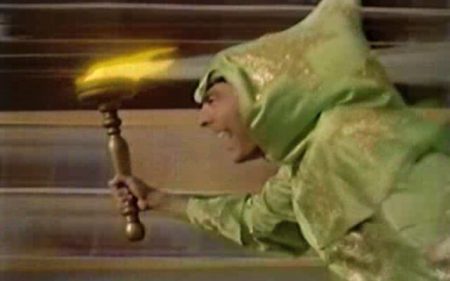
Still from Wizard of Speed and Time

COMMENTS: Moviemaking is a cutthroat business, you know. Maybe you got a hint of that from a film like The Player. Or possibly  Barton Fink. Could have been The Big Picture. Or perhaps State and Main. Come to think of it, it might’ve been Living in Oblivion. Or Bowfinger or Hollywood Shuffle or My Life’s In Turnaround or In the Soup or …And God Spoke or any number of films where Hollywood takes a look in the mirror to catch a glimpse of the laborious and fraught process of trying to get a movie made. When filmmakers are instructed to write what they know, there are plenty who do exactly that.

Well, you can add Jittlov’s sole feature to that list, with the twist that what he knows is how to make lively low-budget special effects. In 1979, he created a short film exploiting his editing and stop-motion photography skills. As these things often do, the short became Jittlov’s calling card, a golden ticket into the world of Hollywood filmmaking. That turns out to be the starting point for this feature-length exploration of his journey into the heart of the moviemaking beast. And when it comes to “writing what you know,” Jittlow keeps his focus squarely on what he’s good at: special effects. The result is… almost exactly what you’d expect.

On the one hand, anyone who manages to assemble a feature film, particularly without the aid of a well-heeled studio, has undertaken a major achievement. On the other hand, Jittlov’s production is laden with the self-awareness of this achievement, and practically demands to be recognized for its own bravery and pluckiness. To call it self-indulgent is a ground-shaking level of understatement. Self-indulgence is the point; the message seems to be, “Everybody deserves a piece of this genius.”

For a zany comedy, The Wizard of Speed and Time is notably angry. One subplot of the film is Jittlov’s ongoing battle against moviemaking’s gatekeepers. Studio indifference, greedy vendors, apathetic accountants, zealous cops, guild oppressiveness (boy howdy, does this movie hate unions), gawking tourists, and general grownup shallowness are just a few of the forces lined up against the filmmaker’s pure and simple goal to make jolly little movies. Atlas Shrugged wishes its heroes and villains were drawn as starkly as this.

So this movie stands as Jittlov’s demonstration of what the Magic Store could be like if there wasn’t so much red tape and cynicism in the business. That being the case, let’s hear it for the bad guys, because The Wizard of Space and Time is exhausting. Determined to pile on the charm, it never lets up. Every jokey moment is slammed up against another jokey moment, with irony-laden captions, a music score taken directly from a theme park, undercranked footage, goofy sound effects, and so much post-production audio looping to guide you along the way. It’s so breathlessly insistent, it makes Airplane! look like a film.

The Wizard of Speed and Time is undeniably weird (or, as the movie itself jokes, “WHOLLY ODD”), but it’s so invested in its zany iconoclasm that it’s impossible to enjoy on any terms if you’re not Mike Jittlov. The climax of the film features a complete re-creation of the original short. This is a smart move; it reminds the audience that there is something genuinely charming here. What Jittlov does with little money and a whole lot of imagination is quite remarkable. And probably best appreciated in a small dose.

WHAT THE CRITICS SAY:

“Created by cult animator and weirdo Mike Jittlov, this 1988 hella-low-budget film follows a talented but jobless special effects wizard as he navigates Hollywood… Jittlov’s enthusiastic DIY production earned a generation of cult fans, who allege he slipped over 1000 subliminal messages into the film. Spooky.”–Chase Burns, The Stranger

(This movie was nominated for review by Marko. Suggest a weird movie of your own here.)