All posts by Gregory J. Smalley (366weirdmovies)

Gregory J. Smalley founded 366 Weird Movies in 2008 and has served as editor-in-chief since that time. He is a member of the Online Film Critics Society, and his film writing has appeared online in Pop Matters and The Spool.

108. BAD BOY BUBBY (1993)

“Christ, kid, yer a weirdo!”–Pop

DIRECTED BY: Rolf de Heer

FEATURING: Nicholas Hope, Carmel Johnson, Claire Benito, Ralph Cotterill

PLOT: With only a rudimentary vocabulary but a gift for mimicry, middle-aged Bubby has been raised by his mentally ill, abusive mother with no knowledge of the outside world inside what is essentially a fallout shelter. One day an interloper enters their underground hovel, shattering the only reality Bubby has ever known. Eventually he finds himself released into a modern Australian society he can hardly comprehend, but must learn to fit into somehow.

Still from Bad Boy Bubby (1993)

BACKGROUND:

  •  Partially as an experiment and partially for practical reasons, de Heer chose to shoot the film with thirty-two different cinematographers, essentially one for every location.
  • Bad Boy Bubby uses binaural sound: the film’s soundtrack was recorded and mixed from two microphones Nicholas Hope wore behind his ears, so that the audience would experience the sonic world exactly as it would be heard from Bubby’s perspective. On home video the effect is largely lost, with the end result being only that a few of the conversations in the film sound frustratingly muffled.  The director suggests that the theatrical experience can be reproduced by listening to the movie while channeling the sound through a pair of stereo headphones.
  • Originally, the underground scenes were to have the sides matted to create a narrow, claustrophobic aspect ratio, and the film was to expand into widescreen when Bubby surfaces into the outside world.  Director De Heer thought the effect was too intense and made the film “unwatchable” and dropped the idea.
  • Bad Boy Bubby won a FIPRESCI International Critics Prize, along with several less significant festival awards.
  • We initially passed Bad Boy Bubby over for inclusion on the List, declaring it to be only “borderline weird.” You can read the original review here.
  • A search for reviews of “Bad Boy Bubby” on the Los Angeles Times website yields no results, but offers the helpful suggestion, “Did you mean ‘bat boy’ bubbly?”

INDELIBLE IMAGE: Bubby the punk rock front man performance artist, on stage in a priest’s collar, holding a blowup doll with enormous breasts wearing a gas mask, backed by a band whose heads are swaddled in cling wrap.

WHAT MAKES IT WEIRD: In my original review of Bad Boy Bubby, I demurred adding the film to the List of the 366 Best Weird Movies by noting that the movie “has a unique tone that’s hard to capture, but the first words I’d choose to characterize it are ‘relentlessly offbeat,’ rather than ‘weird’… for the most part de Heer chooses to tell his story using a straightforward, realistic narrative style that makes us believe bizarre Bubby is a real person in a real world.” The first words I’d use to describe it are still “relentlessly offbeat,” but on further reflection I’ve concluded that Bubby‘s offbeat moments come relentlessly enough that “weird” is a fine choice for the second word I’d use to describe it. I do not want to be in the business of denying the weirdness of movies that feature middle-aged feral children, cling-wrap murders and bizarre swings in tone, especially when they have rabid cult followings and excellent critical reputations.


Short clip from Bad Boy Bubby

COMMENTS: Bad Boy Bubby is a film that moves slowly from deep darkness into light. It is Continue reading 108. BAD BOY BUBBY (1993) →

CAPSULE: MY JOY (2010)

DIRECTED BY: Sergei Loznitsa

FEATURING: Viktor Nemets

PLOT: A Russian truck driver veers off the main highway and into a hinterland of institutionalized

Still from My Joy (2010)

corruption and disjointed narrative.

WHY IT WON’T MAKE THE LIST: My Joy is serious, slow, bleak, oblique, and political; put together, all these adjectives coalesce into “important” in the mind of the average film critic or festival programmer. They do not, however, add up to “entertaining” in the eyes of the average viewer. Add to this the fact that the adjective we are most interested in—“weird”—is present in the film only at trace levels, and My Joy is more of interest to cineastes who make it a point to see important films, as well as to those with a special interest in the sociopolitical situation inside modern day Russia, than it is to pure weirdophiles.

COMMENTS: My Joy‘s confusing journey into the Russian heart of darkness makes more sense after a second viewing, although thanks to plentiful narrative elisions there are still many mysteries that are never resolved. After an unexplained funereal opening, the story proper begins when long haul Russian truck driver Georgy slips away from a couple of crooked checkpoint cops as they are distracted by a more attractive detainee. In a brutal flashback to the days of the post liberation of Berlin Red Army, an aged hitchhiker tells him a story of how military bullies stole his suitcase, his wife, and even his name. (It’s not the last time the film will travel back in time to that particular era; this bitter nostalgia suggests both that the current Russian situation resembles those anarchic times and, more fatalistically, that graft and thievery are the way business has always been done in this part of the world). A child prostitute then shows Georgy a detour around an accident, and he finds himself lost in the wilderness with his cargo until he meets a group of petty thieves. At this point, about an hour has passed—very slowly, in the Russian style, with lots of long shots of people milling about and cab-level views of the trucker driving along deserted roads between the sparse action. Suddenly, it seems that Georgy (the only decent and honest man in all of Russia, as far as we have seen) disappears from the story, as we find ourselves Continue reading CAPSULE: MY JOY (2010) →

CAPSULE: LABYRINTH (1986)

Recommended

DIRECTED BY:

FEATURING: ,

PLOT: A dreamy teenage girl must rescue her kidnapped baby brother by journeying to the Goblin City at the center of a bizarre labyrinth.

Still from Labyrinth (1986)
WHY IT WON’T MAKE THE LIST: Despite the MC Escher-inspired set-design, the unexpected sexual tension between teenaged Connelly and fruitily-dressed goblin king Bowie, and a devout cult following, Labryinth is ultimately just too close to a mainstream Muppet fantasy to place on a List of the 366 Weirdest movies. We’ve passed over slightly stranger movies in this genre—the visually similar Henson-directed The Dark Crystal and the thematically similar Henson-produced MirrorMask—and, although I think Labyrinth is a better film than either of those, it’s difficult to justify certifying this one when its companion films don’t even get to sniff the List.

COMMENTS: In The Wizard of Oz, Judy Garland’s breasts were famously flattened out with tape so the 16-year old could play a pre-pubescent girl. Labyrinth takes a different strategy: 14-old Jennifer Connelly plays exactly her age, portraying a hormonally testy girl-woman caught at the stage where her attention starts to shift from stuffed animals to the well-stuffed pants of strutting rock stars. That shot of rising estrogen distinguishes Labyrinth from other Oz/Alice in Wonderland fairy tale variations, giving it a subtext that goes over the heads of the tots in the audience but leaves adults with additional nuggets to ponder (and no, that’s not another reference to Bowie’s stretch pants).

There’s an impressive amount of imagination on display here, starting with Henson’s puppets, who reveal an almost limitless variety (each individual goblin looks like a representative of its own species) and a nearly human expressiveness (to be honest, the puppets out-act both Connelly and Bowie). The girl’s three companions—the cowardly dwarf Hoggle, the bestial Ludo, and Sir Didymus, the comic relief knight/terrier—are all worthy additions to Henson’s Muppet menagerie, and there is a zoo full of eccentric Wonderland-esque supporting creatures, including walking playing cards, Continue reading CAPSULE: LABYRINTH (1986) →

LIST CANDIDATE: THE BED SITTING ROOM (1969)

The Bed Sitting Room has been promoted to the List of the 366 Weirdest Movies Ever Made. This post is closed for commenting. Please make all comments on the official Certified Weird entry.

DIRECTED BY:

FEATURING: , Michael Hordern, Rita Tushingham, Richard Warwick, Arthur Lowe, , Marty Feldman, , Dudley Moore,

PLOT: After the Bomb falls, a family who lives on a still-functioning subway train travels to the surface in search of a nurse for their pregnant daughter.

Still from The Bed Sitting Room (1969)

WHY IT MIGHT MAKE THE LIST: This absurd anxiety nightmare about the Bomb could only have come out of the Swinging Sixties; it’s one of the weirder relics of an era when filmmakers felt it was their patriotic duty to laugh in the face of the imminent apocalypse.

COMMENTS: The Bed Sitting Room began its life as a one-act play, written by comedian Spike Milligan and John Antrobus in 1962, the year of the Cuban Missile Crisis. At that time, at the height of Cold War paranoia, nuked-up powers were playing games of chicken with each other and worldwide nuclear annihilation seemed inevitable. In the average person’s eyes the world and its leaders had gone insane, and who better to depict the inevitable aftermath of our self-destructive impulses than Milligan and his “Goon Show” squad, under the cheerfully absurd direction of A Hard Days Night‘s Richard Lester? The results are a ridiculous apocalypse the likes of which has never been depicted on screen before. Looking like it was shot in a Welsh garbage dump, with heaping mountains of discarded boots and crockery and the police flying through the sky in a burnt-out VW bug attached to a balloon, the movie anticipates the junkyard visuals of post-apocalyptic films to follow. Tonally, however, Bed Sitting Room is miles away from the cutthroat scavenger worlds of Mad Max or A Boy and His Dog; it’s Theater of the Absurd performed by vaudevillians. The jokes are almost feather-light, contrasting with the inherent horror of the situation. “I’m not eating,” complains a patient. When the doctor asks why, he answers matter-of-factly, “can’t get the stuff.” In another scene a lonely recluse asks “would you do for me what my first wife did?” to a nervous middle aged woman who’s fallen into his fallout shelter. Having no choice, she reluctantly agrees, and he hands her pots, pans and teacups to throw at him as he dodges them shouting “she means nothing to me!” The movie is full of corny Continue reading LIST CANDIDATE: THE BED SITTING ROOM (1969) →

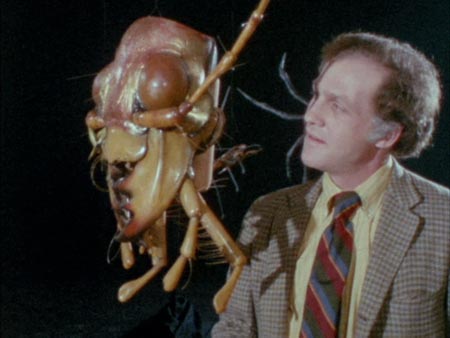
CAPSULE: THE HELLSTROM CHRONICLE (1971)

Must See

DIRECTED BY: Ed Spiegel (Hellstrom sequences), Walon Green (producer and principal photography), David L. Wolper (executive producer)

FEATURING: Lawrence Pressman

PLOT: The fictional Dr. Nils Hellstrom explains the evolutionary advantages of insects and

Still from The Hellstrom Chronicle (1971)

concludes they are biologically superior to humans, leading him to predict dire consequences for the future of our species.

WHY IT WON’T MAKE THE LIST: Documentaries don’t come much weirder than this, but even the orgies of insectoid sex and violence and Dr. Hellstrom’s flaky mad scientist rants about the inherent superiority of spiders, termites and centipedes can’t raise this to the level of the truly bizarre. Despite the fact that it doesn’t have the goods to rank among the weirdest movies of all times, however, it’s still a beautiful abnormality that’s well worth your attention.

COMMENTS: The Hellstrom Chronicle contains a lot of curiosities, but the heart of the movie are the amazing images captured through (then miraculous) micro-photography: a caterpillar developing from a fertilized cell to a larva in the space of a minute, a shot of beetles locked in a death struggle that widens and pans to show a human couple cuddling on the lawn, individual brightly-colored butterfly scales glowing in the sunlight like Lite Brites. As that last image suggests, there is a psychedelic character to much of this parade of fantastical bug-tography, one that the filmmakers play up as they segue from those super-closeups of wings to shaky cam scenes of fields of butterflies flying through a forest, as Lalo Schifrin’s electronic free-jazz symphony soars ecstatically. From sequences like this we realize why this documentary was so popular on college campuses in the 1970s; you can almost see the clouds of pot smoke rising up in front of the five-foot tall black beetles with their jutting horns silhouetted against the sunrise, and hear the low murmurs of “far out, man.”

With its dissonant sitars, electric pianos dithering over waves of cymbals, and waveform synthesizers wavering in the background, Schrifin’s remarkable score evokes not only midnight trips but also conventional sci-fi giant insect cues, which is appropriate because much of the Continue reading CAPSULE: THE HELLSTROM CHRONICLE (1971) →