Tag Archives: Romance

CAPSULE: DAYDREAM NATION (2010)

DIRECTED BY: Michael Goldbach

FEATURING: , Reece Thompson, Josh Lucas, Andie MacDowell, Ted Whittall

PLOT: A teenage girl and her dad move to a small town populated with drug-addled teenagers and a mysterious serial killer. Feeling alienated and struggling to make friends, she sees a fellow intellectual outcast in her English teacher and decides to seduce him, while her bumbling classmate Thurston starts to fall for her.

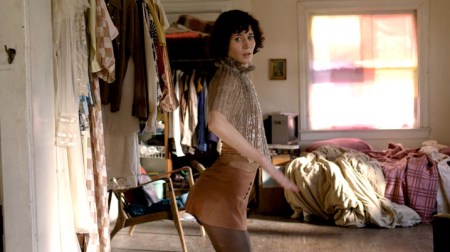
Still from Daydream Nation (2010)

WHY IT WON’T MAKE THE LIST: Though its dark undertones, nonlinear format, and attempts to comment on the violence and sexiness apparently inherent to small-town teenagers have garnered comparisons to Donnie Darko and Twin Peaks, this is just an angsty, poorly-scripted knockoff with very little true weirdness.

COMMENTS: Narrated by the gorgeous Kat Dennings, who switches back and forth between her recent past and the present, Daydream Nation attempts to mesh poignant high school drama with erratic comedy and suburban darkness.  Caroline, our protagonist, is intelligent and disaffected, often sneaking in awkwardly sophisticated references that her peers don’t understand.  She embarks on a relationship with her teacher on a lark, in an effort to try something new and become a different person for a while; the unstable Mr. Anderson quickly becomes obsessively infatuated with her.  Their relationship falters as Caroline starts responding to the advances of Thurston (Reece Thompson), a druggie classmate mourning the recent death of a friend.  These core proceedings are surrounded by a lingering industrial fire, serial killings, parental interventions, and a ghost or two.

Seemingly shot entirely through a high-contrast haze, the film offers a few visual treats but nothing in the way of ingenuity.  The same can be said for the script, which has a few shining moments of interest but lingers in derivative mediocrity for most of the runtime.  Writer/director Michael Goldbach doesn’t seem to have much confidence in his ability to tell a story, inundating us with unnecessary amounts of narration and several needless plot devices.  The central character of Caroline—while played wonderfully by Kat Dennings—suffers the most. The best parts of the film involve her speaking her mind, calling out the hypocrisy and sexism of those around her, but these scenes are immediately followed by the character chastising herself in private, thinking herself a “bitch” just because she spoke the truth. It’s as if Goldbach wanted to write a strong female character, but then lost his momentum and copped out to typical gender stereotypes.

Daydream Nation aims for subtlety, but comes out with blaring obviousness thanks to the clumsy pacing and script. The performances from Dennings, Thompson, Lucas, and MacDowell are solid, but can’t save the ridiculous dialogue or self-indulgent shooting style (not that I’m complaining about the myriad drawn-out, close-up shots of Dennings, but really, it’s all a bit much). And it isn’t even that weird!

WHAT THE CRITICS SAY:

“…rolls elements of ‘Juno,’ ‘American Beauty,’ ‘Donnie Darko’ and ‘Twin Peaks’ into a potent blunt.”–Stephen Holden, The New York Times (contemporaneous)

CAPSULE: RICKY (2009)

DIRECTED BY: François Ozon

FEATURING: Alexandra Lamy, Mélusine Mayance, Sergi López

PLOT:  A single mom factory worker gives birth to a very special baby; of course, every mother thinks her baby is miraculous, but in this case the press thinks so, too.

Still from Ricky (2009)


WHY IT WON’T MAKE THE LIST:  A minor but sometimes effective meditation on motherhood, Ricky might not be good enough to make this exclusive list even if it were extremely bizarre. Its “what if” premise and strange, vacillating tone is just off-normal enough to place the movie within the weird genre, but it in no way pushes the boundaries of the bizarre.

COMMENTS:  If you’ve read other reviews of Ricky, you might have already discovered what it is that makes this baby special; only a few critics have managed to keep the film’s turning point a secret. I don’t think it’s necessary to give away the surprise to discuss the film, but you might be able to figure it out anyway from context. It’s less important precisely what it is that makes Ricky a special baby, which is mainly a matter of concern for the special effects crew, then it is to consider the role Ricky’s “specialness” plays in the story: a metaphor for the wonder with which a mother views her own offspring. The wizardry that brings the baby to life is inconsistent—the analog elements are neat looking, if unconvincing, while the digital realizations are just unconvincing—but that’s not what most people will find unsatisfactory about the film. Ricky begins life as a dreary domestic drama, then shifts gears about halfway through and tries to be a whimsical semi-comedy before gliding into a mystical, suspiciously happy ending. As the movie gets weirder the tone gets lighter, but the hard realities of the earlier drama still weigh it down. The two hemispheres of the movie work against each other; the part of the movie that’s well done is kind of boring, while the more intriguing portion often seems thrown together on the fly.

As stressed lower-middle class parents Katie and Paco, Alexandra Lamy and Sergi López are believably flawed: they bicker and accuse each other, they sometimes neglect Katie’s older child Lisa, and they can be irresponsible parents (no pediatrician for Ricky?), but in the end they fight through their own limitations to do the right thing for their offspring. Lamy sells the film’s potentially ridiculous emotional climax and makes it affecting; a poor performance would have turned it into pure camp. It’s a serious and thoughtful movie with points to praise (particularly Lamy’s performance); but, even as an experiment in deliberately inconsistent tone, it’s hard to say the film works on the whole. In the end, Ricky never really gets off the ground.

The movie begins with an out-of-sequence prologue that’s incompatible with the rest of the story. Although the scene frustrates and confuses some viewers, it’s a great tear-jerking moment for Lamy; and, more importantly, by it contrasting the grim reality of single parenthood with the fantasy that follows, it’s the key to the film’s psychology.

WHAT THE CRITICS SAY:

“The film is bewildering. I don’t know what its terms are, and it doesn’t match any of mine. I found myself regarding it more and more as an inexplicable curiosity.”–Roger Ebert, The Chicago Sun Times (contemporaneous)

CAPSULE: WHAT DREAMS MAY COME (1998)

DIRECTED BY: Vincent Ward

FEATURING: , Annabella Sciorra, Cuba Gooding Jr., Max von Sydow

PLOT: A pediatrician dies and goes to paradise, but he’s willing to throw away an eternity of

Still from What Dreams May Come (1998)

bliss to find his wife, who’s trapped in a far less pleasant afterlife.

WHY IT WON’T MAKE THE LIST:  Majestic visuals make Dreams worth a gander for most, but due to high levels of sugary sentiment it’s contraindicated for diabetic cinephiles.  While it has some unusual moments (and a cool eyeblink cameo from weird icon Werner Herzog as a tormented head), its weirdness isn’t much higher than any other Hollywood-approved fantasy.

COMMENTS:  The romantic afterlife fantasy What Dreams May Come flopped at the box office, but won a well-deserved Oscar for Best Visual Effects.  When pediatrician Chris (Robin Williams) dies and goes to heaven, the afterlife manifests as one of his wife’s oil paintings.  Williams (joined by spiritual guide Cuba Gooding Jr.) wanders around inside an incredibly detailed landscape that looks like it was literally created out of paint; when his shoe slips on the mud, it exposes an undercoat of iridescent green and orange. It’s a miraculous mise-en-scène that, by itself, makes the movie worth catching.  Other visuals pack quite a punch as well, especially when the action moves from a prismatic heaven to a gray hell: we watch a horde of swimming dead menacing Chris’s boat, and see him carefully transverse a field where the faces of the damned grow like heads of lettuce.  Unfortunately, the other aspects of the production can’t keep up to the standard set by the visuals, and a vein of sappiness undermines the whole endeavor.   What Dreams was made during the period when Robin Williams was still transitioning from a wacky motormouthed comedian to a “serious” dramatic actor, and he received some praise for this performance at the time; looking back, however, it seems too restrained, as if he’s trying to keep his massive personality in check.  Gooding Jr. tries to compensate for Williams’ surprising lack of energy, and goes over the top a couple of times (I half expected him to shout out, “show me the salvation!”). Annabella Sciorra comes off best, but she needed a Continue reading CAPSULE: WHAT DREAMS MAY COME (1998)

CAPSULE: DEAD AWAKE (2010)

DIRECTED BY: Omar Naim

FEATURING: Nick Stahl, , Amy Smart

PLOT: Haunted by the memory of a car crash, a lonely funeral assistant fakes his own

death. Tracking a mystery mourner, he finds himself tangled in intrigue while suffering from bizarre, piecemeal flashbacks from his discordant, seemingly supernaturally influenced past.

WHY IT WON’T MAKE THE LIST:  While Dead Awake captures our imagination at first with ominous flashbacks and peculiar visions which emphasize details in a way that foreshadow profound significance, none of these clues pan out to reveal an extraordinary plot.  The method of revelation builds interest in previous events that turn out to be not very mysterious once we are let in on their meaning.  Worse, at about the halfway point, the story becomes a derivative, conventional chiller.

COMMENTS:  The setup:  Nick Stahl plays sullen, skulking  funeral director who stages his own death to see if old friends will arrive at his funeral.  When an enigmatic young woman comes to mutter cryptic utterances over his “corpse,” he follows her and has some unusual misadventures.  In the meantime, he flirts with an ex-girlfriend who also came to his viewing, unlocking a cascade of strange memories and guilt about some mysterious, previous tragedy that broke them apart.  Eventually, we find out how both women are connected to  Nick’s past and to his haunting recollections.

Sounds like the makings of a real whiz-bang chiller-thriller, right?  Wrong!  What a massive disappointment. I was expecting something clever, brooding and supernatural like Dark Corners, and that’s how Dead Awake starts out. There is a mysterious car crash, a mortuary attendant faking his own funeral, a mysterious griever talking in riddles, indications that half the characters may be dead and not know it, and eerie flashbacks wrought with hidden symbolic meaning.

The non-linear plot, dark tone and twists and turns made me think I was in for a real doozy of a story.  And then the film peters out.  The flashbacks reveal no great mystery, the symbolism turns out to be arbitrary and empty, and real ideas are replaced with melodrama, over-acting and a grandiose musical score that is more fitting of a sweeping historical epic.  The score seems calculated to try to fool the viewer into thinking he is watching something more important than he really is (it didn’t work).

The movie wraps up with an unlikely stretch of a “climax” (more of an anti-climax) and a corny, happy (more like sappy) ending with a lame and very mild twist that opens up a bunch of plot holes.

I paid money for this???  I swear, no more poppy juice and Colt .45 before I read DVD jackets at the video store.

I saw that Nick Stahl was in this and so far, I have seen him in three other movies that turned out to be artistic, independent, and pretty good, so I took a gamble.  Mind you, Dead Awake is not a bad movie.  It doesn’t smack of major studio schlock.  The problem is that is promises to be so darned intriguing and then drops the ball, almost as if a writers strike led to someone with no imagination completing the script from the halfway point.

Rose McGowan, formerly a delicious woman, looks just . . . awful, post plastic surgery.

WHAT THE CRITICS SAY:

“A poorly structured and even more poorly shot mixture of a gothic suspense thriller with a vanilla romance filmed in Des Moines, “Dead Awake” never comes close to springing to life.”–Mark Olsen, The Los Angeles Times (contemporaneous)

Dead Awake trailer

LIST CANDIDATE: MAKE-OUT WITH VIOLENCE (2008)

DIRECTED BY:  Deagol Brothers

FEATURING:  Eric Lehning, Cody DeVos, Leah High, Brett Miller, Tia Shearer, Jordan Lehning

PLOT: A young man finds one summer love with the reanimated object of his desire.

Still from Make-out with Violence (2008)

WHY IT SHOULD MAKE THE LIST: Skillful blending of genres combined with a premise of genuinely romantic necrophilia make this movie 100 percent weird, without being over-the-top.

COMMENTS: Patrick and Wendy are best friends for life. He is crazy. She is dead.

When Patrick finds Wendy reanimated, he attempts to remedy his unrequited love for her. Pursing his obsession, his existence spirals into the uncanny.

Thinking, creative-minded viewers will be entranced by this peculiar, arty atmosphere tale. Not a horror movie with conventional thrills and chills, Make-Out With Violence is an unsettling story about love triangles and living death. Dreamy cinematic sequences blend into contrasting scenes of horror and the grotesque.

Brothers Carol and Patrick love best friends Addy and Wendy respectively. Wendy loves Brian, Brian has a fling with Addy, Addy gets jealous when Carol makes eyes at her friend Anne, and Wendy is dead. Dead, and inexplicably reanimated.

Wendy went missing the spring of her senior year. Never found and declared dead the summer before college, she is discovered in a field by Carol.  Undead, but in a semi-catatonic state, Wendy is mostly unresponsive.  Because she was so well liked and admired by all who knew her, Carol and Patrick are compelled take her to the home of an out-of-town friend where they attempt to care for her.

As the summer waxes, then wanes the brothers and their friends pursue their love interests. Carrol dates Addy. And well, Patrick “dates” dead Wendy, both siblings taking time out to tend to her as if such an endeavor is perfectly normal.  All goes well until their love triangles cause them to break their pact of secrecy and Addy finds out about Wendy, with macabre consequences.

Good acting, pleasing photography, and a gentle, artful soundtrack complement wholesome, likable characters, and a dreamy, sepia-toned, perspective on youth and summer. The overall effect makes the cinematic experience like a rosy look back at our idealized impression of golden meadows and free spiritedness of the 1970’s, interspersed with creepy, repellent sequences of undeath.

Make-Out With Violence is a different kind of horror movie, definitely not for a mainstream audience. This film is a well produced, conventionally assembled movie with a truly bizarre plot. It will appeal to fans of mood films such as 2007’s One Day Like Rain, who will find Make-Out With Violence to be infinitely more lucid and coherent.

I am including the trailer below against my better judgment. Whoever put it together should be shot. It fails to adequately convey the essence, tone and substantive impact of the film, making it look like a Generation-X teenage movie, which it is not.

WHAT THE CRITICS SAY:

“…invests in spacey horror tropes one moment, plunges into absurdist adolescent angst the next and begs questions every step of the way, but just about holds together with its strong compositional sense, killer atmospheric lighting and wall-to-wall music track… the offbeat rhythms of the pic’s non-pro cast cranks up the film’s bizarre intensity.”–Ronnie Scheib, Variety (contemporaneous)

Make Out With Violence trailer