Tag Archives: Psychological Thriller

97. MULHOLLAND DRIVE (2001)

366 Weird Movies may earn commissions from purchases made through product links.

“Do not demystify.  When you know too much, you can never see the film the same way again. It’s ruined for you for good. All the magic leaks out, and it’s putrefied.”–David Lynch, explaining to Terrence Rafferty why he will not record director’s commentaries

Recommended

DIRECTED BY: David Lynch

FEATURING: , ,

PLOT: A woman (Harring) is involved in a nighttime accident on Mulholland Drive and flees into the city of Los Angeles with amnesia; she sneaks into an apartment soon to be occupied by naive young Betty (Watts), who has come to Hollywood hoping to find stardom.  Meanwhile, a film director (Theroux) finds himself pressured by mysterious mobsters to cast an unknown actress in his upcoming project.  Betty helps the amnesiac woman try to recover her identity, but the clues only lead to a strange avant-garde nightclub, a key, a box, and a sudden reality shift that throws everything that came before into confusion.

Still from Mulholland Drive (2001)

BACKGROUND:

  • Lynch originally intended Mulholland Drive as a TV series in the mold of “Twin Peaks.”  When the networks passed on the pilot, the French producer Studio Canal stepped in with additional financing to turn the pilot into a feature film.  In between ABC’s proactive cancellation of the series and the creation of the film version, all of the sets and props were dismantled, forcing Lynch to come up with a different way to complete the story.
  • Monty Montgomery, whose appearance as “The Cowboy” is an uncanny show-stopper, is a Hollywood movie producer (who produced Wild at Heart for Lynch).  Mulholland Drive is his only acting credit (he’s listed as “Lafayette Montgomery” in the credits).
  • Lynch insisted no chapter stops be included on the DVD.
  • The original DVD release included an insert from Lynch containing “10 Keys to Unlocking This Thriller.”
  • Mulholland Drive received significant critical acclaim, nabbing Lynch a Best Director award at Cannes (shared with Joel Coen for The Man Who Wasn’t There) and a Best Director Oscar nomination.  It was voted best picture of the Year by the Boston Film Critics Society, the Chicago Film Critics Association, the new York Film Critics Circle, and the Online Film Critics Society (where it tied with Memento in the voting).  It was also voted best foreign picture by the Academy Award equivalents of Brazil, France, Spain, and Australia.

INDELIBLE IMAGE: The Silencio nightclub, decorated in Lynch’s trademark red velvet drapes and staffed by his trademark subconscious monsters.

WHAT MAKES IT WEIRD: If the massive reality shifts and actresses unexpectedly playing multiple roles is not enough for you, then the monster behind the Winkie’s, a Spanish version of Roy Orbison’s “Crying” delivered by a woman who collapses onstage, and a mafia-style media syndicate run by a deformed dwarf who uses an eyebrowless cowboy as his right-hand man will convince you that we are deep in that subconscious pit of eroticism, kitsch and weirdness that can only go by the name Lynchland.


Original trailer for Mulholland Drive

COMMENTS:  Oddly enough, what may be the most important scene in Mulholland Drive Continue reading 97. MULHOLLAND DRIVE (2001)

90. BLACK SWAN (2010)

“It’s a Polanski movie, and then it becomes a Dario Argento movie. And maybe a little bit of David Cronenberg too.”–Vincent Cassell

Must See

DIRECTED BY: Darren Aronofsky

FEATURING: Natalie Portman, Mila Kunis, , Barbara Hershey, Winona Ryder

PLOT: Nina, a goody two-shoes ballerina, wants to dance the lead role in a production of “Swan Lake,” but although she’s perfect for the role of the White Swan, she lacks the seductiveness to portray the Black Swan. Lily, a sexy, irresponsible dancer newly arrived from a San Francisco troupe, becomes her primary competition for the part, but also helps her loosen up by talking her out on the town for a night of drinking and meeting guys. Nina starts physically break down and hallucinate as the stress of preparing for the role takes its toll; by opening night, she can’t distinguish reality from the story she dances of the princess trapped in the body of a swan who takes her own life.

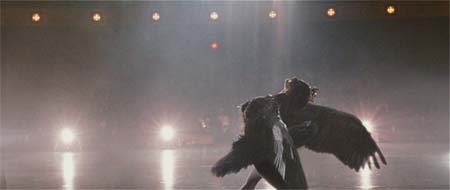
Still from Black Swan (2010)

BACKGROUND:

  • Natalie Portman danced many of her own parts, and actually dislocated a rib while dancing during the shoot. More difficult moves were performed by professional ballerinas, and for two sequences Portman’s face was digitally superimposed on dancer Sarah Lane’s body. There was a minor controversy over how much of the dancing Portman actually did herself and how much was performed by doubles; Aronofsky estimated that the actress executed more than 80% of the dance moves that appear onscreen.
  • Portman won the 2010 Best Actress Oscar for her role as Nina. The film was also nominated for Best Picture, Director, Cinematography and Editing.
  • Aronofsky received “The Understudy,” the original script that became Black Swan, while he was making Requiem for a Dream (2000). He described the script as Dostoevsky’s “The Double” meets All About Eve. Aronofsky combined that script, which was set in an off-Broadway production, with an idea he had to shoot a movie in the New York ballet world to create Black Swan.
  • Aronofsky and Portman had discussed doing a ballet movie together 8 years prior to shooting.
  • Made on a relatively small budget of about $12 million, Black Swan has grossed more than $300 million worldwide as of this writing.

INDELIBLE IMAGE: Nina’s “triumphant” onstage transformation into the Black Swan: as she pirouettes, feathers sprout from her arms, thickening with every swirl, until her limbs have been replaced by wings.

WHAT MAKES IT WEIRD:  Up until opening night, Black Swan is a backstage melodrama about backstabbing ballerinas, with an exaggerated, lurid psychopathology that’s thrust even further over-the-top by lesbian love scenes, hints of horror, and mirrors, mirrors, mirrors.  When the curtain rises on the big night, we experience the performance through the subjective perspective of an overworked, paranoid, demented dancer, whose psychology has been shattered by the film’s sledgehammer symbolism.  No avant-grade choreographer could stage as disorienting a “Swan Lake” as the one she hallucinates for us through her obsessed eyes.

Promotional Music Video for Black Swan

COMMENTS: Black Swan is the weirdest movie ever to win a major Academy Award (Natalie Continue reading 90. BLACK SWAN (2010)

CAPSULE: DEAD AWAKE (2010)

DIRECTED BY: Omar Naim

FEATURING: Nick Stahl, , Amy Smart

PLOT: Haunted by the memory of a car crash, a lonely funeral assistant fakes his own

death. Tracking a mystery mourner, he finds himself tangled in intrigue while suffering from bizarre, piecemeal flashbacks from his discordant, seemingly supernaturally influenced past.

WHY IT WON’T MAKE THE LIST:  While Dead Awake captures our imagination at first with ominous flashbacks and peculiar visions which emphasize details in a way that foreshadow profound significance, none of these clues pan out to reveal an extraordinary plot.  The method of revelation builds interest in previous events that turn out to be not very mysterious once we are let in on their meaning.  Worse, at about the halfway point, the story becomes a derivative, conventional chiller.

COMMENTS:  The setup:  Nick Stahl plays sullen, skulking  funeral director who stages his own death to see if old friends will arrive at his funeral.  When an enigmatic young woman comes to mutter cryptic utterances over his “corpse,” he follows her and has some unusual misadventures.  In the meantime, he flirts with an ex-girlfriend who also came to his viewing, unlocking a cascade of strange memories and guilt about some mysterious, previous tragedy that broke them apart.  Eventually, we find out how both women are connected to  Nick’s past and to his haunting recollections.

Sounds like the makings of a real whiz-bang chiller-thriller, right?  Wrong!  What a massive disappointment. I was expecting something clever, brooding and supernatural like Dark Corners, and that’s how Dead Awake starts out. There is a mysterious car crash, a mortuary attendant faking his own funeral, a mysterious griever talking in riddles, indications that half the characters may be dead and not know it, and eerie flashbacks wrought with hidden symbolic meaning.

The non-linear plot, dark tone and twists and turns made me think I was in for a real doozy of a story.  And then the film peters out.  The flashbacks reveal no great mystery, the symbolism turns out to be arbitrary and empty, and real ideas are replaced with melodrama, over-acting and a grandiose musical score that is more fitting of a sweeping historical epic.  The score seems calculated to try to fool the viewer into thinking he is watching something more important than he really is (it didn’t work).

The movie wraps up with an unlikely stretch of a “climax” (more of an anti-climax) and a corny, happy (more like sappy) ending with a lame and very mild twist that opens up a bunch of plot holes.

I paid money for this???  I swear, no more poppy juice and Colt .45 before I read DVD jackets at the video store.

I saw that Nick Stahl was in this and so far, I have seen him in three other movies that turned out to be artistic, independent, and pretty good, so I took a gamble.  Mind you, Dead Awake is not a bad movie.  It doesn’t smack of major studio schlock.  The problem is that is promises to be so darned intriguing and then drops the ball, almost as if a writers strike led to someone with no imagination completing the script from the halfway point.

Rose McGowan, formerly a delicious woman, looks just . . . awful, post plastic surgery.

WHAT THE CRITICS SAY:

“A poorly structured and even more poorly shot mixture of a gothic suspense thriller with a vanilla romance filmed in Des Moines, “Dead Awake” never comes close to springing to life.”–Mark Olsen, The Los Angeles Times (contemporaneous)

Dead Awake trailer

LIST CANDIDATE: THE ATTIC EXPEDITIONS (2001)

This post was originally lost in the Great Server Crash of 2010; the article was partially recovered from Google cache, and the rest of the text was recreated. Sorry, original comments were irretrievably lost in cyberspace.

DIRECTED BY: Jeremy Kasten

FEATURING: Andras Jones, , Jeffrey Combs, Beth Bates, Ted Raimi

PLOT: Awakening from a dream to find himself on an operating table, an amnesiac is informed that he is a schizophrenic murderer who has been committed to a private institution and is now being sent to a halfway home—nicknamed “the House of Love”—to be rehabilitated.

Scene from The Attic Expeditions (2001)

WHY IT MIGHT MAKE THE LIST: The Attic Expeditions sounds echoes of some (better) weird movies: Jacob’s Ladder (in the way that the script offers different possible explanations for the protagonist’s hallucinations, and jerks the viewer back and forth between those theories) and Donnie Darko (in that it seems the director intended to tell a fantastical story that “made sense” on a literal level, but lost control of the story when he took it one paradox too far). An interesting, confusing, out-of-control picture, it’s as fascinating for its misses as for its hits. It falls just short of a general recommendation, but it is recommended to anyone interested in psychological, mindbending horror seasoned with heaping doses of confusion and who isn’t a stickler for great acting. This is the kind of curious, singular picture that could wind up filling one of the final slots in the List.

COMMENTS: Trevor Blackburn may be a schizophrenic murderer, or he may be an amnesiac sorcerer, or he may be the victim of an unethical psychological experiment; or he may be all three. It’s impossible to tell, especially since The Attic Expeditions is full of contradictions and contains segments where the timeline suddenly resets and the action repeats itself with slight variations. The mystery promiscuously throws out clues, but every possible explanation for Trevor’s woes seems chained to its own refutation. Trevor is an unreliable narrator in triplicate: he’s a definite amnesiac, a possible schizophrenic, and, to top it all off, his state-appointed guardian appears to be deliberately playing with his loose grip on reality. Psychiatrist Dr. Ek (played by Jefferey Combs as a variation on Herbert West as a pot-smoking, skin-popping headshrinker) uses Trevor as a case study for an experiment in Continue reading LIST CANDIDATE: THE ATTIC EXPEDITIONS (2001)

CAPSULE: PSYCH: 9 (2010)

DIRECTED BY:  Andrew Shortell

FEATURING:  Sara Foster, Cary Elwes, Michael Biehn, Gabriel Mann, Ryan James,

PLOT: A records clerk working the graveyard shift in a shut-down hospital has puzzling,

Still from Psych 9

ghastly visions that may or may not be connected to a string of murders and her own past. As she strives to interpret the unusual events, she becomes ensnared in the uncanny, plummeting into a morass of sick secrets, murder, arson and madness.

WHY IT WON’T MAKE THE LISTPsych: 9 sports a delightful, creatively non-linear plot. The story is conveyed via a reality-blurring mixture of flashbacks and delusions blended with the present.   Aside from the clever story-telling technique however, Psych: 9 is an otherwise conventional psychological thriller, with mystery and horror elements.

COMMENTS:  Roslyn (Foster) takes a night job sorting records in a defunct, mostly deserted, eerie old hospital. At work, a sleazy security guard (James) likes to leer, her nervous husband (Mann) likes to visit, and an off-kilter detective (Biehn) is taken to calling on her. Her only trustworthy ally is a shrink who is busy sorting records up on the fifth floor, and he’s somehow just a little bit too nice.

The detective is investigating a series of sensational hammer murders in the hospital’s creepy neighborhood, and the shifty-eyed husband, Cole, who drives a taxi, just happens to be in the vicinity every time the murders occur. Suspiciously, Cole can’t account for the whereabouts of, you guessed it, his long, sharp geologist’s hammer missing from his toolbox.

To make things even more coincidentally unsettling, Roslyn was born in the hospital where she now works and has some undisclosed issues about her past. Disturbingly, these past issues connect to troubling uncertainties about her present. Complicating matters, she starts seeing scary apparitions that may or may not really be there. Roslyn also has occasional daydream/nightmares. They are deepening in intensity and increasingly resemble psychotic episodes.

Roslyn does her best to maintain her composure by delving into her duties, and she has her Continue reading CAPSULE: PSYCH: 9 (2010)