Tag Archives: Christopher Lee

CAPSULE: ALICE IN WONDERLAND (2010)

DIRECTED BY: Tim Burton

FEATURING: , Johnny Depp, the head of , , voices of Stephen Fry and Christopher Lee

PLOT:  About to be proposed to by a doltish fop, Alice excuses herself to tumble down a rabbit hole where she learns she has been chosen to slay the Jabberwock[y].

Still from Alice in Wonderland (2010)

WHY IT WON’T MAKE THE LIST:  Not weird enough.  Burton, perhaps fearful of angering the gravy-train drivers at Disney, dims down the absurdity in this version of Alice, recasting the tale as an epic fantasy war fought by a cast of weirdos.

COMMENTS:  Alice in Wonderland (which should have been titled Alice in Underland, if anyone had been paying attention) is a good-looking film with a few positives, but a recycled story that’s far from enchanting.  The candy-colored visuals are as top-notch as expected, with plenty of little details to soak in: look for a dragonfly-sized flying rocking horse and a moat with floating stones that appear to be petrified severed heads.  Helena Bonham Carter’s macrocephalic visage is almost worth the price of admission, and her performance as the Red Queen is suitably comic and imperious.  But the story—ouch!  Alice’s previous visit to Wonderland—oops, make that Underland, as it’s denizens insist it’s properly called—nine years ago was real, but she’s forgotten it for some reason, which is fine because her past adventures served no purpose whatsoever.  In this sequel, the poem “Jabberwocky” is a prophecy that predicts Alice will find the vorpal blade and snicker-snack it into the neck of the dreaded Jabberwock(y) on Frabjous Day.  The Mad Hatter reads the verse word for word to the disbelieving Alice, neither of them noticing that the lines refer to a “beamish boy;” Alice may be beamish, but she’s no boy.  But who cares about such details?  They can’t even get the monster’s name right after reading it off the page: everyone refers to the Jabberwock as the “Jabberwocky” (which is like calling Odysseus “Odyssey”).  We may wonder about such inconsistencies, but such uffish considerations only matter in a tightly constructed nonsense world like Wonderland; we’re in Underland, and here there are quirky companions to collect before galumphing off to slay dragons with magical swords.  Burton’s non-nonsense epic fantasy plays like an original concept by Lewis Carroll that’s been script doctored by J.R.R. Tolkien, then sent back by the corporate suits to add more fight scenes to appeal to boys and a feminist moral about self-actualization for the girls.  Despite the occasional chase scene by a pack of guards who look as much like Terminator robots as playing cards, curiously, for the most part the early story plays out much as in Carroll’s tale.  Alice retraces her steps, eating and drinking shrinking and growing potions and cakes and meets a hookah smoking Caterpillar.  The Cheshire Cat directs her to a mad tea party.  But things get less and less curiouser and more and more familiarer as the tale continues.  It turns out that the tea party really isn’t mad, it’s just a ruse by the Resistance to avoid detection by the authorities. Johnny Depp’s Mad Hatter isn’t mad either (and certainly not bonkers); perhaps he’s slightly perturbed, but his faculties are all about him as leads the fight for freedom, even taking up a sword for the final battle.  I have no problem with taking liberties with Carroll’s tone and story, but if you’re going to depart from the original you should replace it with something interesting, not just a generic fantasy quest rehash.  Nick Willing’s Alice, with it’s human “oysters” being drained of their emotions, tapped into a more cusiously skewed Alice scenario.  It’s a shame that that premise couldn’t have been matched to this budget.  Tim Burton’s Alice isn’t bad, it’s just forgettable—something that could only happen in Underland, not Wonderland.

To some extent, Burton may be the victim of high expectations.  Carroll and Burton seemed the perfect match, and there were high hopes that this material might allow Tim to return to the glory days of Beetlejuice, Edward Scissorhands and The Nightmare Before Christmas, when his fantasies managed to tap the popular consciousness while still dripping with edgy originality. Those of us who got our hopes up should have recognized that Alice in Wonderland is a kids’ movie intended as a blockbuster; Disney isn’t about to let Burton take chances with the story.  His commission directed him to deliver Tim Burton visuals inside a safe script, and that’s what he did.  The movie works fine for the little ones, but offers little to adults besides eye candy and a couple of chuckles.  If Burton’s going to bounce back (and I’m starting to doubt he ever will), we’ll have to wait until he feels like he’s finally garnered enough dough and Hollywood validation to start taking chances again.

WHAT THE CRITICS SAY:

“…neither is [Burton’s] Alice, sad to report, in the least bit lysergic. On the contrary, the movie is positively sober in its positive image projection and concern with itself as a business model. Like more than one recent movie, Alice seems a trailer for a Wonderland computer game—and it is. The final battle is clearly designed for gaming.”–J. Hobermann, The Village Voice (contemporaneous)

21. THE WICKER MAN (1973)

“I think it is a film fantastique in a way… a film fantastique can have almost anything in it, it’s based on facts but it can take flights of fancy which are still rooted to the truth, to the reality of the story, so the imagination can roam.”–Robin Hardy

Must See

DIRECTED BY: Robin Hardy

FEATURING:  Edward Woodward, Christopher Lee, Diane Cilento, Britt Ekland,

PLOT:  A devout Christian policeman flies to the isolated island of Summerisle off the coast of Scotland to investigate a report of a missing girl.  When he gets there, everyone denies knowledge of the girl, but he notices with increasing disgust that the entire island is practicing old pagan rituals and licentious sex.  As his investigation continues, he uncovers evidence suggesting that the missing girl was a resident of the island, and may have met a horrible fate.

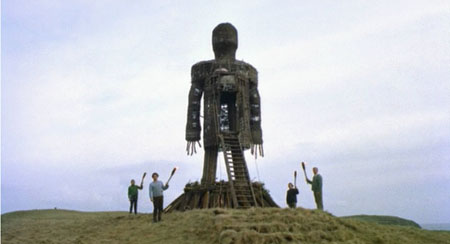
the_wicker_man_1973

BACKGROUND:

  • Screenwriter Anthony Shaffer was a hot property in 1973 after adapting his own successful mystery play Sleuth into a 1972 hit movie with Laurence Olivier and Michael Caine, and penning the screenplay for Frenzy (1972) for Alfred Hitchcock.  His clout was so great that this film was released under the official title Anthony Shaffer’s The Wicker Man.  He later adapted Agatha Christie novels such as Murder on the Orient Express (1974) for the big screen.
  • Director Robin Hardy, despite doing an excellent job on this film, did not direct a feature film again until 1986’s Wicker Man variation, The Fantasist.
  • Christopher Lee, who had just come to the end of his run as Hammer’s Dracula, donated his acting services to the production.  He was quoted in 1977 as saying, “It’s the best part I’ve ever had.  Unquestionably.”
  • The “wicker man” was a historically accurate feature of Druidic religions that was first described to the world by Julius Caesar in his “Commentary on the Gallic Wars.”
  • In Britain the film was released on the bottom half of a double bill with Don’t Look Now, perhaps the most impressive psychological horror double feature in history.
  • Shaffer and Hardy published a novelization of the film in 1976.
  • “Cinefastique” devoted an entire 1977 issue to the film, calling it “the Citizen Kane of horror movies.”
  • In 2001, an additional 12 minutes of deleted scenes were added to create a “Director’s Cut” version.
  • Some of the original footage is believed to be lost forever, including part of the scene where Sgt. Howie first meets Lord Summerisle.  The original negative was accidentally thrown away when original producer British Lion Films went under and cleaned out its vaults.
  • The climax was voted #45 in Bravo’s list of the “100 Scariest Movie Moments.”
  • The 2006 Neil LaBute remake starring Nicolas Cage had as little as possible to do with the original story, was universally reviled, and was even accused of being misogynistic.  Some argue that it is so poorly conceived and made that it has significant camp value.
  • Hardy released a “spiritual sequel,” The Wicker Tree, in 2011.

INDELIBLE IMAGE:  The wicker man itself (although, for those of a certain gender, Britt Ekland’s nude dance may be even harder to forget).

WHAT MAKES IT WEIRD:  Hardy and Shaffer create an atmosphere like no other; it’s an encounter of civilized man with strange, primeval beliefs.  Select scenes are subtly surreal—observe how the villagers break into an impossibly well-choreographed bawdy song about the innkeeper’s daughter preternaturally designed to discomfit their sexually repressed guest.  Other weird incidents are more outrageously in the viewer’s face: the vision of a woman breastfeeding a child in a graveyard while delicately holding an egg in her outstretched hand.  Almost invisible details such as the children’s lessons scribbled on the classroom blackboard (“the toadstone protects the newly born from the weird woman”) saturate the film and reveal how painstakingly its makers constructed a haunting alternate world of simultaneously fascinating and repulsive pagan beliefs.  The rituals Sergeant Howie witnesses don’t always make sense (and when they do, their significance is repulsive to him), but they tap into a deep, buried vein of myth.  The viewer himself undergoes a dread confrontation with Old Gods who are at the same time familiar and terrifyingly strange.

Original trailer for The Wicker Man

COMMENTS: CONFESSION: The version reviewed here–horrors!–is the 88 minute theatrical Continue reading 21. THE WICKER MAN (1973) →