CAPSULE: THE WIZARD OF SPEED AND TIME (1988)

DIRECTED BY: Mike Jittlov

FEATURING: Mike Jittlov, Richard Kaye, Paige Moore

PLOT: Aspiring filmmaker Mike Jittlov makes a wondrous, delightful short film that catches the eye of Hollywood producers; they enlist him to make a feature containing the same formula of special effects magic and raucous whimsy, but sinister forces conspire to prevent Jittlov from realizing his dream.
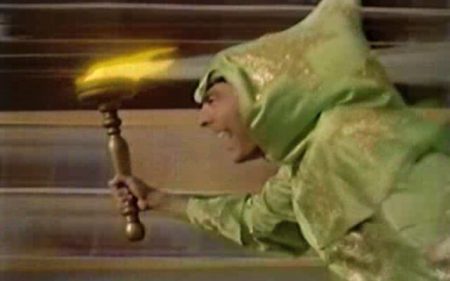
Still from Wizard of Speed and Time

COMMENTS: Moviemaking is a cutthroat business, you know. Maybe you got a hint of that from a film like The Player. Or possibly  Barton Fink. Could have been The Big Picture. Or perhaps State and Main. Come to think of it, it might’ve been Living in Oblivion. Or Bowfinger or Hollywood Shuffle or My Life’s In Turnaround or In the Soup or …And God Spoke or any number of films where Hollywood takes a look in the mirror to catch a glimpse of the laborious and fraught process of trying to get a movie made. When filmmakers are instructed to write what they know, there are plenty who do exactly that.

Well, you can add Jittlov’s sole feature to that list, with the twist that what he knows is how to make lively low-budget special effects. In 1979, he created a short film exploiting his editing and stop-motion photography skills. As these things often do, the short became Jittlov’s calling card, a golden ticket into the world of Hollywood filmmaking. That turns out to be the starting point for this feature-length exploration of his journey into the heart of the moviemaking beast. And when it comes to “writing what you know,” Jittlow keeps his focus squarely on what he’s good at: special effects. The result is… almost exactly what you’d expect.

On the one hand, anyone who manages to assemble a feature film, particularly without the aid of a well-heeled studio, has undertaken a major achievement. On the other hand, Jittlov’s production is laden with the self-awareness of this achievement, and practically demands to be recognized for its own bravery and pluckiness. To call it self-indulgent is a ground-shaking level of understatement. Self-indulgence is the point; the message seems to be, “Everybody deserves a piece of this genius.”

For a zany comedy, The Wizard of Speed and Time is notably angry. One subplot of the film is Jittlov’s ongoing battle against moviemaking’s gatekeepers. Studio indifference, greedy vendors, apathetic accountants, zealous cops, guild oppressiveness (boy howdy, does this movie hate unions), gawking tourists, and general grownup shallowness are just a few of the forces lined up against the filmmaker’s pure and simple goal to make jolly little movies. Atlas Shrugged wishes its heroes and villains were drawn as starkly as this.

So this movie stands as Jittlov’s demonstration of what the Magic Store could be like if there wasn’t so much red tape and cynicism in the business. That being the case, let’s hear it for the bad guys, because The Wizard of Space and Time is exhausting. Determined to pile on the charm, it never lets up. Every jokey moment is slammed up against another jokey moment, with irony-laden captions, a music score taken directly from a theme park, undercranked footage, goofy sound effects, and so much post-production audio looping to guide you along the way. It’s so breathlessly insistent, it makes Airplane! look like a film.

The Wizard of Speed and Time is undeniably weird (or, as the movie itself jokes, “WHOLLY ODD”), but it’s so invested in its zany iconoclasm that it’s impossible to enjoy on any terms if you’re not Mike Jittlov. The climax of the film features a complete re-creation of the original short. This is a smart move; it reminds the audience that there is something genuinely charming here. What Jittlov does with little money and a whole lot of imagination is quite remarkable. And probably best appreciated in a small dose.

WHAT THE CRITICS SAY:

“Created by cult animator and weirdo Mike Jittlov, this 1988 hella-low-budget film follows a talented but jobless special effects wizard as he navigates Hollywood… Jittlov’s enthusiastic DIY production earned a generation of cult fans, who allege he slipped over 1000 subliminal messages into the film. Spooky.”–Chase Burns, The Stranger

(This movie was nominated for review by Marko. Suggest a weird movie of your own here.)

ONLINE FILM CRITICS SOCIETY 25TH ANNUAL AWARDS (WITH OUR VOTES)

The Online Film Critics Society awards for 2021 are out. Two weird films did reasonably well in the nominations this year: The Green Knight and Titane each received multiple nominations, including for Best Picture, although neither won. Although hurt by its distribution strategy, Memoria nevertheless won a special technical award for Sound Design.

As always, despite the occasional levity in my tone, I take my voting responsibility seriously. I do not put forward weird films at the expense of worthier mainstream candidates just because it’s “my thing.” Here is the list of this year’s winners, along with my choices and a touch of personal commentary for the major categories.

BEST PICTURE

The Power of the Dog Winner: The Power of the Dog

Also nominated (listed in ranked order of final votes): Drive My Car, Licorice Pizza, Dune, The Green Knight, Pig, The Worst Person in the World, Titane, West Side Story, Belfast

My pick: The Green Knight

Comments: Jane Campion’s semi-Western drama led the field with nine nominations, and was a kind of consensus pick: it was not clearly artistically miles ahead of the other contenders in a strong year, but it likely was the most widely seen (via Netflix) and had the fewest negatives attached. It was nothing too fancy or chancy, but above average in every respect, from technical aspects to screenplay to acting. I thought The Green Knight did surprisingly well in the voting considering its many negatives: it was released in July and not fresh on anyone’s mind, it was almost a genre picture (though with a literary pedigree and an art-house sensibility), and it had moments of alienating weirdness (talking foxes, random processions of giants). In this case, just being nominated was, indeed, a victory.

BEST ANIMATED FEATURE

Winner: The Mitchells vs. the Machines

Also nominated: Encanto, Flee, Luca, Raya and the Last Dragon

My pick: The Mitchells vs. the Machines

Comments: This movie for the YouTube/Snapchat generation has it all: family drama, a cross-eyed dog, contemporary technological satire, robot-fighting action, a giant demonic Furby, subtle references to other movies, and multiple cat filters. A Sony Pictures Animation film that got shelved due to Covid—before getting snapped up by Netflix—beating out two Disney offerings: it feels like a major upset.

BEST DIRECTOR

Winner: Jane Campion, The Power of the Dog

Also nominated: , Licorice Pizza; Ryusuke Hamaguchi, Drive My Car; Steven Spielberg, West Side Story; , Dune

Continue reading ONLINE FILM CRITICS SOCIETY 25TH ANNUAL AWARDS (WITH OUR VOTES) →

WHY AREN’T HOLLYWOOD FILMS STRANGE ANYMORE?

At the Fantasia Film Festival in 2016, before a screening of the punk video art black comedy She’s Allergic to Cats, I recall programmer Mitch Davis declaring that “weird is hot” in the then-current climate. Having run 366 Weird Movies for 8 years at the time, I was skeptical. Sure, scrappy filmmakers managed to squeeze out a handful of weird movies every year, but I consistently had trouble identifying ten truly weird ones for our year-end lists. Were things about to change for the strange?

Later that night, I asked underground director for his opinion on whether weird movies were “hot.” He said that when he described his work, most people happily responded “‘I’m OK with weird movies,’ but then you show them the weird movie and they’re like ‘ahhh… I didn’t get anything,’ and they’re completely confused and they hate the thing, and I’m like, ‘Ah, I knew it.’”

Still from She's Allergic to Cats (2016)
She’s Allergic to Cats (2016)

The next day I asked Allergic to Cats auteurs and if they thought weird movies were “hot.” They said the concepts they pitched for music videos for local L.A. bands were always rejected for being “too weird.” Reich said things started to change around the time Tim and Eric became popular, but they still had issues. Pitching a webseries, potential producers told them to make it more mainstream; then, they complained it wasn’t weird enough. “We were so outraged, we’d never been accused of not being weird before,” Pinkney laughed.

The point being, I—and the people working on the ground producing weird videos—are always skeptical when outsiders and marketers proclaim that out-of-the-ordinary is currently in demand. Have things changed in the movie industry in the six years since I last asked these questions in 2016? Variety‘s chief film critic Peter Debruge thinks the answer is “yes,” and he wrote a column titled “Why Are Indie Films So Strange Now?” to that effect. But, while Debruge’s observations are optimistic, I think his conclusions don’t match specialists’ expectations for what a true revival of the weird would look like.

To give credit where credit is due, Debruge applauds this “trend,” praising “unapologetically odd and original creations, led by a gifted group of rebel auteurs who don’t kowtow to popular expectations” and suggesting that there is a viewing “appetite [that] in turn supports an indie-film environment where directors are motivated to be more original, more surprising and all around more creative.” So far, so good. But is this really much different than the situation in previous decades? We here at 366 are not noticing a greater concentration of strange films than in prior years. Our own survey of Canonically Weird films by year found that weird movie production peaked between about 1968-1971. 2006, which was just outside the decade-long  weird movie renaissance Debruge postulates, was also a good year for strange films, and there were some notable Continue reading WHY AREN’T HOLLYWOOD FILMS STRANGE ANYMORE? →

“THE SHOW”: SIOBHÁN HEWLETT TALKS MOORE AND MORE

Anecdotes, ambitions, and asides flow forth during this in-depth interview with film star and executive producer Siobhán Hewlett. Known in her home town(s) as “the surfing guitarist,” Ms. Hewlett was good enough to make time for 366. Over the course of an hour, behind-the-scenes stories come to light as Hewlett and Giles Edwards chat about Alan Moore‘s film debut, The Show, directed by the maestro’s long-time photographer Mitch Jenkins.

Celebrating the cinematically surreal, bizarre, cult, oddball, fantastique, strange, psychedelic, and the just plain WEIRD!