
A boy with crooked facial features seeks plastic surgery from a rather bizarre hospital.
Tag Archives: Puppetry
CAPSULE: LABYRINTH (1986)

DIRECTED BY: Jim Henson
FEATURING: Jennifer Connelly, David Bowie
PLOT: A dreamy teenage girl must rescue her kidnapped baby brother by journeying to the Goblin City at the center of a bizarre labyrinth.
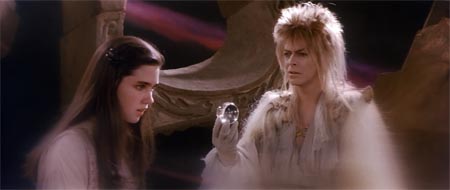
WHY IT WON’T MAKE THE LIST: Despite the MC Escher-inspired set-design, the unexpected sexual tension between teenaged Connelly and fruitily-dressed goblin king Bowie, and a devout cult following, Labryinth is ultimately just too close to a mainstream Muppet fantasy to place on a List of the 366 Weirdest movies. We’ve passed over slightly stranger movies in this genre—the visually similar Henson-directed The Dark Crystal and the thematically similar Henson-produced MirrorMask—and, although I think Labyrinth is a better film than either of those, it’s difficult to justify certifying this one when its companion films don’t even get to sniff the List.
COMMENTS: In The Wizard of Oz, Judy Garland’s breasts were famously flattened out with tape so the 16-year old could play a pre-pubescent girl. Labyrinth takes a different strategy: 14-old Jennifer Connelly plays exactly her age, portraying a hormonally testy girl-woman caught at the stage where her attention starts to shift from stuffed animals to the well-stuffed pants of strutting rock stars. That shot of rising estrogen distinguishes Labyrinth from other Oz/Alice in Wonderland fairy tale variations, giving it a subtext that goes over the heads of the tots in the audience but leaves adults with additional nuggets to ponder (and no, that’s not another reference to Bowie’s stretch pants).
There’s an impressive amount of imagination on display here, starting with Henson’s puppets, who reveal an almost limitless variety (each individual goblin looks like a representative of its own species) and a nearly human expressiveness (to be honest, the puppets out-act both Connelly and Bowie). The girl’s three companions—the cowardly dwarf Hoggle, the bestial Ludo, and Sir Didymus, the comic relief knight/terrier—are all worthy additions to Henson’s Muppet menagerie, and there is a zoo full of eccentric Wonderland-esque supporting creatures, including walking playing cards, Continue reading CAPSULE: LABYRINTH (1986)
SATURDAY SHORT: DON’T HUG ME I’M SCARED
A seemingly innocent sing-a-long style video about creativity goes awry when it urges its characters to “get creative”.
CAPSULE: THE DARK CRYSTAL (1982)
DIRECTED BY: Jim Henson, Frank Oz
FEATURING: Jim Henson, Frank Oz (puppeteering); Stephen Garlick, Lisa Maxwell, Billie Whitelaw (voice acting)
PLOT: A meek Gelfling sets out on a journey to fulfill the prophecy that he will heal the Dark Crystal.

WHY IT WON’T MAKE THE LIST: With its advanced puppetry and dazzling color, The Dark Crystal is a visually spectacular movie. The standard-issue quest story, however, is nothing unusual; just recycled Tolkien, watered down for kids.
COMMENTS: The Dark Crystal may be the most elaborate puppet show ever staged. There are no human actors in the film, and the sets—from the spiny castle rising from a bleak landscape to the twisted interior corridors of the Skeksis’ lair to the forests of walking plants—are all fairy tale artifice, storybook illustrations adapted into three-dimensional scenery. A menagerie of imaginatively designed creatures parade in front of these beautifully textured backdrops. Most impressive are the evil Skeksis, hunched bipeds who simultaneously resemble reptiles, dinosaurs and birds of prey. They are opposed by the gentle Mystics, four armed, droning sloths with kind wizardly faces, and Gelflings, the “human” characters, who look like an experiment in breeding J.R.R. Tolkien’s elves with chimpanzees from The Planet of the Apes. The meticulously molded puppets–each turkey-faced Skeksis’ beak is individually gnarled—have expressive eyes, and their jaws move when they speak. The rest of the puppet faces, however, are immobile; so despite the minute detailing, the mix of animatronics with static features makes the creatures overall appearance unreal and somewhat uncanny—maybe even “weird.” (The fact that the puppets move at about three-quarters the speed of a human actor, while seriously hampering the action sequences, also adds to the movie’s artificial reality).
The simplistic, muted emotions conveyed by the creatures’ features aren’t terribly jarring, however, because their puppet shells are inhabited by one-dimensional characters. Lack of character depth isn’t a problem for the villainous Skeksis. It’s fun (and even a bit nightmarish) to watch them squabbling among each other, engaging in strange rituals and speaking in individualized voices which run the gamut from dusty croaks to throaty grunts to sinister whines. The flatness does become an issue when it comes to our Gelfling heroes, however; Chosen One Jen, and his eventual companion Kira, are simply bland, projecting little individuality or complexity. The pair are mild and fearful, but more competent than they realize, so they are effective as surrogates for the children in the audience. Adults, however, will have are hard time drumming up much enthusiasm for these two meek ciphers, especially since the outcome of their quest is literally foreordained (is there ever a salvation prophecy in a fantasy movie that the heroes don’t manage to fulfill?).
Jen the reluctant Hobbit (I mean, Gelfling) must return a Ring (I mean, a broken shard of the crystal) to the heart of Mordor (I mean, the castle of the Skeksis), while being stalked on his journey by a skulking Gollum (I mean, the banished Skeksis Chancellor). This basic story structure is enough to enthrall kids, but the best we adults can say about it is that it’s comfortably familiar, and that the plot never distracts us from looking at the pretty pictures. And there are some memorable moments to behold: the ritual opening with the Skeksis gathered around the glowing purple Crystal, absorbing its power; the Gelflings floating downstream through a storybook forest; the caravan of Mystics trudging across a desert at sunset. If you had those moments imprinted on you as a child, you’re likely to remember The Dark Crystal as a fantasy masterpiece; if you see it for the first time as an adult, you’ll see an impressive puppet show, and maybe wish that you could go back in time to an innocent age when it would have been pure magic to behold.
The unsung hero of The Dark Crystal is illustrator Brian Froud, who was responsible for the creature designs. Jim Henson would team up with Froud again in 1986 for Labyrinth, a more complex, allegorical story that mixed puppets with live actors Jennifer Connelly and David Bowie.
WHAT THE CRITICS SAY:
(This movie was nominated for review by “Trip Carter,” who remembered this [as well as Labyrinth] as “overflowing with weirdness.” Suggest a weird movie of your own here.)