Category Archives: Capsules

CAPSULE: MURDER DEATH KOREATOWN (2020)

366 Weird Movies may earn commissions from purchases made through product links.

DIRECTED BY: None listed

FEATURING: None listed

PLOT: An unemployed man becomes obsessed with a murder that happened in a nearby apartment complex, but his investigation turns paranoid as he imagines a wide-ranging conspiracy.
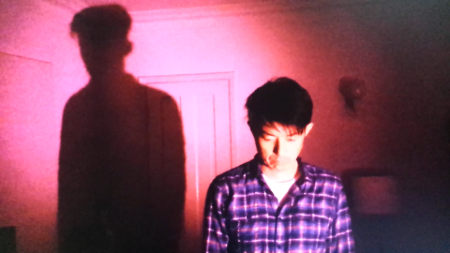
Still from Murder Death Koreatown (2020)

COMMENTS: Though taking its starting cue from a real-life murder, Murder Death Koreatown is, it’s safe to say, fictional, as you will doubtlessly decide for yourself by the time its deranged protagonist starts spouting theories about the Pastors, ghosts, and voices speaking to him from the sewers. It’s like a re-edited version of one of those paranoid YouTube videos that leave you wondering whether the uploader is genuinely crazy or is just stringing you along for the lulz, or like Under the Silver Lake remade on a $100 budget in the style of The Blair Witch Project.

Our unemployed, over-stressed narrator begins by following (real-looking) blood splatters on his sidewalk, and then discovering that one of his neighbors murdered her husband in a neighboring apartment complex in L.A.’s Koreatown. He discovers some minor inconsistencies, and interviews some (real-looking) locals to see if they noticed anything unusual. As his investigation continues, he starts uncovering connections which aren’t really connections—and which sometimes don’t even rise to the level of coincidences—but which are completely obvious and convincing to the protagonist. We ought to be suspicious when we focuses the camera on the blinds in his apartment and marvels, “look at this weird light…” (we have no idea what he’s talking about, but it’s a hint that he takes significance from stuff we wouldn’t even notice). Also, unless you’re Dale Cooper, it’s never a good idea to admit evidence from your dreams into a murder investigation. It’s not really a spoiler to suggest that the movie is a believable study of one man’s descent into delusional paranoia.

Your enjoyment of Murder Death Koreatown will be linked to your tolerance for watching feature-length shot-on-cellphone vlogs. The movie is, by necessity, talky—there are no significant effects or action sequences. Unfortunately, the narrator’s voice isn’t compelling: he delivers most of his lines in a drab “woe is me” tone, and at one point his bleats of terror make him sound like a Muppet startled by a spider. On the plus side, the actor they found to play the shifty-eyed homeless vet in the alley is so convincing that you might believe he’s a real hobo, and that the plot was actually built around his schizophrenic ramblings. The effective horror soundtrack is another element that supersedes the budget; in fact, it’s so well-made that it at times undermines the film’s found footage credibility. Ironically, it’s too professional a touch for a movie that’s trying to make its amateurism into a selling point.

If you’re willing to overlook the budgetary issues, however, Murder Death Koreatown is a solid watch—and if you plot it on a dollars spent to entertainment value curve, it’s off the chart. It holds our interest for just over 70 minutes and does an exceptional job of viral marketing, which is a solid double for a microbudget feature. You can read some of the movie’s promotional gimmickry at the link embedded below.

For more along these lines, Graham Jones’ Fudge 44 (2006) has a similar low-budget, mock-vérité appeal.

https://imgur.com/a/UPnp5U0

WHAT THE CRITICS SAY:

“…in mystifying its own ending, Murder Death Koreatown leaves us, like the investigator, grasping for a transcendent truth that the film itself cannot sustain.”–Anton Bitel, Projected Figures (contemporaneous)


CAPSULE: KAGERO-ZA (1981)

366 Weird Movies may earn commissions from purchases made through product links.

DIRECTED BY:

FEATURING: Yusaku Matsuda, , Katsuo Nakamura, , Eriko Kusuda

PLOT: A playwright gets caught up with a rich industrialist’s two wives, putting both his life and soul in mortal danger.

COMMENTS: After the success of Zigeunerweisen, Seijun Suzuki returned to the Taisho era for another morbid tale with supernatural undertones. Zigeunerweisen was often unfocused and difficult to follow, but Kagero-za is even more loosely structured, borderline incomprehensible at times. Its title refers to a haze seen on particularly hot days, which can play tricks on the eyes and create illusions. In keeping with this title, the film moves with the slow, languid pace of a dream. It’s never certain if what’s being seen is real or illusion.

The film begins, fittingly, with an illusion seen in a heat haze. Or was it an illusion? A young man (Yusaku Matsuda) meets a mysterious married woman, Shinako (Michiyo Okusu), who asks him to escort her to a nearby hospital, for fear of an old woman she saw selling bladder cherries at high prices—and also advertising them as women’s souls. When they investigate, the old woman seems to have vanished into the vapors that she came from, and the married woman ends up giving the man her soul instead. From this point onward, the man is repeatedly drawn to her, seduced by circumstance and seemingly doomed to commit double suicide with her when her rich husband (Katsuo Nakamura) finds out about the affair.

But all is not what it seems. The woman’s husband has another wife, Ine (Eriko Kusuda), who may or may not be dead. In the film’s most explicit commentary on the effects of Westernization in the Taisho era, the husband is said to have met Ine while studying abroad in Germany, captivated by her blond hair but also determined to make a Japanese woman out of her. The fact he studied abroad in Europe suggests that he is either an industrialist or a member of the new class of elites which led the charge of modernization in Japan at this time. Shinako, the other wife, is relegated to the shadows, barely noticed by her husband. However, she serves as a reminder of Japanese tradition in its purest form, repeatedly coming back to haunt her husband and her lover in an unending cycle which torments all involved.

Halfway through the film, Shinako portentously muses that “If dreams didn’t end, they wouldn’t be dreams anymore.” With this in mind, it might be best to take the world of Kagero-za as a dream which becomes its own reality. What begins as a fairly simple love triangle with Gothic undertones becomes progressively stranger in its second half, going off on feverish tangents which range from freemasons exchanging dolls with intricately carved sex organs hidden inside to a children’s kabuki theater which ominously reenacts the film’s central love triangles, while an unseen playwright gives directions from on high and the real-life characters look on with expressions of frozen alarm.

Of course, none of this makes much sense, but it wouldn’t be a Seijun Suzuki film if it did. It’s a dream journey not unlike ’s Eyes Wide Shut, except that it involves a man’s affair with a married woman and his subsequent internal and external crises, rather than a man struggling to come to terms with his wife’s real or imagined infidelities. Still, the pacing is interminably slow and the particulars of the central affair (which is more imagined than real to begin with) are rehashed to the point that they lose all sense of meaning or tension. It’s worth watching for its stunning cinematography and surreal depiction of cultural corruption in pre-WW2 Japan, but it’s a pretentious and muddled step down from the chilling and subtly supernatural Zigeunerweisen.

WHAT THE CRITICS SAY:

“…the wantonly eccentric narrative is set in 1926 Tokyo, though, given Suzuki’s contempt for coherence, it might as well take place in another planet… [T]here’s no denying Suzuki’s knack for ravishing disorientation even if you take one character’s description of ‘a too complicated game to enjoy’ to apply for the film.” – Fernando F. Croce, Slant Magazine (DVD)

CAPSULE: CAN’T KILL THIS (2019)

AKA Fuck You Immortality

366 Weird Movies may earn commissions from purchases made through product links.

DIRECTED BY: Federico Scargiali

FEATURING: Bill Hutchens, Josephine Scandi, Brutius Selby

PLOT: An old drug buddy from the 1970s appears to be immortal, so Tony and Kacy try to track him down, and then try to kill him.

COMMENTS: There is a minor character in Can’t Kill This who reminded me of a high school video project that has plagued my memory on and off since its completion. When stumbling around the English countryside looking for Joe, hippies Tony and Kacy accidentally knock on the caravan door of a luchador (el Perro Callejero—“the Street Dog”). Outside his domicile is a junkyard overrun with chickens, which he refers to as “pollo loco”; this just happens to have been the original name for my final film project back during my senior year. We had filmed quite a lot of ancillary shots for what was intended to be a Blair Witch Project spoof (those of you old enough to remember that movie’s cinema run probably cannot blame a flippant seventeen-year-old for feeling inspired). However! (And this is the exciting bit.) About two-thirds through shooting, there was a massive snow storm and we lost all possibility of continuity. And so, on the fly, and by the seat of our respective pants, we threw together an alternative just days before the deadline: Mister Psychopants.

Now that you know a little more about me, let me tell you what you need to know about Can’t Kill This: it was likely done with the earnestness of a late-teenage filmmaker, and, indeed, adopts the same genre (mockumentary). However, Scargiali’s movie was not done last-minute by a gang of high schoolers. These facts don’t necessarily always show, however, as slogging through the eighty minutes of run-time, I found myself laughing thrice (and bear in mind that this is supposed to be a stoner comedy). The first humorous scene involved an amusing secret “door-knock” code bit, touching upon the correct pronunciation of “Fhtang.”. The second funny scene involved Tony in a bathtub having a narrative adventure with two rubber duckies. I do not remember the specifics of the third one, but I do know that I laughed more than twice.

Despite my chirpy, mindless optimism about filmmakers and their directorial debuts, I’m not sure I can honestly say that I look forward to what Scargiali gets up to in the future. I did watch all of Can’t Kill This, and I liked the premise—but I would have much preferred the movie that had formed in my mind when I saw the ominous poster and read whatever bare-bones description came my way before volunteering for this assignment. To wrap this up with a six-word review, “Totally watchable, but I wouldn’t bother.”

WHAT THE CRITICS SAY:

“With the destination that is hard to pin down, Can’t Kill This is a road trip through odd feel-good vibes, dark comedy, and slapstick gore… It could easily be a demented road-movie cousin to ‘Best in Show’ (2000) with an extra dose of LSD and practical gore.”–Rev Terry, VideoReligion.com (contemporaneous)

CAPSULE: ZIGEUNERWEISEN (1980)

366 Weird Movies may earn commissions from purchases made through product links.

DIRECTED BY:

FEATURING: Toshiya Fujita, , Naoko Otani, , Kisako Makishi 

PLOT: Two professors and a mysterious geisha form a bond that transcends life and death.

COMMENTS: In the West, Seijun Suzuki is primarily known for his hallucinatory 1960s thrillers for the Nikkatsu studio, especially Tokyo Drifter and Branded to Kill. Over a decade later, however, Suzuki made a series of three period films set in Japan’s Taisho era (1912-1925). Filled with hallucinatory imagery, intoxicating period atmosphere, and ghostly ambience, in Japan these three films, known collectively as the Taisho Trilogy, are held in equal esteem with Suzuki’s early films; but they have been difficult to find in the U.S. until recently. Arrow Films gave them a limited release in 2017 in a lavish 6-disc DVD/Blu-ray box set, but now Arrow has streamlined both the size and cost of the set, finally putting these three hidden gems back into circulation as part of an affordable 3-disc Blu-ray box set. The extras from the previous set (which include introductions from critic Tony Rayn, a making-of featurette and a vintage interview with the late Seijun Suzuki) have all been carried over to the new release.

The Taisho era was a time of rapid modernization in Japan, but only in certain sectors of society, particularly the upper classes. Traditional ways of life and long-held superstitions about ghosts and spirits remained prevalent even as Western music, clothing, and technology began to seep into society. This is the world in which Zigeunerweisen (1980), Kagero-za (1981), and Yumeji (1991) take place. Zigeunerweisen opens with two men listening to a 10-inch gramophone recording of the titular “Zigeunerweisen,” a contemporary composition by Spanish violinist Pablo de Sarasate, in which a voice is heard saying something unintelligible. They note that hearing this almost inaudible voice is more interesting than the music itself—it’s the voice of someone they’ve never met, the unintentional preservation of an everyday moment which occurred halfway around the world.

The recording will appear again, but it’s not the only case in which characters will be haunted by disembodied voices. Ghosts are very present in the lives of Aochi (Toshiya Fujita), a German professor at a military academy, and Nakasago (Yoshio Harada), Aochi’s former colleague and vagabond friend. After parting ways when Nakasogo quit the academy to become a drifter, the two meet in a seaside town where Nakasogo seems to have been involved in the death of a local woman. Suzuki introduces Nakagoso with a feverish montage of close-ups, emphasizing his unkempt good looks and wild man charisma. We then see the a woman lying dead on the ground; a red crab appears from between her legs and fills the screen.

After Aochi helps Nakasago escape from the police and local mob, the two retreat to a local inn, where they entice a mourning geisha (Naoko Otani) to entertain them. Nakasogo is fascinated with her story of her brother’s suicide by poison, and how his white bones turned to pink ashes after being cremated. Nakasogo’s subsequent obsession with bones becomes a central theme throughout the film. He even coerces Aochi into making a pact that whoever dies first will donate their bones to the other.

There are many subplots and suggestions of supernatural intrigue throughout Zigeunerweisen, but it remains mostly submerged beneath the surface, more subtly felt than explicitly expressed. Nakasogo is often insinuated to be a demon in human form, and his secret encounters with Aochi’s wife (Michiyo Okusu) seem to take place in a parallel dream reality. One exception is an early sequence in which Aochi meets Nakasogo’s new wife (also played by Otani) and is enticed into coming back to her house, where a red light ominously flashes and time seems to stand still; Nakasogo’s wife slyly admits that she might be a fox (a common deceiver of humans in Japanese traditional mythology). The film’s chilling climax echoes this scene, bringing the story full circle and finally allowing its supernatural undertones to emerge fully formed.

Even earlier in his career, Suzuki was never a very effective storyteller. As lurid and visually stunning as his 1960s gangster films might be, they’re often unevenly paced and confusing, especially in the case of his hallucinatory tour-de-force Branded to Kill, which was considered so incomprehensible that he was effectively blacklisted from making films in Japan for over 10 years. Zigeunerweisen isn’t quite as difficult to parse out, but even though the running time is longer and the pace is slower, this is still classic Suzuki. The lack of tight storytelling and conventional horror techniques is made up for with imaginative visuals, feverish hallucinations, and a sophisticated sense of the supernatural, which is consistent with Japanese culture and the era in which the film takes place. A fascinating ghost story from the master of surreal Japanese crime thrillers.

WHAT THE CRITICS SAY:

“[W]ith Zigeunerweisen—shot in 1980, after Suzuki took a 10-year break from directing—Suzuki retires the cumbersome plots and predictable settings of his genre films, and lends his bizarre, outrageous, and completely visual language to a bona fide art film.” – John Behling, Slant Magazine

CAPSULE: DEERSKIN (2019)

Le Daim

366 Weird Movies may earn commissions from purchases made through product links.

DIRECTED BY:

FEATURING: Jean Dujardin, Adèle Haenel

PLOT: A middle-aged man becomes obsessed with his new deerskin jacket.

Still from Deerskin (2019)

COMMENTS: “Sorry, but isn’t your movie weird?” One suspects Quentin Dupieux lifted that line verbatim from his own life experiences for this screenplay. It’s one of many self-references in Deerskin, whose main character is a delusional fraud[efn_note]Neither I nor, I believe, Quentin Dupieux believe that Quentin Dupieux is a delusional fraud—the metaphor plays out more like a meta-joke at the expense of artistic self-doubt.[/efn_note] posing as an independent filmmaker while undergoing a midlife crisis.

Never fear, Deerskin—a movie about a man, a leather jacket, and the destructive pledge that binds the two together—is indeed a weird movie. But considering the manic maximalism of Dupieux’s last major outing—2014’s Reality, which seemed like it had about fifteen interweaving subplots in a dreams-inside-of-dreams structure—Deerskin is relatively restrained, focused on only two major characters and a single absurd conceit. In that sense, it’s almost a ian film. Indeed, aside from the odd opening (which will be explained later) and a scene of Jean Dujardin flushing his corduroy jacket down a public toilet, nothing beyond the moderately quirky occurs in the film’s first fifteen minutes. Dujardin’s character is clearly not all there, and occasional horror movie violin strikes suggest looming disaster, but it’s not until his deerskin jacket starts talking back to him that Dupieux leans into the scenario’s inherent eccentricity. The idea that we see the film from Dujardin’s insane perspective “explains” his strange activities for the rest of the movie, and perhaps makes it more palatable for general audiences not accustomed to the dream-logic universes Dupieux typically creates.

Dupieux likely slows down the craziness in order to take advantage of Dujardin’s presence. The stately actor is Deerskin‘s biggest asset, and the movie is almost Dupieux’s take on a character study. We suspect that the idea of an abstract, arty study of a man in the midst of an existential crisis is what attracted the French star to the project. Ruggedly handsome, if growing a bit paunchy, with a distinguished touch of grey in his beard, Dujardin creates a character who is deeply insecure and ridiculous—because he’s both vain and a bit dim. Unmoored and wandering, fleeing a relationship for reasons unstated, Dujardin gives his withered self-confidence a coat of luster with the deerskin jacket, which he believes gives him a “killer style” that everyone envies and talks about. But, in his mind, it’s not enough that he own the world’s coolest jacket—wouldn’t it be better if he owned the world’s only jacket?

The jacket concurs.

I don’t know if Deerskin‘s subdued style really fits Dupieux’s talents. He’s always been an over-the-top auteur with a unique voice, and his lack of restraint in focusing his ideas has always been a key part of that voice. I can’t say that maturity and self-reflection fits him any better than Dujardin’s too-tight jacket fits his character. Although Deerskin may be a bit easier for the neophyte to buy into than Dupieux’s previous larks, I’d still recommend the novice start off by jumping into the deep end with the slasher spoof Rubber, where the director sets out his bold manifesto of “no reason.” You can circle back to Deerskin later and see if you think the director is aging gracefully, or if he needs a truly wild midlife crisis of his own to remind him of his youth.

Deerskin is a victim of 2020’s pandemic, unable to receive even the usual limited release in theaters. Distributor Greenwich Entertainment is releasing it online and sharing half the revenue with the local theaters who would usually screen it; you can find a list of participating institutions at this link. The movie hits home video in late June.

WHAT THE CRITICS SAY:

“‘Deerskin’ is funny, weird and original; it features two charismatic stars, and it does everything it needs to do in only 77 minutes.”–Mick LaSalle, San Francisco Chronicle (contemporaneous)