Tag Archives: Animation

CAPSULE: FANTASIA 2000 (1999)

DIRECTORS: James Algar, Gaetan Brizzi, Paul Brizzi, Francis Glebas, Eric Goldberg, Don Hahn, Pixote Hunt

CAST: James Levine (conducting the Chicago Symphony Orchestra), plus hosts James Earl Jones, Quincy Jones, Angela Lansbury, Bette Midler, Steve Martin, Penn and Teller, and Itzhak Perlman

PLOT: Like the original Fantasia (1940), Fantasia 2000 has no overarching plot. Instead, the film presents a series of short subjects “illustrating” classical compositions by such masters as Igor Stravinsky, George Gershwin and Ottorino Respighi.

Still from Fantasia 2000 (1999)
WHY IT WON’T MAKE THE LIST: This semi-sequel lacks the edge of the first Fantasia’s sinister “Night on Bald Mountain” sequence (the one with the giant demon). Also, this later Fantasia is unlikely to attract the kind of audience that went to the late 1960’s re-issue of the first film while under the influence. After all, the original Fantasia received the Harvard Lampoon’s 1968 “OhGodOhGodOhGodTheLightsTheSoundsTheColors” award, which it shared with Yellow Submarine and 2001: A Space Odyssey.

COMMENTS: While lacking the innovative qualities of its predecessor, which was one of the first–if not the first–films recorded in multichannel sound, Fantasia 2000 is a (much) shorter, faster and more kid-friendly variation on the original, all of which does not necessarily make it better. Nevertheless, the film is both amusing, and, during the Stravinsky and Respighi sequences, surprisingly stirring.

Fantasia 2000 begins with Beethoven’s “Symphony No. 5 in C Minor” being portrayed in abstract fashion with lots of Origami-style butterflies fluttering across the screen. This sequence is obviously meant to recall the original Fantasia’s opening: an impressionistic rendering of Bach’s “Toccata and Fugue in D Minor”, which was the dullest scene in either movie. Things perk up considerably after that, as Respighi’s “Pines of Rome” is turned into a touching computer-animated tale of humpback whales. Then comes a funny take on Gershwin’s “Rhapsody in Blue”, animated in the style of legendary New York caricaturist Al Hirschfeld. This is followed by another digital segment: Shostakovich’s “Piano Concerto No. 2 in F. Major”, now rendered as a somewhat lackluster adaptation of Hans Christian Andersen’s “The Steadfast Tin Soldier.” Next up is a very brief bit from Camille Saint-Saens’ “The Carnival of the Animals, Finale”, which here becomes a watercolor-painted sequence featuring pink flamingos playing with a yo-yo. One gets the feeling that this is supposed to be reminiscent of the 1940 original’s version of “Dance of the Hours,” with its immortal ballet-dancing hippos and ostriches, but if that is the case, then the earlier film’s anthropomorphic gags are far more memorable. There’s more anthropomorphism to come, as “Carnival of the Animals” is followed by a reprise of Paul Dukas’ “The Sorcerer’s Apprentice.” This is simply the classic sequence from the original Fantasia edited in here: Mickey Mouse, thinking himself a great wizard, must fend off an army of living brooms. As it was it the best scene in the original, this is the best sequence in the second one, probably because it’s the only segment that illustrates what the composer was actually writing about. Donald Duck then gets equal time, as it were, by starring in Edward Elgar’s “Pomp and Circumstance.” This is not a story about Donald’s graduation, but a retelling of “Noah’s Ark” with Donald and Daisy standing in for Noah, and it’s amusing enough. The film’s finale is a memorable take on Igor Stravinsky’s “The Firebird Suite,” as a woodland sprite brings the spirit of spring to the forest, only to be vanquished by the Firebird spirit, who lives in a volcano. But this is Disney, so the sprite rises again like the phoenix. Although this is arguably the most lavishly animated segment in Fantasia 2000, some of the imagery is suspiciously reminiscent of Hayao Miyazaki’s 1997 film Princess Mononoke, as well as the forest fire in Disney’s own 1942 Bambi (complete with woodland creatures). Nevertheless, this is a fine note for the film to go out on.

Nothing in Fantasia 2000 is the slightest bit weird, but it is all gorgeously animated and quite entertaining. Compared to its legendary, if sometimes ponderous, 1940 predecessor, however, Fantasia 2000 does seem a bit lightweight.

WHAT THE CRITICS SAY:

“If it’s a head trip you’re looking for in the millennial version of Walt Disney’s ‘Fantasia,’ you’ll have to wait for the grand finale, in which the world appears to come to an end, then suddenly bursts to life again… [it] often has the feel of a giant corporate promotion…”–Stephen Holden, The New York Times (contemporaneous)

167. RUN LOLA RUN (1998)

Lola rennt

366 Weird Movies may earn commissions from purchases made through product links.

“One of the big problems of the movie for me was always that I thought, how can we make the repetition idea become something spectacular and exciting, and not make it feel like ‘oh my God, it’s starting again, how boring.’ So this was really a big task for me, not losing the concentration of the audience and really having them care for what happens again and again. So we tried to really make it very exciting and very strange and different…”–Tom Tykwer, Run Lola Run DVD commentary

Must See

DIRECTED BY:

FEATURING: , Moritz Bleibtreu, Herbert Knaup, Nina Petri

PLOT: Lola’s boyfriend calls her on the phone: he needs 100,000 Deutschmarks in twenty minutes to pay off a gangster, or he’s going to be killed. Lola has no money and no transportation, but she formulates a plan in a split second, and takes off running. She arrives too late and the story ends in tragedy; but fortunately, she gets a do-over.

Still from Run Lola Run (1998)
BACKGROUND:

  • Lola‘s narrative structure is almost identical to Krzysztof Kieślowski’s 1981 film Blind Chance.
  • The film’s first epigram is a famous quote from T.S. Eliot’s “Little Gidding.” The second quotation, “Nach dem Spiel ist vor dem Spiel” (“after the game is before the game”) is from World Cup champion coach Sepp Herberger.
  • This fast-paced film contains 1581 cuts, averaging out to 2.7 seconds per shot.
  • Lola rennt swept the major categories at the 1999 German Film Awards, with the notable exception of Best Actress—Franka Potente was not even nominated. It won around twenty other awards from international critics associations, but was not nominated for an Academy Award.
  • Voted #86 on Empire’s List of the 100 Best Films Of World Cinema.

INDELIBLE IMAGE: Lola, running. Writer/director Tom Tykwer himself has said that the genesis of the film came from an image that sprang to his mind of a woman running through the streets; he constructed a scenario around the picture in his mind’s eye to explain where this vision was racing to. Since we’re interested in weirdness, we’ll focus on one specific iteration of the recurring image of Lola running: when she dashes out of her parents’ home, the camera circles around her mother’s room to catch a television set, where a cartoon version of Lola is flying down the spiral staircase.

WHAT MAKES IT WEIRD: Run Lola Run has the hip surreality of a music video. Stylized within a heartbeat of its life, Lola is as proudly and defiantly artificial as Franka Potente’s Strawberry-Shortcake-with-her-head-on-fire dye job.


Original trailer for Run Lola Run

COMMENTS: “Foreign movies come off really weird,” headlines one Amazon reviewer, who confesses that he got annoyed watching the opening and Continue reading 167. RUN LOLA RUN (1998)

THE ADVENTURES OF PRINCE ACHMED (1926)

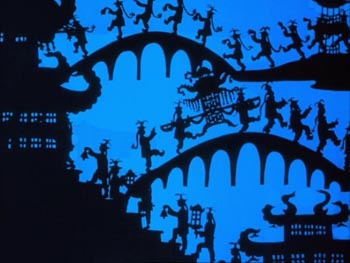
Historians, film buffs, and Disney fanatics all cite Snow White and the Seven Dwarfs (1937) as the first animated feature. While it is the first animated feature as we Americans tend to think of animation, actually that “first” honor goes to a little known, innovative oddity from eleven years earlier. The Adventures Of Prince Achmed (1926) is a labor of love from the pioneering female German filmmaker Lotte Reiniger and her husband, Carl Koch.

What makes Achmed still unique 88 years later is animation entirely composed of cutout silhouettes. The result  was one of the silent era’s most enchanting and captivating films. It is also a lucid reminder that the medium of film was at its most innovative in its infancy, before the rules were set and the mediums defined.

Reiniger lucked into a patron for her artistic efforts: Louis Hagen supplied her with enough film stock and financing to proceed with her project. Using scissors and black construction paper as her primary tools, Reiniger spent three years meticulously working in an attic on Achmed with a small crew that included her husband/cinematographer, Koch.

Influenced in part by Georges Méliès and Arabian Nights, Reiniger created a world of sensuous, exquisitely detailed beauty. The film has an almost surprisingly coherent and linear narrative, given that Reiniger was embraced by the European avant-garde. Unfortunately, the director had difficulty booking Achmed, and with the exception of Dr. Doolittle And His Animals (1928), the rest of her career was relegated to short films. There was work on a third feature, to be based on Maurice Ravel’s enchanting opera, “L’Enfant et les Sortilèges”; unfortunately, rights to the music could not be secured and the film was abandoned. The Adventures Of Prince Achmed is the only one of Reiniger’s films to date that has seen a home video release. Some of her shorts occasionally appear on television, but often in truncated versions. One such example is Doolittle, which has aired with added (and intrusive) voice over narration, coupled with woefully inadequate projection speeds. Fortunately, YouTube has been more respectful. The Star of Bethlehem (1921), Cinderella (1922), The Adventures of Prince AchmedPapageno (from Mozart’s “The Magic Flute”) (1935), The Magic Horse (1953), and Jack and The Beanstalk (1955) along with a short documentary of her work can all be found there. The documentary shows her storyboarding techniques and the almost rapid-fired speed at which she crafted her baroque figures.

Still from The Adventures of Prince Achmed (1926)There is a noticeable gap of activity in Reiniger’s filmography from 1938 to the early 1950s. With the rise of Fascism, Reiniger and Koch struggled to flee Germany. Although not Jewish, politically they leaned left, which marked them as subversives. Jean Renoir was among those who aided the couple, but they lived in abject poverty until finally being able to settle in England in 1949. Despite the initial financial failure of Achmed, Reiniger and Koch were respected in film circles and were able to be relatively prolific.

Achmed is of its time in its portrayal of the good guys as completely good, bad guys as completely bad, and the pretty girl as in need of saving (Reiniger’s later films frequently had biblical, Victorian, fairy tale, and operatic themes). Still, it’s put over so beautifully, even the most hardened cynics will hardly care. The color tinting renders the film a phantasmagoric smorgasbord of gemstones. Achmed is awash in emeralds, sapphires, rubies, garnets, aquamarines, amethyst, topaz, citrine, tanzanite, and fire opal.

The Adventures of Prince Achmed weaves interrelated narratives involving our protagonist, his princess sister, their Caliph father, an erotic heroine (who Achmed voyeuristically spies on while she is bathing), a flying horse, a malevolent shape shifting African magician, the Witch of the Fiery Mountain, dancing harlequins, sphinxes, terrifying demons, Aladdin, and the genie of the magic lamp. Locales include an exotic island, a majestic palace, Peru, and China.

Reiniger was  master of her medium and an innovator. Every step through her unique world is an enchanting one.

CAPSULE: WATERSHIP DOWN (1978)

DIRECTED BY: Martin Rosen, John Hubley (uncredited)

FEATURING: Voices of , Zero Mostel, Richard Briers, , , Denholm Elliott, Harry Andrews, Nigel Hawthorne, Michael Hordern,

PLOT: Rabbits living in a warren called Sandleford leave their home when one of them, named Fiver (Briers), has a foreboding vision. Fiver and his brother Hazel (Hurt) lead their companions to a new hill, but the group finds even more acrimony and strife when they meet the imposing General Woundwort (Andrews).

Still from Watership Down (1978)

WHY IT WON’T MAKE THE LIST: Because while often dark, violent and sad, this film is only weird if you think that “cartoons” are only for kids. Anyone who’s seen Yellow Submarine, or practically any anime from Japan knows better. Watership Down is mature, but not weird.

COMMENTS: :Since most audiences think of animated characters as cute, furry and musical (like in most Disney product) or incessantly wisecracking (as in the films from Dreamworks, and practically every other studio), it’s refreshing to mentally travel back to a time—1978—when animation was in the doldrums, and filmmakers would take a chance on something as melancholy and brooding as Watership Down. In this movie, based on Richard Adams’ 1974 bestseller, rabbits bleed, foam at the mouth and die—on camera. There are no pop culture references, no Broadway-style musical numbers, and no jokes about bodily functions. So it’s easy to admire and appreciate this British film—on an academic level– for doing something different. But, unfortunately, the movie is just not that compelling. The animation is… good enough, with the bunnies being still cute, but not excessively anthropomorphic. But some of the other supporting characters, like the annoying seagull Kehaar (voiced by the great Zero Mostel, in his final performance), seem to have flown in straight from a 1970’s Saturday morning cartoon. There are several impressive backgrounds, and effects like flowing water, which are particularly impressive when you consider that this was all done before the dawn of CGI. For a low-budget film, the animation isn’t bad. But the pacing is lethargic (it seems like the movie is almost half over before it really gets going), and it seems that trying to compress Adams’ 475-page novel into 92-minutes (which is only about as long as most conventional animated productions) is problematic.

With 36 years having passed since the release of this film, it’s difficult to watch it now without being reminded of other animated pictures with at least superficially similar plots. For instance, there was the admittedly much more light-hearted Chicken Run (another rare British animated film), about hens trying to escape a farm, as well as The Secret of NIMH, about a family of mice trying to relocate their home. Compared to those two gems, Watership Down comes up a bit short. On the plus side, the film’s music by Angela Morley is beautiful and haunting, as is Mike Batts’s song “Bright Eyes”, sung unmistakably by Art Garfunkel. When “Bright Eyes” is reprised during the closing moments of “Watership Down”, it’s genuinely affecting.

The DVD (there is no North American Region A Blu-ray) comes with a couple of behind-the-scenes documentaries that are arguably more interesting than the movie itself. In one of them, director-writer-producer Rosen explains how he–having never directed anything before–took over the reins after original director John Hubley left, and how Malcolm Williamson also bailed on the project after writing only two pieces of music for the film. Angela Morley then came in and adapted that minimal score for the entire movie.

One final bit of trivia. “Leonard Maltin’s Movie Guide” called Watership Down “One of the best non-Disney animated films ever made.” While this is arguable in itself, the quote on the back of the DVD box eliminates the “non-Disney” qualification!

WHAT THE CRITICS SAY:

“…filled with… extraordinary pieces of mythic imagery…”–Richard Scheib, Moria: The Science Fiction, Horror and Fantasy Film Review (DVD)

(This movie was nominated for review by “Wormhead.” Suggest a weird movie of your own here.)