Tag Archives: 1983

111. SANS SOLEIL (1983)

AKA Sunless

“It is tempting, and not unjustified, to speculate that one reason for Marker’s growing visibility and popularity is that, as a culture, we have now finally caught up with works that once seemed like dispatches from another planet…”–Catherine Lupton, “Chris Marker: Memory’s Apostle” (2007 Criterion Collection essay)

Must See

DIRECTED BY:

FEATURING: Alexandra Stewart (narrator, English language version)

PLOT: Essentially plotless, Sans Soleil is structured as a series of letters sent from around the world by a fictional director addressed to the anonymous female narrator. The footage shown ranges from the banal to the incredible, and each image sparks a meditation from the letter writer. Among other sights, we view Japanese praying at a shrine to dead cats, the imaginary nightmares of sleeping subway riders, and the bloody slaughter of a giraffe by poachers.

Still from Sans Soleil (1983)

BACKGROUND:

  • Sandor Krasna, the cameraman whose letters the unnamed narrator is supposedly reading, is fictional, an alter-ego of reclusive director Chris Maker. The name “Chris Marker” is itself a pseudonym for Christian François Bouche-Villeneuve.
  • Marker has said he was born in Mongolia, a claim some film historians dispute. He was a philosophy student before joining the French resistance during the Nazi occupation. After the war he became a journalist, then a documentary filmmaker.
  • Sans Soleil was Marker’s first personal film after years spent making a series of Marxist political documentaries.
  • The title comes from a song cycle by Modest Mussorgsky; some of the melodies are recreated in nearly unrecognizable electronic versions arranged by Isao Tomita.
  • In one section of the film “Sandor Krasna” has traveled to San Francisco to visit locations from Alfred Hitchcock’s Vertigo. Remembering the scene where Madeline points to the tree stump, the narrator says “he remembered another film in which this passage was quoted…” The other film, of course, is Marker’s own La Jetée.

INDELIBLE IMAGE: For many, Sans Soleil‘s unforgettable scene is the slice in time when a striking-looking young woman in Cape Verde, who knows the camera is pointed at her but demurely refuses to acknowledge it, briefly makes eye contact; Marker highlights the moment, remarking about “the real glance, straightforward, that lasted a twenty-fourth of a second, the length of a film frame.” (It’s an inversion of a famous bit from Marker’s La Jetée, where every shot is technically the length of a film frame except for a single glance at the camera). As unexpectedly powerful as this brief moment of eye contact is, it’s unfortunately not so weird. So, for our indelible image we instead turn to the video transformation of the ceramic cat idol into an abstract orange and blue blob, a moment where Marker brings two of the film’s diverse interests into a temporary harmony, illustrating how he weaves his seemingly random obsessions into a coherent tapestry.

WHAT MAKES IT WEIRD: Sans Soleil begins with an image of three Icelandic girls and


Clip from Sans Soleil

voiceover narration admitting that the photographer can find no other image to link it to, followed by a brief shot of American warplanes on an aircraft carrier, followed by scenes Japanese commuters napping on a ferry. This ADD documentary changes topics every minute or two, with each brief sequence accompanied by a spoken observation that could be read as profound, poetic, pretentious, or even all three at once. Sans Soleil visits cat shrines, the slaughter of a giraffe, and a monkey porn museum in its wanderings. If that’s not weird enough for you, the film takes time out of its busy schedule to recreate the imaginary nightmares of passengers dozing on a Tokyo subway. All of the scenes are accompanied by freaky synthetic electronic sounds percolating up through a video mix that’s often altered with then-avant-garde video transformation techniques. With their feet nailed to reality, documentaries have to strain hard to escape the bonds of gravity and sail to the heights of weirdness, but Sans Soleil is one experiment in nonfiction that manages to soar effortlessly.

COMMENTS: Essentially, Sans Soleil is an arthouse version of Mondo Cane. (For the record, I Continue reading 111. SANS SOLEIL (1983)

LIST CANDIDATE: XTRO (1983)

DIRECTED BY: Harry Bromley Davenport

FEATURING: Bernice Stegers, Phillip Sayer, Danny Brainin, Maryam d’Abo

PLOT: A husband and father disappears one day while playing frisbee with his young son; three years later, he returns to the family as an amnesiac who eats snake eggs for sustenance.

Still from Xtro (1983)

WHY IT’S ON THE BORDERLINEXtro is vying for the spot on the List reserved for an incoherent low-budget sci-fi/horror combo movie.  Unfortunately, that spot has already been filled by Phantasm, a more involving and iconic film; is there room for two films in the genre?  Xtro is definitely a b-flick of interest, but it’s inconsistent, and there seem to be better candidates for the List running around out there.

COMMENTSXtro makes the most of some fascinating and inventive exploitation moments that stick out all the more because they’re set against a poorly developed background story.  It features so-so acting (particularly from the not so precocious child co-star), dull patches of domestic drama, and an annoying synthesizer score by the director, who is no John Carpenter.  But people tend to forget all that, remembering instead the graphic scene where a woman gives birth to a full-grown man, who helpfully chews off his own umbilical cord after emerging!  It takes some work to upstage the nude scenes by a debuting future Bond girl Maryam d’Abo, which by themselves would have insured the film a semi-legendary status, but Xtro manages to come up with multiple gross-out tableaux that push d’Abo’s ta-tas into the background.  Most notable is a sequence where a dwarf clown kills the French nanny by conking her on the head with a rubber hammer, then uses her body to incubate alien eggs. Bizarre, perverse sexual imagery abounds: a woman is impregnated (through the mouth) by a phalluslike appendage that emerges from an alien’s body through a zipper built directly into its skin. At other times characters exchange what one presumes is alien DNA by sucking on each other’s sides or shoulders, which appears to produce sexual ecstasy.  A murderous giant plastic solider and a prowling panther who appears from nowhere add to the mad quality. The movie is set in comfortably cliched horror movie territory, so you always feel like you know where it’s heading, and yet the plot often makes little sense.  Most significantly, there’s no explanation for the alien’s motives for returning to Earth.  Presumably, Sam only wanted to retrieve his son, but why kill random folks and hire a clown to train the tyke in phantasmagorical techniques to murder the neighbors?  Why not just zap the lad up to the mothership, the way Dad was abducted in the first place? Arthouse patrons will want to stay far away, but fans of crazed, excessive b-movies may want to snatch this one up; the weird money scenes make the film linger in the memory longer than it really deserves.

Xtro was mentioned in the same breath as films placed on the British “video nasty” list, but it was never actually banned.  Although it’s shocking and definitely earns an “R” rating, it’s hardly among the most sadistic and offensive movies ever made.  The original ad campaigns played off the success of Spielberg’s then recent E.T. with the tag line, “Some extraterrestrials aren’t friendly.”  The DVD contains the original ending (lopped off by New Line Cinema for the American release), which is much different in tone and even weirder than the climax with which most viewers are familiar.

WHAT THE CRITICS SAY:

“Weird but not wonderful low-budget horror that is a succession of odd moments rather than a conventional narrative.”–Halliwell’s Film Guide

25. NOSTALGHIA (1983)

366 Weird Movies may earn commissions from purchases made through product links.

“I wanted the film to be about the fatal attachment of Russians to their national roots, an attachment which they will carry with them for their entire lives, regardless of where destiny may fling them.  How could I have imagined as I was making Nostalghia that the stifling sense of longing that fills the screen space of that film was to become my lot for the rest of my life; that from now until the end of my days I would bear the painful malady within myself?” –Andrei Tarkovsky, Sculpting in Time

Recommended

DIRECTED BY: Andrei Tarkovsky

FEATURING: Oleg Yankovskiy, Domiziana Giordano, Erland Josephson

PLOT: Andrei is a Russian poet is traveling around Italy in the company of a fetching translator, researching a biography of a Russian composer who studied in Italy before returning to Russia only to drink and kill himself.  Andrei becomes homesick and bored with the project, and with life in general, until he becomes fascinated by a insane man living in a small town famous for its natural mineral baths.  The madman gives him a simple symbolic task to perform—which Andrei procrastinates in completing— then leaves for Rome on a mission of his own.

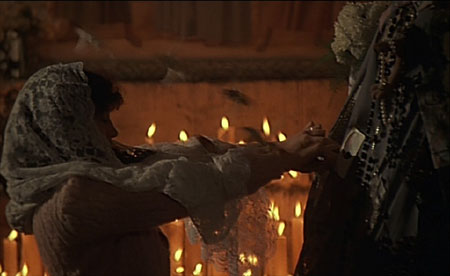
Still from Nostalghia (1983)
BACKGROUND:

  • Tarkovsky was considered one of the finest filmmakers in the Soviet Union; he frequently ran into difficulty with the Soviet censors, however, particularly for his Christian viewpoints.  Although his films won acclaim at international film festivals, they were often shown to limited audiences in edited versions in his own country.  Work on the historical epic Tarkovsky was helming prior to Nostalghia had been halted by the Soviet censorship board because of scenes seen as critical of the state’s policy of official atheism.
  • Nostalghia was the first film Tarkovsky made outside the Soviet Union.  Originally intended to be a Soviet/Italian co-production, the state-owned USSR film production Mosfilm withdrew financial support for the project without comment after filming had already begun.
  • The film competed for the Palme d’Or at Cannes, but was awarded a special jury prize instead.  Tarkovsky claimed that the Soviet contingent applied pressure to assure that the film would not be awarded the grand prize.
  • Tarkovsky defected to the West soon after Nostalghia was completed, leaving his wife and son behind.  They were eventually allowed to leave the country when he was diagnosed with lung cancer in 1986.  Rumors persist that Tarkovsky did not die of natural causes, but was actually poisoned by the KGB in retaliation for his defection.

INDELIBLE IMAGE:  There are many fine candidates.  The scene of Andrei attempting to carry a lit candle cupped in his hand across a drained spa may stick with the viewer, if not for its symbolism, then because it audaciously continues for over eight minutes.  But the final, static, picture postcard-like composition of a Russian homestead nestled inside an Italian cathedral perhaps captures Tarkovsky’s theme the best, and is shockingly beautiful, as well.

WHAT MAKES IT WEIRD:  The fluidity between the conscious and subconscious worlds. Although it’s almost always clear whether the events depicted actually occur or are imagined, Tarkovsky is much more interested in what is going on inside the heads of his alienated Russian poet and the Italian madman than in what is happening in the “real” world. He uses strong, sometimes obscure visual symbolism and dreams to convey an affecting mood of existential loneliness.


Trailer for Nostalghia

COMMENTSNostalghia can’t be approached without a word of warning: this movie is Continue reading 25. NOSTALGHIA (1983)