
366 Weird Movies may earn commissions from purchases made through product links.

DIRECTED BY: Jay Rosenblatt
FEATURING THE VOICE OF: Garrison Keillor
PLOT (“AFRAID SO”): A series of questions are proffered, each of which elicits the unspoken title as a regretful affirmative, accompanied by a visual snippet reinforcing the dreadful outcome.

COMMENTS: With the advent of VHS tapes and later DVDs, a long-running market for the distribution of educational films and documentaries on 8mm and 16mm reels dried up in an instant. Schools and other institutions suddenly had storage closets full of unneeded film reels, and most were unceremoniously tossed in the trash. This development meant little to most people, but was a vital discovery for one man in particular: filmmaker Jay Rosenblatt, who rescued the unwanted footage and, for three decades, has repurposed that castoff celluloid into new forms, using images from the past to provide ironic counterpoint to the fears and anxieties of the present. We have seen this kind of resurrected montage before, most notably in “21-87”, Arthur Lipsett’s influential assemblage of rescued cutting-room-floor effluvia. (Among those who carried the torch was a very young film student named George Lucas, who drew upon Lipsett’s technique in his first work.) But where Lipsett used clips to carry the weight of delivering his message, Rosenblatt often deploys his found footage to serve a larger narrative, as subtext rather than text.
Consider the film recommended to us: “Afraid So,” unusual in Rosenblatt’s oeuvre for being an adaptation of Jeanne Marie Beaumont’s poem, which derives grim humor from the escalation of stakes, the questions it asks rising in significance from “Was the baggage rerouted?” to “Do I have to remove my clothes?” and eventually to “Is the bone broken?” Garrison Keillor’s trademark lethargic Minnesota demeanor (originally recorded for radio) is a good match for the piece, delivering a ruefully funny air of resigned doom, so it’s fair to think that visuals won’t add much to the poem’s impact. Initially, Rosenblatt seems to prove this thesis true. “Is it starting to rain?” yields drops in a puddle; “Are we out of coffee?” leads to a filling cup. But as Keillor progresses, Rosenblatt heightens the tension, choosing pictures that make the negative outcomes so much worse than what Beaumont’s words imply. “Will this go on my record?” is accompanied by footage of a man clubbing someone from behind in a public place, a crime distinct from the mere speeding ticket you might suspect. Similarly, “Will it leave a scar?” hints at a medical procedure, but Rosenblatt’s chosen clip makes it clear that the operation at hand is a mastectomy. Once we reach “Will this be in the papers?” and “Is my time up already?,” the title answer is not just worrisome, but deathly. Appropriate, then, that the only sound aside from Keillor’s voice is the piercing tri-tone of a weather alert. Yes, bad things are coming.
“Afraid So” was released on home video as part of a compilation of Rosenblatt’s work from 2001-2011. The other films in the set fall mainly into two camps, the first being political. “Prayer” (2002) is a hot rebuke to the anti-Muslim fervor in the immediate wake of 9/11, juxtaposing footage of Islamic prostration and the emotional fervor it inspires against similar images of Christian supplication, and then against a third form of kneeling and bowing that carries with it apocalyptic themes. Rosenblatt is far more literal in 2006’s “I Just Wanted To Be Somebody,” a surprisingly empathetic digest of the rise and fall of Anita Bryant, the recently deceased former Miss America, singer, orange juice spokesperson, and anti-gay activist who blew up her career and her personal life over her vehement opposition to gay rights legislation in Dade County, Florida. Rosenblatt mostly lets Bryant hang herself with her own words, but after her professional and personal lives begin to falter, the narration offers a note of pity through the comments of a one-time opponent.
The other films show Rosenblatt shifting to becoming a more active participant in the narrative, confronting grief and loss in personal terms. “Phantom Limb” (2005) is inspired not only by the death of Rosenblatt’s adolescent brother, but also the pain of his parents’ inability to be present in his life in the wake of the tragedy. (It includes actual home movie excerpts from Rosenblatt’s family, as well as present-day interviews alongside the older footage.) “The Darkness of Day” (2009) is a meditation on suicide that begins with a shocking anecdote and holds that power via excerpts from the diary of close relation, revealing the depths of the man’s despair. The most elegiac piece in the set is probably “The D Train” (2011), which depicts an old man on a streetcar looking back over life and realizing that a lot more has passed than lies ahead. Dedicated to his late father, Rosenblatt takes the random order of “Afraid So” and re-casts it as a kaleidoscopic look back. In each film, the re-used clips become a stand-in for memory, a sort of pre-made nostalgia that allows us all to tap into the same shared past.
Rosenblatt has lately started to move away from the technique described here. He earned a pair of Oscar nods in the best documentary short subject category for his examination of a bullying incident in his elementary school for which the filmmaker still feels complicit and for an annual chronicle of the growth of the his daughter. The subjects of these films make them more immediate, and therefore less suitable for the discard-remix approach. However, it’s unlikely that Rosenblatt has given up the style altogether. At a time when so many people are looking backward to earlier days, it’s an important reminder that we’re likely to see our unsettled present over our shoulder.
HOME VIDEO INFO:
The collection The Films of Jay Rosenblatt: Volume 2 is available on Amazon on an out-of-print DVD. Most of Rosenblatt’s short films are available to rent from his website; the hyperlinks above go directly to those films. All of the films mentioned above are available on Kanopy, along with several more from Rosenblatt’s oeuvre, including two more from the Vol. 2 set, “Nine Lives: The Eternal Moment of Now” and “Worm.” The only film from the DVD not available through Kanopy, “Way to Your Heart,” is a music video for the band Persephone’s Bees, which can be viewed on their YouTube channel.
WHAT THE CRITICS SAY:
…even as Afraid So presents the familiar, it makes it strange. And that’s the ingenuity of Rosenblatt’s found footage assemblies, their invitation that you see both at once, and moreover, that you see yourself seeing. Your own process of reading is always the subject, and you can’t help but become aware of yourself as you respond, whether you find in the films comedy and ironic juxtaposition, tragedies revealed, or memories evoked.” – Cynthia Fuchs, Pop Matters
(“Afraid So” was nominated for review by afm. Suggest a weird movie of your own here.)
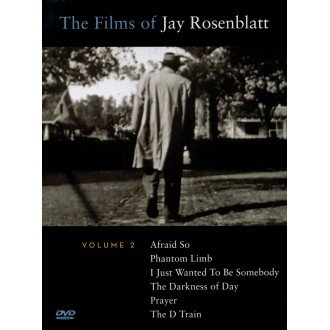
- The Films of Jay Rosenblatt : Volume 2 ( AFRAID SO / PHANTOM LIMB / I JUST WANTED TO BE SOMEBODY / T
- The Films of Jay Rosenblatt : Volume 2
- AFRAID SO / PHANTOM LIMB / I JUST WANTED TO BE SOMEBODY / THE DARKNESS OF DAY / PRAYER / THE D TRAIN