Category Archives: Alfred Eaker’s Fringe Cinema

OCTOBER 31ST FRINGE VIEWING LIST

Here’s an alternative seasonal viewing list for the weird, that goes beyond the usual vampire/zombie/demon/slasher fare (although some favorite characters make appearances).

1. Matthew Barney’s Cremaster Cycle 3 (2002) . Only the third of Barney’s epic Cremaster Cycle, made over an eight year period, has made it’s way to any type of video release, which is criminally unfortunate. The Guggenheim Museum, who financed it, exhibits the Cycle and describes it as a  “a self-enclosed aesthetic system consisting of five feature-length films that explore the processes of creation.”  Trailers are available on the Cremaster website; www.cremaster.net. The third movie is available via Amazon and other outlets, albeit at expensive prices [Ed. Note: the version of Cremaster 3 that’s commercially available is not actually the full movie, but a 30 minute excerpt that’s still highly collectible as the only Cremaster footage released].  The Cremaster Cycle is complex, challenging, provocative and not for the attention span-challenged.

Still from Dracula: Pages from a Virgin's Diary (2002)2. Guy Maddin‘s Dracula-Pages from a Virgin’s Diary (2002). Guy’s Dracula ballet, choreographed to Mahler.  Just when you though nothing more could be done with this old, old story.  Of course, we are talking Mr. Maddin here.

3. Ingmar Bergman’s Hour of the Wolf (1968). Bergman’s ode to German Expressionism has been labeled his sole horror film. Hour is a further continuation of frequent Bergman themes—the defeated artist, loss of God, nihilism—and stars Bergman regular Max Von Sydow.  Some find this dull and slow, others find it mesmerizing and nightmarish.

4. Roman Polanski‘s The Tenant (1976) returned this consummate craftsman back to the territory of Repulsion and remains one of his best films.  Polanski is now facing extradition charges for having sexual relations with a willing, underage girl thirty years Continue reading OCTOBER 31ST FRINGE VIEWING LIST

GLEN OR GLENDA: NAIVE SURREALISM’S ARK OF THE COVENANT

“Female has the fluff and finery, as specified by those who design and sell. Little Miss Female, you should feel quite proud of the situation! You of course realize it’s predominantly men who design your clothes, your jewelry, your makeup, your hair styling, your perfume!” – Ed Wood narration from Glen or Glenda.

Ed Wood is certainly the auteur saint of naive surrealism. Everything he touched had his indelible stamp of personality all over it. More accurately, everything he touched oozed with Woodianisms.

However, his zany enthusiasm was short-lived. Night of the Ghouls is a depressing example of a very fatigued Ed Wood. Even before that, both Jail Bait and Bride of the Monster seem sub-standard Wood, even if they do bear his mark and are manna for his enthusiasts.

Still from Glen or Glenda (1953)If  Ed was sadly showing early hints of what was to inevitably come in those two films, then he was at his inspired, bouncing off the wall zenith in both Glen or Glenda and Plan 9 from Outer Space.

It was stick-forever-up-his-ass film critic Michael Medved who unintentionally rose Ed and his magnum opus, Plan 9 from Outer Space from the shallow grave of obscurity into cult nirvana when he awarded Ed and his film as the worst film and director of all time.

Despite Medved’s smarmy condescension, he should be forever thanked for posthumously catapulting Ed into the spotlight.  Medved’s sole purpose for living was to play John the Baptist announcing Ed’s coming. All the crimes and misdemeanors of criticism that came after are (reluctantly) excused in light of this important moment in history (alas, Leonard Maltin has had no such redeeming moment for his crimes).

Still, Medved was slightly off. It’s Glen or Glenda, Ed’s directorial debut,that deserves the accolades, a mountain of raining ticker tape to propel this little tranny misfit into well deserved fame and fortune. There is much appreciated surreal irony in Medved’s accidental canonization of Saint Ed. It seems equally apt that ‘s very good, intentional homage, Ed Wood, lost every invested dime. If Burton’s film had been a box office hit, the cult of Ed Wood would have gone the way of all orthodox religions. Thank Ed, this was not to be.

For hardcore surrealists, it’s those unintentionally surreal gold nuggets that are the most valued, and Ed’s almost indescribable Glen or Glenda is the ark of the covenant for naive surrealism.  There are  several other choice gems: Ed’s own Plan 9 From Outer Space, Phil Tucker’s Robot Monster, the movies Live a Little, Love a Little ( with the groan-inducing Edge of Reality surreal dream sequence) and Easy Come, Easy Go (frogman Elvis doing yoga-is-as-yoga-does with Elsa Lanchester), Santa Claus Conquers the Martians, and a legion of not-so-deserving camp classics, including Manos: Hands of Fate, which is indeed awful, but incredibly dull and does not deserve to be placed in the same category.

There is little point in attempting to describe Ed’s autobiographical opus, ‘s hammy, inexplicable presence, or the pretentious narrative pleas for acceptance.

Glen or Glenda is the  perfect, surreal toast to the Halloween season.

THE WILD AND ZANY WORLD OF TODD M. COE

Todd M. Coe is one of those secret finds that is all too tempting to keep secret.

Todd M CoeTodd’s animated shorts evoke the decade of the 1970’s, which  he is hopelessly in love with.  Drive-in commercials, exploitation, cheesy horror, 70’s adult  posters, variety show television specials, low budget spaghetti westerns, robots, the rock group Kiss, Aaron Spelling cop shows, feathered hair, plaid bell bottoms, and, of course animation are all manna from pop culture heaven for him.
Todd could undoubtedly add a few thousand items from that decade to the list, such as one of his favorites (and the delightfully of it’s period) Paul Lynde Halloween Special ,with Donnie and Marie Osmond, Mrs. Brady, Witchie Poo and Billy Barty all trading groan worthy barbs with the inimitable and much missed Mr. Lynde. Todd discussed this perennial favorite in a series of emails and his enthusiasm was admittedly infectious.

Todd is a post-modern, eclectic “slapstick surrealist”.  His four shorts can be seen on both youtube (his channel is called school pizza) and on his website—http://www.toddmcoe.com/—where you can also view his numerous illustrations, drawings and paintings.

Todd pours his obvious love of subject into all of his amazingly detailed work and, boy does he pour it on, like a good oozing heap of Aunt Jemima syrup.

Taking a tour through Todd’s website is an inspiration. After a near fatal overdose from the increasingly bland overkill of Tim Burton’s monotonous school of animation, or even more monotonous, bland Japanese Animation, Todd’s work is a much needed breath of fresh red, white and blue air.

Don’t be surprised to find yourself humming the Love American Style and SchoolHouse Rock’s Conjunction Junction theme songs as you take the Todd M. Coe ride.

I certainly did, and now I’m really fighting the urge to throw in a video of the Banana Splits, locating my 45 record of Styx’s Mr. Roboto, re-read my Green Lantern comics, fall in love with the Farrah posterall over again (God bless that angel’s soul), take a whack at the etch a sketch, and pour myself a big bowl of Crisp cereal. I doubt I win that fight.

Thank you much Mr. Coe.

HEART OF THE BEHOLDER (2005) & THE LAST TEMPTATION OF CHRIST (1988)

Still from Heart of the Beholder (2005)In 2005, Ken Tipton made a labor of love; an indie film called Heart of the Beholder, regarding the true story of the initial video release of Last Temptation of Christ and the effects it has on a family who owned a small video chain in St. Louis, Missouri during the 1980s.

The CFD, Citizens for Decency, arrived when the owners of the chain chose to carry  Martin Scorsese’s controversial film.  These God-loving red, white and blue, flag- waving Americans came out in droves to harass, bully and literally threaten their employees, family, business, and life.

These are the same Americans who undoubtedly burned Dixie Chick albums when that group criticized God’s ambassador here on earth, little George W, and are the same Americans who still visit the Heart of the Beholder website telling Mr. Tipton and company that they are going to  hell while undoubtedly pleasuring themselves at the thought of the filmmakers frying  for all eternity.  Heart of the Beholder is a damned important, desperately needed film.

Although Heart of the Beholder got good reviews and even won some festival awards, predictably, no distributor would touch it.  One would surely think that the making of the film would have brought in some support, perhaps from Temptation‘s producers, Scorsese, etc.   Continue reading HEART OF THE BEHOLDER (2005) & THE LAST TEMPTATION OF CHRIST (1988)

IN A WORD, “CHAPLIN”

Any hip, against-the-grain aficionado with an appreciation for the surreal, the avant-garde, and the experimental will tell you flat out that there’s no comparison: it’s Keaton over Chaplin.   You simply have to concede Keaton’s superiority because Chaplin was too accepted, too famous, too popular, too sentimental, too rich, too pedestrian in directorial style, too populist, too egotistical, too narcissistic, and nowhere near as prone to risk-taking as Keaton.

That was THE prevailing thought from the 60’s until quite recently and accurate only in theory because, like Beethoven, Chaplin really can’t be overrated, while Keaton certainly is (i.e., The General).

That doesn’t mean the above comparison has no truth and, naturally, it would be preposterous to say that Chaplin did not make some truly terrible films (King of New York and A Day’s Pleasure are people’s exhibit A).

However, Keaton’s  experimentalist stature is grossly exaggerated.  He was certainly the most innovative of the “A” list silent clowns, but was nowhere near as much so as either  the recently re-discovered Charlie Bowers or Harry Langdon, who, as blasphemous as it may sound, really had more memorably etched, modern characterizations (Chaplin did say he only felt threatened by Langdon).

In hindsight, Keaton’s innovation, which  surfaced  only  sporadically, seems suspiciously unintentional, even if his best films are indeed brilliant and highly innovative—The Playhouse and Sherlock Jr.

Years later, when working with Samuel Beckett on Film, Keaton revealed his  impatience with experimentation by loudly grumbling.

One walks away from Keaton’s best films feeling impressed.  One walks away from Chaplin’s best film unforgettably  moved.

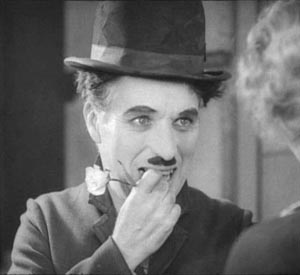
Chaplin in City LightsThere is hardly a more profoundly artistic, emotionally overwhelming ending than that of City Lights .  It remains the most memorable ending in screen history.  Montgomery Clift declared it the  greatest screen acting he had  seen (that’s saying quite a bit from an actor of Clift’s caliber, but perhaps he had not seen Falconetti in Dreyer’s Passion of Joan of Arc, which is hardly acting in the gauged sense).

City Lights deserves all the acclaim it has received.  It is Chaplin at his most spiritual and at his most expertly balanced (the pathos does not draw attention to itself, as in many of Continue reading IN A WORD, “CHAPLIN”